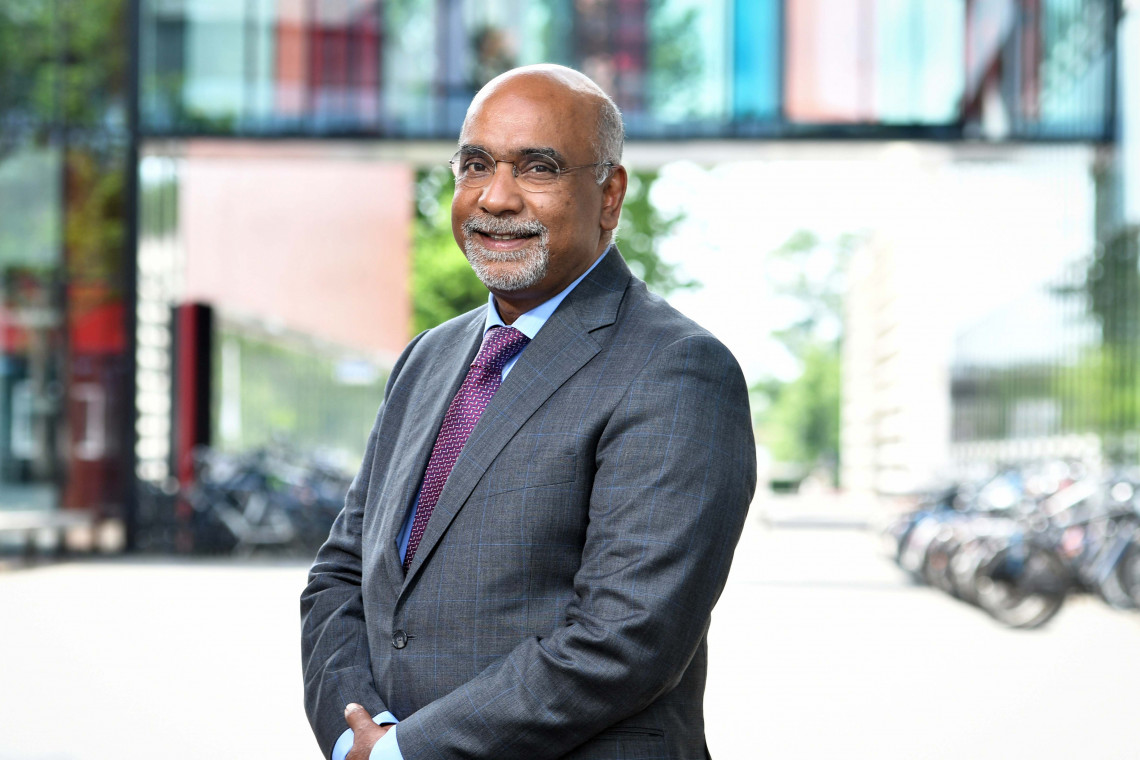


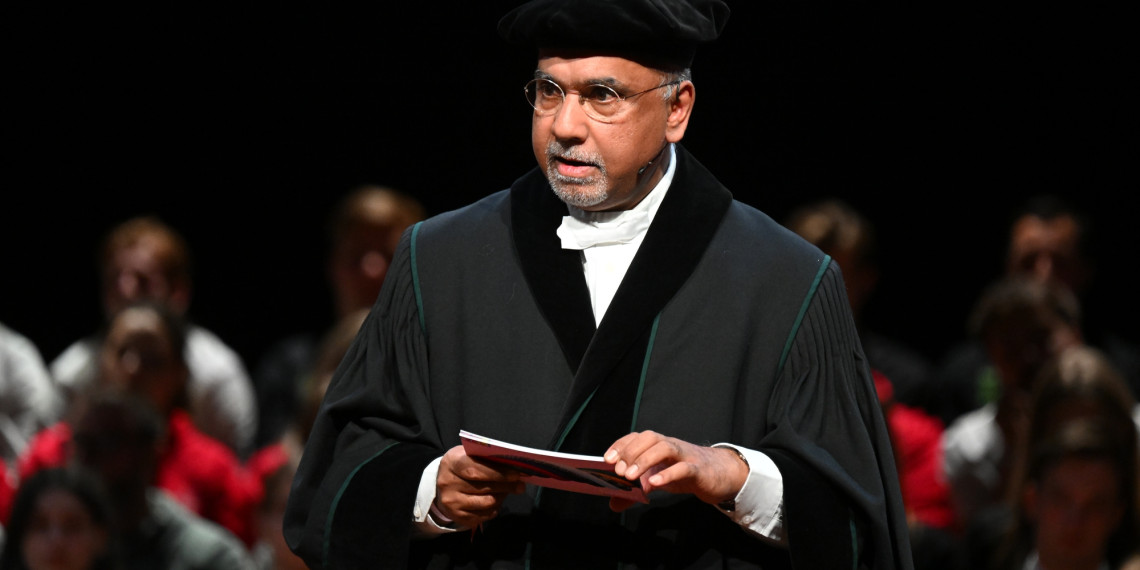
Moving boxes are stacked in his office in the executive wing. Everything that has not yet been packed has already been handed over – and vice versa. How does this final working week feel? Subramaniam pauses for a moment. ‘Mixed. I know this place well, of course – it’s a wonderful place. Leaving it behind… I recently came across a poem by the German poet Hermann Hesse, Stufen. There is a line in it: ‘Und jedem Anfang wohnt ein Zauber inne, der uns beschützt und der uns hilft, zu leben.’ Magic dwells in every beginning, something that protects us and helps us live. I am about to begin something new – there is magic in that. But there is also magic in what I am leaving behind.’
He will take two weeks to decompress before starting his new role as president of the Executive Board at the University of Amsterdam. At home, with his family, in the capital. Letting things settle. Walking a lot in the spring sunshine – and cooking, of course, another passion of his. The aim is to bring his ‘head and heart back into alignment’.
How do you go about bringing things to a close?
‘Primarily by handing things over properly, so that dossiers are in good hands with colleagues. That matters for the heart as well. But we work as a collegiate board, so much is already known and will not come as a surprise. Whether it concerns personal matters or long‑term dossiers, you always try to share not only the facts, but also the feelings involved. I am an emotional person myself. So it will not surprise anyone when I say that feelings can help point me in the right direction. How you feel about issues is also important information to pass on.’
You speak about aligning head and heart. Which of the two dominated over the past five years?
‘I cannot say they were always in balance. We were dealing with an environment that was constantly and rapidly changing.’
Looking back, how do you feel about your time as UT’s president?
‘I am not dissatisfied. I acted to the best of my knowledge and conscience. As the saying goes: in this line of work, you make decisions based on what you know at the time. In a governance role, you often have to work with a scarcity of data and facts, yet the organisation still expects you to decide. But when new information emerges, you should not hesitate to say: I was mistaken, we now have more data, and changing course is the sensible decision.’
'An organisation that appears entrepreneurial can also be quite conservative'
Are you referring to a specific situation?
‘No, I mean this in general. There is a perception of administrators – and I do not know if the generalisation is entirely fair – that they rarely revise decisions based on new insights and facts, that they cling too rigidly to the chosen course. That is not the kind of administrator I am. You should not be afraid to change direction – as long as it does not turn into erratic policy‑making.’
Can you give an example?
‘When I started here in 2021, I had the impression that higher education was facing major changes. There was the well‑known PwC report on the funding shortfall, and I saw opportunities for a small, entrepreneurial organisation like this one to respond – perhaps one that was a little more agile. In the end, it turned out to be much tougher than I had anticipated, partly due to the rapidly changing circumstances. What I also noticed was that an organisation that appears entrepreneurial can also be quite conservative. I do not mean that negatively per se, but it did make things hard work.’

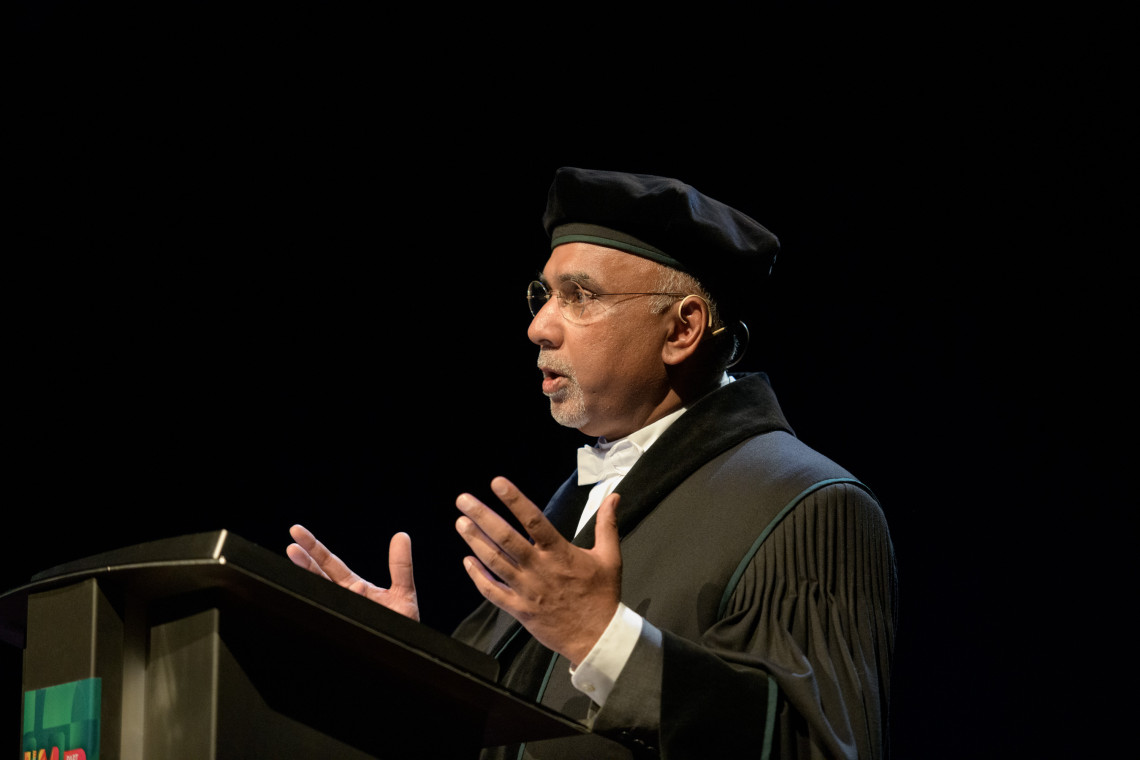
At the king's visit to MESA+.
It would be fair to describe his term as turbulent. Subramaniam started in the middle of the COVID‑19 crisis, followed by Russia’s invasion of Ukraine, an ensuing energy crisis, and ongoing tensions in West Asia with repercussions far beyond the region. Meanwhile, political attention turned to the internationalisation of universities, which was to be curbed through the ‘Internationalisation in Balance Act’. This coincided with a cabinet marked by far‑right and, at times, anti‑intellectual tendencies, as well as a wave of budget cuts that ultimately led to reorganisations at two faculties.
What was the greatest challenge for you?
‘The common thread was articulating the importance of the university – particularly for the region and beyond. Not in a sense of ‘we are here and we matter to you’, but as part of an ecosystem. At secondary school, I learned about symbiosis: one species cannot survive without another. There is a form of mutual dependency. That is a positive force – you grow and flourish together as an ecosystem, when everything is present and supportive.’
Is that what you tried to do in the Twente region?
‘Absolutely. To see the university as one of the elements within that ecosystem. That needs to be nurtured, but not just for your own benefit – within the context of the entire ecosystem. I invested a great deal of time in regional collaboration, with educational institutions, governments, and industry, to emphasise that we are of and for Twente. I believe that has succeeded. The idea of working together more closely was always there, but it has now become much more active and explicit. My message – also to people within our UT community – is that you have to put in the effort. We must be careful not to lose touch with society; instead, we need to strengthen that connection. That is a challenge for all universities. I am proud that, as a region, we now present ourselves more clearly as one voice, one team. Internally, too, you thrive when you work together more, when you think and operate as an ecosystem. As president of the Executive Board, I could not force anyone, but I could create frameworks and encourage people to work from that perspective.’

At the joint OAY with Saxion this academic year.
A natural counterpart to pride is disappointment. Was the reorganisation at the S&T faculty your biggest disappointment?
‘Not a disappointment, but it was the hardest thing I have done: putting my ‘signature’ under that reorganisation plan. I would not call it disappointment; it was about taking responsibility. At a certain point, you realise that you stand for something different than before – namely, the health and long‑term future of the institution as a whole, even though it also meant the disappearance of my former research group.’
'Despite a new government, the situation remains fragile, and we must be aware of that'
And yet there was suddenly a positive result of €27.5 million.
‘I am the first to say: we should have done this better. At the same time, we are not there yet. We are a university in transition, with two faculties still not in the black, and the largest national budget cuts have yet to hit us. Despite a new government, the situation remains fragile, and we must be aware of that. What I said about better articulating our story externally also applies internally: we need to communicate more clearly and consistently with our own community. I am happy to take responsibility for that.’
What lesson from UT will you take with you to Amsterdam?
‘That you must always stay in dialogue and remain connected – and that you should dare to change, as long as you explain yourself properly. At the UvA, the scale will be different, but in many ways it will also be similar. Staying in dialogue was something I also did with the representative bodies. I am proud of the relationship with the University Council, which has improved significantly over the past years. What we ensured was that people were involved from the outset. It is important that, as president, you remain clear about your role and that the ground rules are agreed in advance. That is how you achieve better results together – and that is what it is all about.’
Ultimately, a university is about students, you say. What message would you like to leave them with?
‘That they are the beating heart of the university – it is all about you. These young people make me genuinely happy. They always have fantastic ideas that inspire me. And I have great respect for student engagement, for example among student board members of the Student Union and the University Council. They take on their responsibilities for the university with a strong sense of commitment.’

With U-Today's cooking vlogger Rianne Hagen (find the vlog here)
After a hundred days as president, Subramaniam referred in an earlier interview to a speech by Indian scholar Sumantra Ghoshal, who spoke about ‘the smell of the place’: the difference between being exhausted in the scorching summer heat of Calcutta and the energy he felt while walking in the forests of Fontainebleau. ‘I would like to help create such an environment here – one in which others can develop and feel inspired to run and jump, just like in Fontainebleau,’ Subramaniam said at the time about UT.
'There are many egos. UT needs to move towards a bit more we, and a bit less I'
Have you succeeded in changing that ‘smell of the place’ here?
‘To some extent, perhaps. But not completely. You cannot shape everything yourself – there are too many variables, and too many egos. Sometimes egos the size of a planet.’
How do you think you are leaving UT behind?
‘I hope a little more resilient and robust. We have gone through deep lows, but we are now building towards the future. I am not dissatisfied with what I leave behind, but there is still a lot of work ahead for my successor. He or she will also need to continue emphasising the urgency and necessity of change – and that UT could afford to be a bit more business‑like. People here put their heart and soul into their work, which creates a sense of mutual responsibility. UT needs to move towards a bit more we, and a bit less I.’
Those egos – do they not get in the way?
‘There are indeed many egos, and unfortunately you sometimes see that reflected in how we treat one another. I have always wanted to emphasise our shared humanity. You cannot do it alone; we need each other. Sometimes academic staff look down on support staff – I have always detested that. How we treat one another is crucial to everything. We are one community. And that also applies to how we interact with others, such as ROC van Twente and Saxion University of Applied Sciences. We all play a key role as part of the same ecosystem.’

With new education minister Rianne Letschert.