

A monster of a calculation
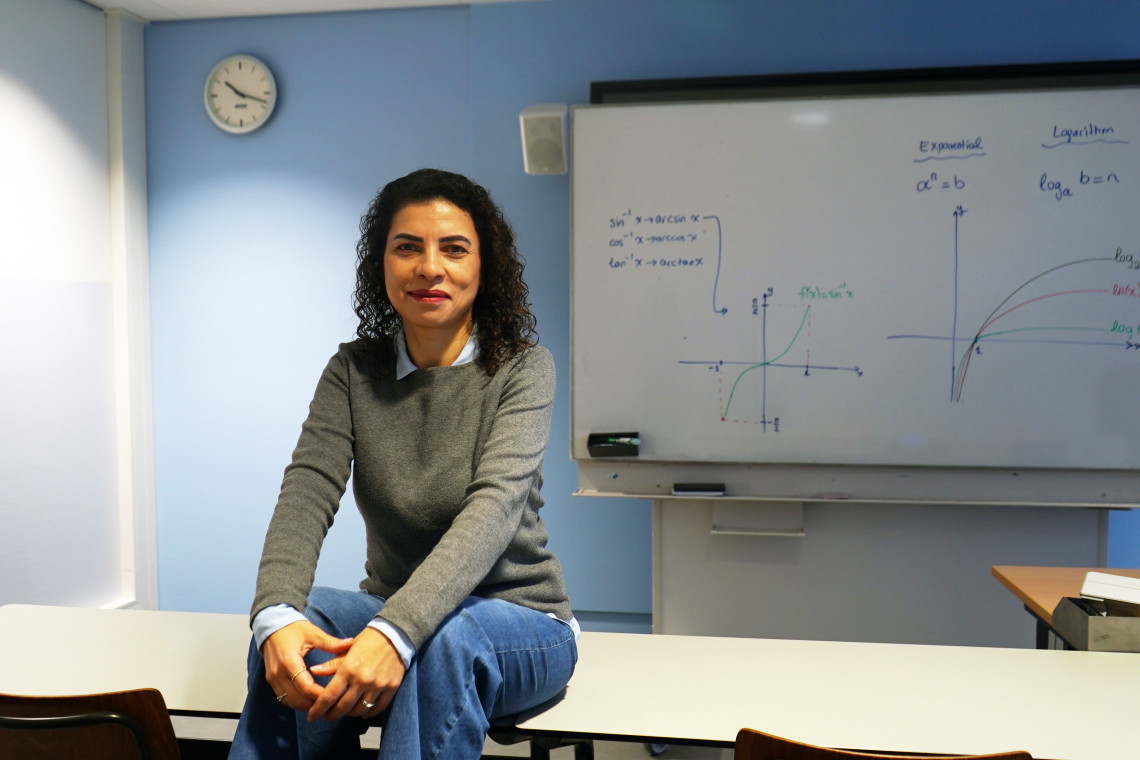
She is quick to point out that things do not always come naturally and that she sometimes gets stuck. ‘That’s inherent to the job. Sometimes you end up with a monster of a mathematical calculation on your blackboard that doesn’t get you anywhere. Then you have to take a step back and break the problem down into its basic elements. Hopefully, that will lead you to an alternative solution'.
‘Mathematics is logically structured, and once you understand a principle, you don’t have to memorise that much’
She credits her colleagues as an important source of support, as they regularly take a look at her work. ‘A fresh pair of eyes can see things a little differently’. Even so, some projects still come to nothing. ‘Then you just have to take a moment to be disappointed, gather your courage and look for something new'.
Puzzling things out
According to Stegehuis, she never set out to become an acclaimed mathematician. She simply stumbled into the field because she was good at science subjects in secondary school. ‘I also enjoyed subjects like physics. Mathematics is logically structured, and once you understand a principle, you don’t have to memorise that much. It’s just one big puzzle', the researcher explains.
Thanks to her Vidi grant, she will be able to spend the coming years working on mathematical models of virus transmission in networks. Stegehuis explains how her approach differs from traditional models. ‘When a virus enters a network, an interaction starts to emerge. This could involve a virus during a pandemic, but it could also be a computer virus. Traditional models mainly look at static situations. During a pandemic, however, all kinds of measures are introduced, causing the network to adapt and creating random interactions. People suddenly start staying at home, for example, and have less social contact or interact in different ways.’
She is particularly interested in the fact that networks consist of nodes and connections, making them easy to visualise. Stegehuis applies mathematical principles to these networks and uses simulations to model how viruses spread. ‘You can see new situations and connections emerge, or disappear altogether.’
About Clara Stegehuis
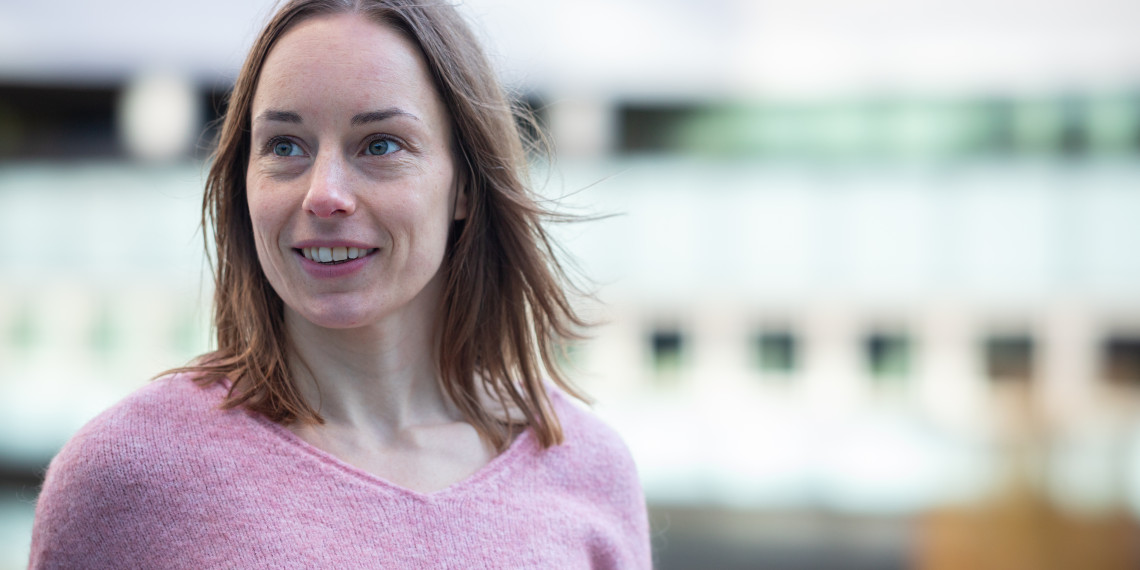
Clara Stegehuis completed both her bachelor's and master's degrees in Applied Mathematics at UT. She subsequently started her PhD at Eindhoven University of Technology in 2014. After completing her doctorate, she returned to Twente in 2019. The following year, she won the Professor de Winter Prize and secured a Veni grant. In 2025, Stegehuis was nominated for the title of New Scientist Science Talent of the Year, an award organised by the popular science magazine New Scientist. Most recently, she received a Vidi grant worth €850,000 from the Dutch Research Council (NWO).
Margins of error
She acknowledges that random interactions make it impossible to calculate everything precisely. ‘In mathematics, the goal isn’t to eliminate uncertainty altogether, but to quantify it. You can calculate extreme scenarios, looking at what happens in the best- and worst-case situations. This gives you a margin of error or a range within which you expect the process to take place. It’s never a 100 per cent accurate prediction, but it does provide a valuable model of possible extremes that others can use to shape their policies.’
‘At the end of the day, I close my laptop and go home to my family. Mathematics stays at UT’
She finds it fascinating that a single mathematical principle can be applied so broadly and concretely to all kinds of everyday problems. Together with associate professor Suzan Bayhan from the Technical Computer Science programme, for example, she investigated how 5G masts could become more energy-efficient by optimising their coverage. ‘The next moment, you might be researching chemical reactions or interactions on social media. That also leads to all kinds of interesting collaborations.’

The COVID-19 pandemic
The idea for her research proposal emerged before the COVID-19 pandemic, although that period helped it mature further. ‘During the pandemic, my previous research was suddenly cited in all kinds of places. Perhaps that contributed to the awards. My current research was partly inspired by that period, though. Since then, I’ve also been working with the National Institute for Public Health and the Environment (RIVM) on a more fundamental level to clarify the theoretical principles behind networks.’
During that same period, she had two children and, with childcare unavailable, found it difficult to get much work done. To this day, she sees home as a place to unwind. ‘At the end of the day, I close my laptop and go home to my family. Mathematics stays at UT. I relax by doing a lot of exercise. Usually, I roll out a mat at home and do some exercises. I also take part in group training sessions and recently started doing calisthenics at a local club.’
Secondary school students
Stegehuis sets aside a relatively large amount of time each week for lectures and guest lessons at secondary schools. She tries to connect with the everyday experiences of the average student as much as possible. ‘I think it’s important for pupils to see that mathematics is about more than Pythagoras' theorem or the quadratic formula, and that it is woven into almost everything in everyday life. At a music festival, I showed how you can use Spotify data to calculate who the most influential artist of the past twenty years was. That turned out to be Rihanna, by the way. I also make videos with a secondary school teacher about the mathematics behind AI.’
‘These are interesting times, especially now that AI is playing an increasingly important role’
The use of AI
She has noticed that the rise of AI is also causing quite a stir in the field of mathematics. Her colleague Felix Schwenninger and his collaborator Emiel Lorist from TU Delft used AI to help solve Crouzeix’s Conjecture, a mathematical problem that had kept mathematicians occupied for twenty years.
Stegehuis also occasionally uses AI to write software or check calculations for errors, although she remains cautious. ‘If it manages to find something, that’s a nice bonus. But when I once tried using AI to write a conference paper, very little of it was correct. In the end, I still had to rewrite everything myself, which actually took me more time overall. It has to be accurate and follow the right structure.’
She hopes to continue conducting her own research in the future. She would also like to see the research group specialising in network science grow, as she is one of the few people at UT working in this field. ‘That means I sometimes lack someone to bounce ideas off. These are interesting times, especially now that AI is playing an increasingly important role. We’ll have to wait and see how it changes the field. Time will tell.’