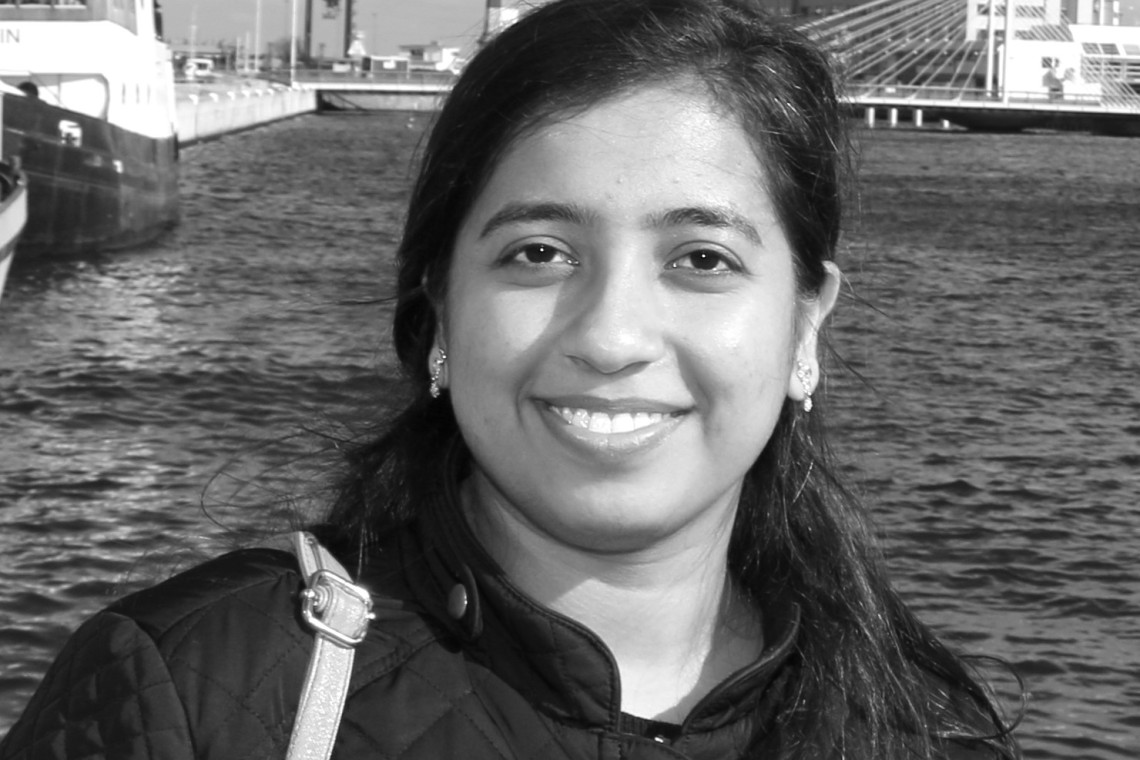


UT PhD candidate Sakshi Kannan (33) died on 11 January 2025 in a hospital in Boston during the birth of her second daughter, Nesiya. ‘When I heard, I had just finished a training session and was having tea at my rowing association,’ says her supervisor, Janine Post. ‘I was actually about to send Sakshi a message asking whether the baby had arrived. At that moment, I received a text message from her husband, Kannan Govindaraj, saying she had passed away. It felt so unreal... I had to ask the person next to me whether what I was reading was correct.’
The unreal turned out to be reality. At the time, the couple had already been living in Boston for some time with their other daughter, five-year-old Stuti. Govindaraj, who obtained his PhD under Post’s supervision in 2020, was affiliated with both UT and Harvard through a Marie Curie fellowship. Kannan accompanied him to the United States and continued working on her PhD research there.
‘Protecting her work’
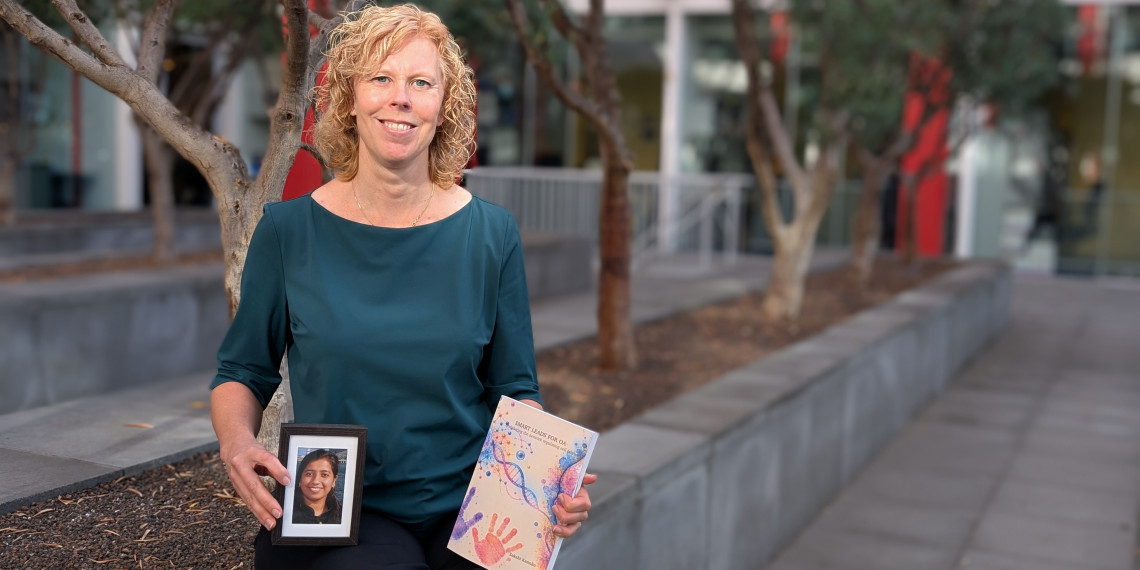
After her death came grief. And before grief, there was adrenaline, particularly for the widower, Govindaraj. He had to leave both daughters behind in Boston in order to attend the funeral in his native India. Meanwhile, Post reserved a meeting room in the Zuidhorst building as a place to remember the late PhD candidate, complete with a condolence book for her relatives. At the same time, she noticed another reflex in herself. ‘I made a time-stamped copy of all Sakshi’s work and saved it as quickly as possible. My first instinct was that I wanted to protect her work in some way.’
That instinct proved right. ‘I saw that she was still creating figures in the BioRender programme well into her pregnancy. Considering that she remained so dedicated to her thesis right up until the end, this work simply had to be completed.’
Posthumous PhD degrees
A posthumous PhD is rare, but not unique. In recent years, several people in the Netherlands have been awarded a doctoral degree after their death. As far as is known, the most recent ceremony of this kind at UT took place in 2018. At that time, the supervisors of the late PhD candidate Wilma Kippers, who died in an accident, defended her thesis on her behalf.
ChatGPT as an assistant
Eventually, Post increasingly developed the plan to complete the thesis and defend it posthumously. ‘With the starting point that it should be Sakshi’s own scientific story.’ The fact that the posthumous defence is taking place more than a year and a half after her death is partly because the family first had to submit a formal request. In addition, the work still had to be completed.
Most of the thesis had already been written or published by Kannan. For several textual sections, such as the general introduction and discussion, Post used ChatGPT as a writing assistant. ‘I had to define the prompt very strictly: solely on the basis of her emails, presentations, manuscripts and research documentation. Everything had to be in her spirit, because it is her thesis. And if something is incomplete or ends abruptly... Well, that was the reality.’
As supervisor, Post remained ultimately responsible for the scientific quality of the dissertation. And the thesis cover? It features Indian cultural symbolism, cellular structures and networks, together with the actual handprints of daughters Stuti and Nesiya.
‘In every respect on her way to becoming an independent scientist’
Now that the committee has approved the thesis, Post is not entirely sure what to expect at the defence on 20 October. Except that the ceremony will follow all official rules and traditions, albeit with a few minor adjustments. Widower Kannan Govindaraj and Professor Marcel Karperien, professor and chair of the research group, will serve as paranymphs and provide ceremonial support.
As for the defence itself, Post is somewhat nervous. ‘It is Sakshi’s thesis. I want to show that as well as possible. At the same time, there is this nagging thought: who am I to defend someone else’s scientific life’s work? The committee has been asked to focus particularly on Sakshi’s contribution.’
The associate professor in the Developmental BioEngineering group at the Faculty of S&T also notes an important caveat. ‘Ultimately, what is written in a thesis is only a fraction of the work a PhD student does. The work that takes place not only in the labs, but also in conversations with colleagues. In her case, she combined computational models with laboratory experiments to understand how cartilage cells decide whether to remain healthy cartilage or develop into osteoarthritis or bone formation. She integrated the literature with her own findings and, based on that, designed new research questions... In every respect, she was on her way to becoming an independent scientist. And that just happens to be the main requirement for obtaining a PhD.’
‘Showing how valued and respected she was’
Post knows that the day of the defence itself is bound to be emotional. ‘Although I hope there will be more smiles than tears. After all, this is also a celebration of her life in science,’ says Post. ‘She was not just doing research, she devoted her heart and soul to solving a societal problem.’
Sakshi Kannan was in every respect as modest as she was driven, and that is what Post hopes to convey on 20 October. A tribute to someone who, together with her husband, spent nights in the office next to the laboratory because she needed to do measurements every four hours. Someone who, alongside her scientific career, was deeply committed to the local Protestant church and an active member of the International Christian Fellowship in Enschede.
‘If we manage to arrange visas for her parents, it will be their first time in the Netherlands. I hope that they, and Sakshi’s daughters, will see that day how valued and respected Sakshi was. How she was an integral part of the local community. And what a modest, but above all strong woman she was. Someone who leaves behind daughters with the potential to become equally strong women. That is what I want her parents, daughters and everyone else attending on 20 October to experience.’
The defence of the doctoral thesis of Sakshi Kannan, entitled SMART LEADS TO OA: deciphering the network regulating cell fate, will take place on Tuesday 20 October at 2.30 pm in Waaier 4