

four interviews
During UT’s 65th Dies Natalis on Friday 27 November, the university will award four honorary doctorates. The U-Today editorial team has interviewed all four recipients and will be publishing the stories over the coming weeks. The third instalment features Molly Stevens, Professor of Bionanoscience at the University of Oxford.
It is a Friday morning in September, shortly after 10.30am at the Kavli Institute of the University of Oxford. The institute is part of a global network of research centres established by the Kavli Foundation, to promote world-class science. It is also home to ‘The Stevens Group’, named after and led by Professor Dame Molly Stevens. Here, she works with a large and vibrant group of researchers, mainly master’s students, PhD candidates, and postdoctoral researchers, on multidisciplinary challenges in health technology.
Humanity
What makes Molly Stevens special as a professor and leader? Alessandra Lo Fiego, Scientific Programme and Collaboration manager, who welcomes the UT interviewer, does not have to think long about her answer. ‘Humanity,’ she says resolutely. ‘Molly is sociable, kind and always willing to listen to her people. She is there for you.’
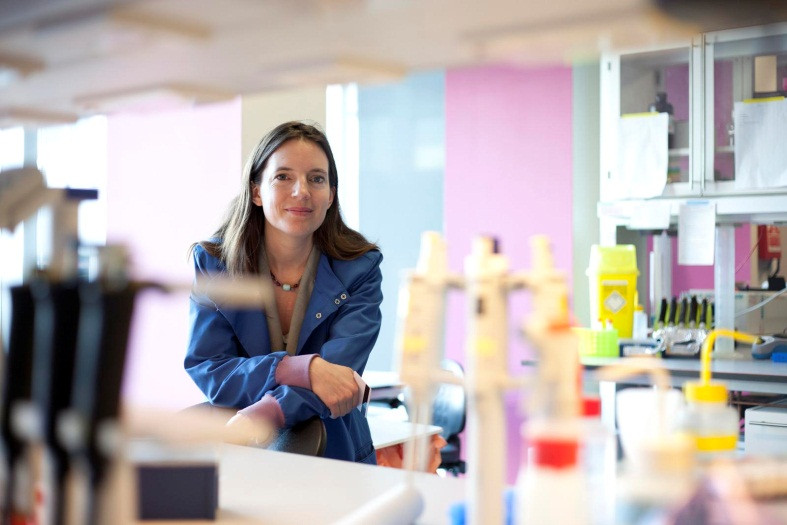
Lo Fiego explains more about the team and the institute. Stevens herself is still in a job interview with a prospective postdoc. First up is a tour of the laboratory. There, PhD candidate Cecilia Gallego Rubio, originally from Spain, enthusiastically talks about her research into the application of nanomaterials for the development of new diagnostic healthcare tools. She shows various pieces of equipment used for DNA research. ‘You probably have this at UT as well. All labs look the same, don’t they?’
Time is precious
A message comes through on a PhD student’s phone: Stevens is now available for an interview. How long will it take, she wants to know. An hour? Surely it can be done in 45 minutes, she suggests. It quickly becomes clear that time is precious to the acclaimed professor. Every minute is put to good use. For her scientific work, her team, and her family. More on that later.
This honorary doctorate from UT is the first doctorate Stevens has received from a foreign institution. She has previously received two honorary doctorates, one from the University of Bath and one from the University of Nottingham.
What does this honorary doctorate from UT mean to you?
‘It came completely out of the blue. And when I discovered that your university only awards this distinction once every five years, it made it even more special. I need to find the right words. ’Not worthy’ is not quite the right description, but I feel that even though I receive it its really my entire team that deserves this. In any case, it is very special to receive this honorary doctorate and represent them.’
Were you already familiar with UT?
‘Of course. UT has an incredible reputation for the quality of its research. Over the years, I have met several academics from your university. I tried to look it up, but if I remember correctly, I gave a seminar on campus years ago. And now I will be returning in November for the ceremony. It will be a good opportunity for me to see what UT is focusing on in terms of research. I hope to meet many people and learn more about that. I am certainly very curious and looking forward to the visit.’
Can you explain what your scientific work focuses on?
‘My group, The Stevens Group, is quite a large group. The structure is collaborative, so all these people work together on projects. We develop projects in an interdisciplinary way. An engineer, a physicist, a chemist, a data scientist, and a cell biologist may all work together on the same project. I am particularly interested in how we can develop biomaterial platforms for different applications, for example in regenerative medicine or biosensor applications. Above all, I want to understand mechanisms at the nanoscale to enable better biomaterials design. I really want to make an impact.’
What fascinates you about molecular research at the nanoscale? 

‘It is simply amazing. If you can understand it, you understand how things work in the world. But the focus should not only be on fundamental science. I want to do innovative research that helps people. Besides being particularly strong in fundamental research, our group is also strong in translating that knowledge into practice. We do that by taking innovations out of the lab and further developing them in spin-off companies, for example. We are always thinking about how we can bring innovation into society. The fact that we can do both makes me very happy. It is intellectually challenging work, but we are also genuinely contributing to society.’
Is that your main motivation, being able to contribute to society?
‘I absolutely want to help people, because I am aware of how privileged and fortunate I am as a researcher and as a person. I realise that not everyone is as fortunate, as privileged or as healthy, and not everyone is well supported by our healthcare systems. One of my main motivations is thinking about how we can use science to make society more sustainable and equitable. I think it is incredibly important to help people in low- and middle-income countries through technology and innovation.’
You work on advanced biosensors and regenerative therapies. How do you see the role of these innovations in the hospital of the future?
‘The early detection of diseases is one area in which our technology is enabling major progress. But you could also think of wearable technologies and advanced materials. There are many opportunities there to improve healthcare. In addition, combining these technologies with AI is very interesting. The more physiological data we collect, the more interesting it becomes. I already see many examples of AI being used in medical imaging. Tumours can be detected even earlier. AI is also being used to detect eye diseases and a myriad of other things. And this is only the tip of the iceberg.’
What opportunities do you see for Twente to build a distinctive international position in this field?
‘To answer that question properly, I would first need to explore your university’s research in greater depth. I hope to hear more about it in November.’
What has been a major breakthrough in your research so far that has helped people?
‘My team succeeded in developing biomaterials that function as a kind of scaffolding on which human stem cells can grow. This made it possible to grow living bone tissue and artificial heart muscle tissue in the laboratory as well as develop gels that promote healing and decrease scarring in the body. In the future, this technology could help address conditions like fibrosis and healing after surgeries. Another major breakthrough is the use of nanoparticles that change colour when they come into contact with microscopic amounts of specific enzymes. This enables a much earlier detection of diseases such as cancer and infectious diseases than traditional tests do. These are wonderful breakthroughs and a great deal of work has already been completed, but so much research still must be done. It feels as though I’ve only just begun.’
Yet you were once the youngest professor?
‘That was when I was appointed at Imperial College London. I was 34 years old and had twins, a boy and a girl. I later had another son too. It was never really an issue for me, the question of whether I should have children. I always knew I wanted to become a mother, regardless of my career. Nor was I ever ambitious for a particular career path. What I am ambitious about is doing what I find important. I have never been driven by titles. I have always had a goal in mind, however. And that goal only became clearer when I had children. Because of them, I live very consciously, because I realise how limited our time in life is. That is why I work and live as efficiently as possible, and remain alert to things that distract me from my work and take up too much time. How? I work with great concentration and focus. When I am working, I am really working. And when I am with my family, I am there for them. Time is simply incredibly valuable.’
Where does that sense of urgency come from, do you think?
‘I have visited several hospitals in Africa for our research. When I return home, I am more motivated by how important it is to develop innovative technologies for large groups of people. I realise that our brilliant team has important work to do, because we can make a difference for people there. There is such a great need for better healthcare technology. I had already seen that when I travelled through Southeast Asia and Nepal for an extended period when I was younger. After returning from those trips, I did not yet know how, but I knew I wanted to play a role in improving people’s lives. I wanted to make a difference for vulnerable communities. I see science as the ultimate mechanism for me to achieve that.’
What does an average day look like for you?
‘I work hard, but I am also very social. We often have friends over. And I love being outdoors. Nature helps me recharge. I often invite colleagues too, holding team meetings in the park. If we do not need to look at data on a screen, why should we sit indoors? We also regularly rent a house somewhere in nature for what we call a group retreat. Wait, let me show you a video from our latest one. We hike, cook, and laugh together, and we talk a lot. I want to support my team holistically and pay attention to the individual. Because all those individuals together make up that fantastic team.’

How do you attract the right people? There must be many talented researchers who want to join The Stevens Group.
‘It’s essential for me that people have their hearts in the right place, and I think I have an extra sensor for that. Of course, I check references and conduct interviews, like I did earlier today with a potential postdoc. I also have candidates meet my team. Collaboration is what matters here, so if you are a solitary scientist, this is probably not the place for you. Our group works very well for collaborative people with an extremely high level of scientific excellence. That is when you truly fit into our scientific family.’
What were you like as a student?
‘As an undergraduate student, I did not attend lectures as often if they were in the morning as I was often out late dancing! I had broad interests and though I found my course material super interesting I could learn the content quickly and luckily got top grades so I spent a lot of left-over time socialising. When I was at secondary school I was very shy and this period at university really enabled me to come out of my shell and gain more confidence. My attitude to study changed when I became a PhD candidate and then I really started working hard. As a researcher, I discovered that the more you invest, the more you get out of it, and the more you achieve. During that period, I became highly motivated by research. When I was a postdoc at MIT in Boston, I was among the hardest-working researchers in the group. There was so much to learn and so much to discover and I was fascinated by research. I did go out for dinner with friends and colleagues very often, but afterwards I would often head straight back to the lab.’
What has shaped you most during your career?
‘Well, we are constantly being shaped. I loved my time as an undergraduate pharmacy student. In the UK, there comes a point after secondary school when you must specialise, and I found that difficult because of my broad interests. I grew up bilingually, with French and English, so I have always loved languages and like many bilingual people can learn them quickly. But I also found it difficult to give up a wonderful subject like geography. I was glad that pharmacy was a broad degree where you could learn chemical synthesis alongside physiology and other interesting topics. My PhD and postdoc years then shaped me as a researcher. I was given a great deal of freedom by my supervisors, which I appreciated. And as a postdoc I was given the opportunity to delve deeper into science in an international setting. Thanks to that freedom and supervisors that believed in me and supported me, I learned that I could do things in my own way.’
Home
More than an hour has passed. Time to wrap up. Professor Stevens wants to show one more photograph of her entire team, which hangs in her office. ‘Look,’ she says, pointing to a cheerful picture of a large group of people somewhere in nature. Then she adds: ‘I’m really looking forward to coming to Twente in November. But ideally, I fly as little as possible for work and spend as little time away as possible. I like to be really embedded with my group and I simply love being at home with my family.’