

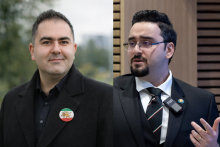
Both men flash wide grins when they get the standard question of how they are doing. ‘We are very happy, for now. There’s hope in the people’s hearts again. Yes, we have been dancing. But that is an Iranian cultural response. When we are suppressed, we dance to show defiance, to make people see that our spirit is unbroken.’
To illustrate the point, Mirgolbabaee uses his laptop to show a video montage. One of the clips shows a mother dancing to traditional Iranian music on the grave of her son, whom she lost to the regime. She holds up an Iranian flag, whilst shouting the name of the crown prince, Reza Pahlavi. Rezaei pulls out a tissue and silently wipes tears from his eyes.
Four pillars of a new Iran
Usually, when a regime is overthrown, the resulting power vacuum leads to a period of violence and chaos. Neighbouring countries such as Syria and Iraq are recent examples. Not when it’s up to the Iranians. ‘Our crown prince has been working on a plan for exactly this occasion, for 47 years. It has four simple basic pillars: democracy, secularity, rule of law, and territorial integrity. He’s called upon the Iranian community to help flesh out the details in whatever way they are equipped, and so we chipped in. Since we’re involved in higher education at UT, we have been working with the crown prince’s team, looking for ways to adapt the Iranian educational system to match European models. We want to build a bridge between here and Iran.’
Remodelling education
One thing that will be immediately removed from the curriculum, say the men, is the mandatory Islamic teachings. ‘Currently, there are compulsory classes such as Islamic Thought 1 and 2, and Islamic Revolution and its roots. They have nothing to do with, say, an engineering education. But they make up about ten percent of your study credits regardless. And if you do not pass, your family can expect a visit from officials, checking whether you’re devoted enough,’ says Mirgolbabaee. ‘In a secular society, you’re free to practice any religion you like. Just don’t force it on anyone.’
According to him, the courses are being taught by corrupt mullahs. ‘My teacher asked me to vote for him in the next municipal elections in exchange for a good grade,’ says Mirgolbabaee. Rezaei laughs in surprise: ‘That happened to me as well!’
Democratic principles and exchange programmes
In their contribution to the educational part of the masterplan, they propose to replace the courses with discussion groups and gatherings around democratic principles. And that’s not all, says Mirgolbabaee. ‘Through the power of the internet, which will be free for everyone, we want to organise regular online guest lectures and courses from the best lecturers around the world. We have the resources, so money won’t be an issue. We’ve also worked on laying the foundations for a system of sister cities that could work together on societal issues, much like you have here in Europe. We’d also really like to introduce an Iranian-style ERASMUS-exchange programme.’
Referendums
The grand plan even has an almost week-to-week schedule worked out for the first months after the regime falls. ‘We’ve made sure that after day zero, the country will stay upright. Bakeries will continue to make bread, the hospitals will keep caring for the sick. Shortly after there will be a string of referendums: how do we want to proceed as a nation? Do we want to be a monarchy or a republic? The crown prince has said that he has no interest in the title of Shah, but will take it up if the public wants it. A select group of officials will work together on composing a constitution, which will be reviewed and voted on in another referendum.’
Rezaei adds: ‘Don’t forget, we’re a highly educated nation with lots of resources, that have been misdirected by a terrible regime to fund terrorist groups. When the regime falls, those funds will go to restoring the country’s infrastructure, education, and healthcare. A prosperous Iran will mean better days for the whole Middle East. We’re tired of the oppression, the whole Iranian community wants this to work,’ says Mirgolbabaee.
How do they feel about the US and Israel interfering in another sovereign country? ‘Our only question is: what took you so long?’, says Rezaei.