


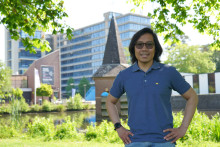
‘Java is three times the size of the Netherlands, but eight times as many people live there,’ Ariyanto says, sketching a broad picture of his home island. ‘We constantly have to maintain a balance between human needs and preserving biodiversity.’
Ariyanto actually works for the Indonesian Ministry of Forestry. He came to Enschede through a scholarship programme set up by the Indonesian government to help employees expand their expertise within their field. His PhD research into protecting the Javan leopard is titled Spatially explicit conservation of the Javan leopards in human dominated landscapes.
The Javastraat is the only thing connecting Enschede to the island where he was born. Ariyanto fully understands why people wonder why he is here rather than there. ‘The main reason is that I work together with Professor Andrew Skidmore, who is known worldwide for his expertise in combining ecology and remote sensing. It is also valuable to build a network here in Europe.’
Humans versus leopards
The island’s high population density puts heavy pressure on the leopard’s habitat. Agriculture, forestry, and the expansion of the road network all require space, often at the expense of forest. Only five percent of the island still consists of fragmented patches of untouched nature where the leopard can survive. According to the latest estimates, only around 325 Javan leopards remain in the wild. Ariyanto: ‘I have never actually seen one in real life myself.’
Crucial to the island
Not long ago, Java’s other major big cat, the Javan tiger, already became extinct. According to Ariyanto, that served as a wake-up call for the government. Since then, Indonesia has invested more heavily in biodiversity management knowledge, with government employees able to apply for scholarships.
‘The leopard is crucial to the island. The remains of its prey provide food for an enormous richness of scavengers and micro-organisms, improving the soil and allowing more to grow. The reverse effect is equally clear: without predation, prey populations grow uncontrollably, leading to overgrazing, erosion, and biodegradation. The leopard sits at the top of the food chain and is the symbol of conservation in Java.’
Dead leopards
There are plenty of photos online of dead leopards, enough to understand that the fragile balance between humans and nature often tips in favour of humans.
‘Animals do not recognise property boundaries, and when they attack livestock, farmers are directly affected,’ Ariyanto explains. ‘Leopards are shot, fall victim to poachers, or end up in the illegal wildlife trade. The animal is mainly seen as dangerous.’
Nowadays, the government tries to persuade people to take less drastic measures and show more understanding towards the animal. ‘We explain that if the leopard suffers, humans will ultimately suffer too.’ The government focuses on education campaigns in schools and community centres. ‘We make clear that a leopard is usually just passing through. If you leave them alone, they will move on by themselves.’
Four pillars
The main aim of Ariyanto’s research is to find ways for humans and leopards to coexist peacefully. To help shape better government policy and support it theoretically, Ariyanto is conducting his PhD research at the Faculty of ITC. His work rests on four pillars: identifying prey animals and biodiversity, modelling prey hotspots, predicting leopard distribution, and creating ecological corridors that connect fragmented habitats.
Using wildlife camera footage from Java, Ariyanto mapped so-called ‘prey hotspots’, areas with relatively high numbers of prey animals and therefore potential habitats for leopards.
‘The hotspot map shows where potential prey species for leopards live, such as deer and wild boar. It showed that leopards are most commonly found in areas with five or more prey species. With that knowledge, you can identify promising habitats and create corridors that allow the animals to reach them. Wildlife cameras have also shown that leopards use production forests and recovering reforestation areas as habitats. That creates opportunities. By connecting those areas through natural corridors, you can create a larger habitat range for the leopard. Through education for forestry workers and their communities, we can help prevent the animals from being shot.’
Back home
On 3 June, Ariyanto will defend his dissertation. Afterwards, he and his family will board a plane back to Java. Is he looking forward to returning?
‘I am used to the crowds of Greater Jakarta, with 42 million inhabitants, so Enschede felt like an oasis of peace for us. For my wife and me, going back is not such a big issue, but for our daughters it is more difficult. They grew up here and have friends here. But I have told them they can go anywhere later when they start studying.’