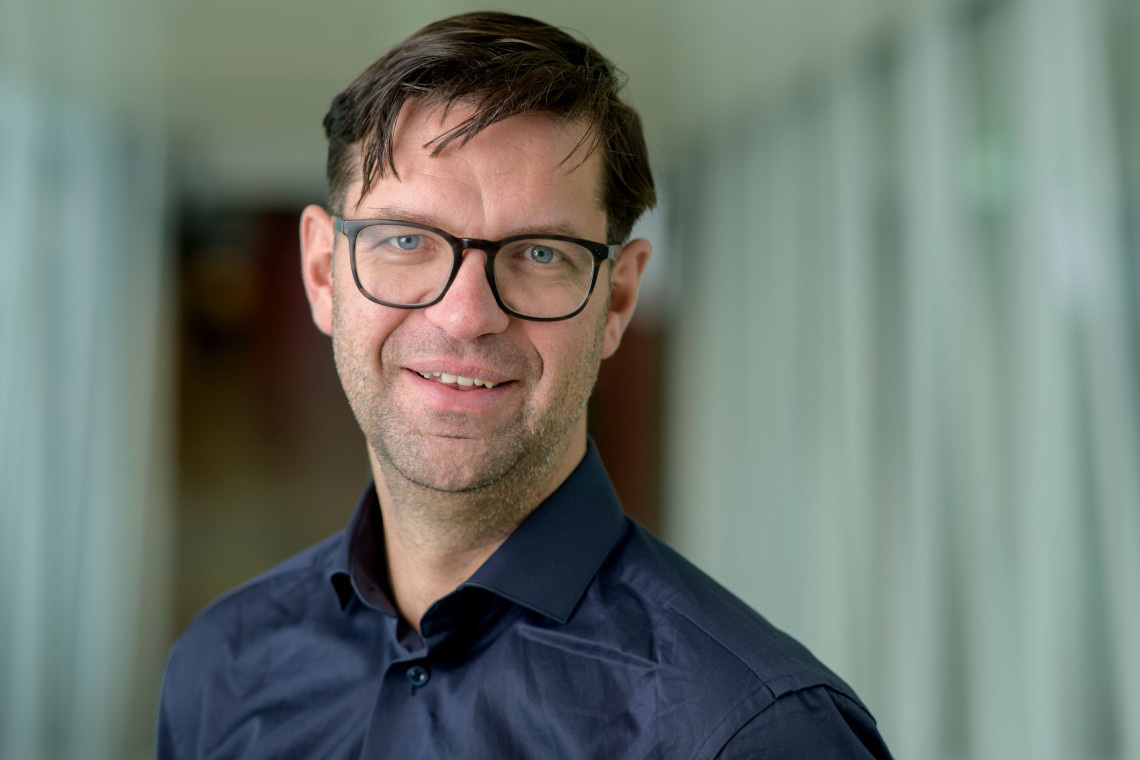


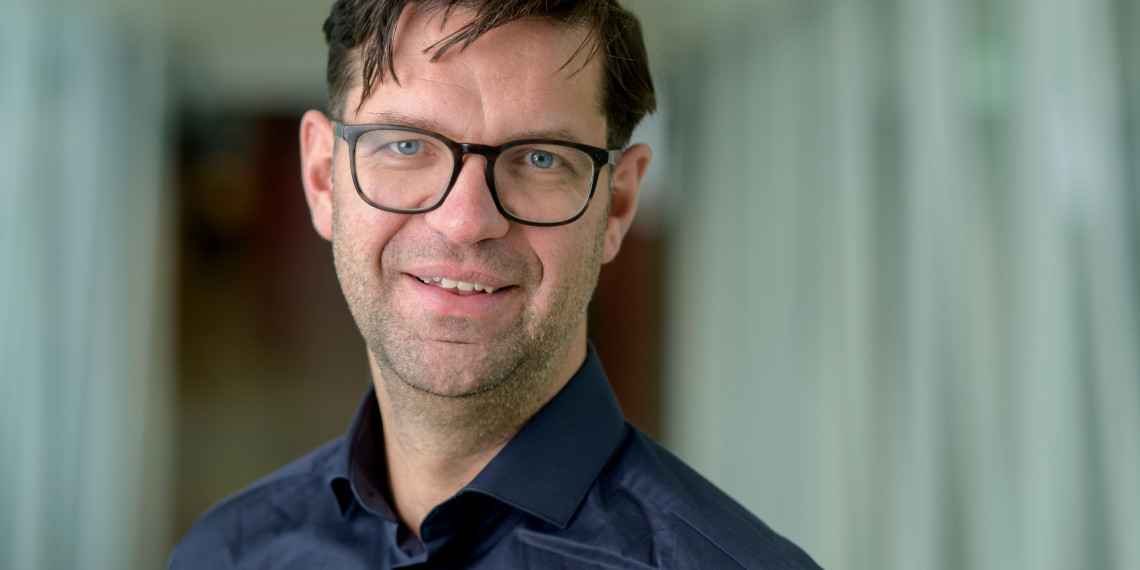
You won the Central Education Award last month. How did you experience the final?
‘The three of us (Bas Borsje, Mohammadreza Farrokhnia and Pim van ’t Hof, ed.) each gave a mini lecture. Nothing but praise for the others, because the margins were incredibly small. I think it ultimately comes down to the details. It took place in that beautiful hall in the Vrijhof, the amphitheatre. I happened to know it already because I once interviewed SP party leader Jimmy Dijk there for Van Torentje naar Torentje. So I was familiar with the room, the lighting, the technical setup. It was a full house, and I was able to connect with the audience. I felt completely in my element. That may have made the difference.’
What characterises your teaching style?
‘All students here can memorise a book, that is not the challenge. What matters is making real contact with students, because that is how I get them excited about the field. At the same time, I think it is crucial to explain difficult concepts in a clear way. I try to combine those two elements as effectively as possible.’
In what way?
‘Take the course Fluid Mechanics: for example, students need to understand how fluids flow past cylinders. That is not exactly the most inspiring topic at first glance. But I always try to end my lectures with engaging examples. Because fluids flowing past cylinders is precisely what you deal with when designing offshore wind farms. And that is something they all want to do. The fundamental theory itself can be rather dry, but what it enables you to do in practice is what I want to convey to students.’
What did you include in your own mini lecture?
‘It was closely aligned with my research: coastal protection based on natural processes. A very Dutch topic – our eternal struggle against water. Of course, we know the Delta Works as an engineering masterpiece, but nowadays we would approach things differently. What I try to teach students is that civil engineering is about more than just concrete and steel. It is about working with the environment and, above all, with people. In reality, it is almost never a purely technical issue. That is why we educate engineers who look beyond technology alone. I also concluded my mini lecture by addressing student wellbeing.’
Why is that so important to you?
‘I am not only a teacher but also a track coordinator. Very often, when students come with a question, it is not just about that one academic issue. When I see the amount of pressure and stress students experience nowadays – just consider the binding study advice – I feel it is important to give them genuine attention. I want to invest in my students, because I see them as future colleagues in the field.’

It is becoming noticeable: the success of Civil Engineering lecturers in this teaching award. You are the fourth within ten years…
‘That’s a nice statistic. We are used to supporting one another here. People step in for each other, for instance if someone is temporarily unable to teach. There is a strong sense of collegiality, willingness, and mutual support. That is something I truly value about this environment.’
How do you view appreciation when it comes to the teaching award? There used to be a financial prize, but that is no longer the case…
‘Recognition is not just about money. I was flooded with congratulations from across UT. That in itself is wonderful.’
Does it say something about the recognition of teaching compared to research?
‘I can relate to that broader recognition. I am also a member of The Young Academy, where we advocate for this as well. We need to move away from focusing solely on papers and grants. Outreach – whether through collaboration with industry or guest lectures at secondary schools – is incredibly important for a university. For me, teaching, research and outreach are seamlessly connected. It all comes together naturally, so it never feels like a burden or pressure. You should not stay in your office all the time. You need to go out, engage with the professional field and connect with other disciplines.’
Speaking of outreach, are you able to inspire prospective students?
‘Interestingly, a few years ago our faculty, Engineering Technology, struggled with that. It was as if we had temporarily lost clarity about what we stood for. Perhaps because we looked inward too much, focusing on managing everything internally. That has completely changed now. For the coming year, Mechanical Engineering is expecting a significant increase in enrolment. Civil Engineering saw a boost in student intake last year. That is purely because we communicated our story better and gave it more attention. So yes, what you focus on, grows – that applies to both education and everything around it.’
Finally, what would you like to share with other UT lecturers?
‘I think we can all do more to communicate what we stand for as a university. I am made in Twente myself. I studied here from my bachelor’s all the way to becoming an associate professor. We have always been a close-knit university; we know each other well. That is something to cherish and to promote more actively.
You know, after I received this award, I got an invitation from our department head, Suzanne Hulscher, to discuss something about postdoc contracts. Fine, I thought, without suspecting anything. But when I arrived, the social corner was filled with colleagues, with cake… That, to me, is UT: standing by each other in difficult times, and celebrating together when there is something to celebrate.’