

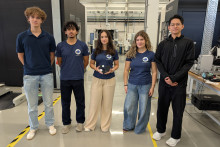
Last year, ‘student team’ RobOcto was founded by Silvia Stanimir, a bachelor’s student of Mechanical Engineering. ‘I was following the ESA available opportunities for university students when I stumbled upon the ESA Academy Experiments Programme (a programme by the space agency that supports student teams to develop their projects from concept to operation, ed.). So I decided to reach out to fellow students, to see if they wanted to join this project.’
Science fiction and octopi
The team of twelve students started in October 2025 and was invited by the European Space Agency for a week of workshops. They ended up being one of only two selected student teams in Europe who were invited to further develop and demonstrate their work. ‘It was a quite intense week, but also so rewarding’, Stanimir says. ‘The moment I walked in at ESA, I immediately said: this is the best day of my life. It was so impressive, a dream come true.’
For their project, the UT students were inspired by octopi. They developed flexible robotic tentacles designed to grab and keep hold of different shapes, sizes and surfaces. The tentacles are actuated by heating and cooling so-called shape-memory alloy wires.

Space debris
Even though it’s still a prototype, the UT students hope that their robotic octopus arm will be able to remove space debris. This debris forms a major problem for space travel, says Stanimir. ‘At some point, the satellites we send into orbit are no longer used. Sometimes they crash into each other, creating debris of large to very tiny particles. The current estimate is that we now have an ever-growing number of about 140 million particles floating around in orbit, reaching a very high velocity. Even a particle of about a millimetre can cause a lot of damage and bring a space mission in danger.’
Flattest floor in Europe
In November, the team will reach their major milestone: to further test their prototype in ESA’s Orbital Robotics Lab. ‘We will test it on the flattest floor in Europe, on a system that simulates zero gravity’, Stanimir explains. ‘With the right supervision and input, this is an amazing opportunity for us to take our project to the next level and prove it has potential.’
And the November visit to ESA in Noordwijk? The group of twelve bachelor’s students is still unsure about their future plans with this project. ‘Following the microgravity testing, we will pursue with noting down our discoveries within an experiment review document, says the team leader. ‘Maybe we will also be able to secure a patent – and possibly continue with this in the future. Who knows.’