

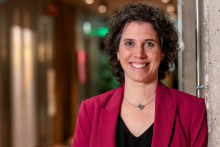
It was another ripple in the academic pond: during her unconventional inaugural lecture last April, Professor Maaike Endedijk made a passionate plea against social unsafety in academia. Through the hashtag #Istandup, she subsequently spread posters across the campus.
Powerful stories and recognition
She did not stop there in the months that followed. Endedijk collected and compiled personal accounts and shared them on her LinkedIn profile. Stories about bullying, intimidation, belittling – and resilience. These accounts from her #Istandup campaign formed the basis of discussion during Thursday afternoon’s workshop, organised as part of UT’s wellbeing weeks.
Around thirty UT staff members made their way to the DesignLab. Working in groups and drawing on the curated stories, they shared their own experiences and insights. Discussions centred on mutual expectations and hierarchy, leadership, awareness of one’s own behaviour, and the role of the university’s support structures. The personal stories themselves also resonated, highlighting questions around what is ‘acceptable’, ‘unacceptable’, or outright inappropriate behaviour.
Participants then reflected on concrete actions to address misconduct and improve the situation. They were also invited to leave recommendations for UT vice-president Machteld Roos. ‘I will make sure she receives them,’ Endedijk said, while reviewing the collected post-it notes.

The right conversation
Looking back, Endedijk expressed satisfaction with both the workshop and the discussions it generated. ‘We still don’t talk enough about what we consider normal, or about how to engage in meaningful conversations with one another. I was particularly pleased to see exchange between support staff and academic staff, allowing them to hear how others experience certain situations, because that is not always visible.’
This observation aligns closely with another key takeaway. ‘Often, you simply don’t know what others consider as normal or not. I understand that, following my inaugural lecture, the Executive Board has launched a task force on culture and behaviour. Without over-bureaucratising things, I hope this group will address questions such as: what are our norms, and what do we find acceptable? For instance, is it acceptable for someone to be denied holiday leave because they have not finished their work? That example came up this afternoon. One of the recommendations was to create more time and space for these kinds of conversations.’
Individual and system
In that context, Endedijk also sees risks in the transition towards a departmental structure at the faculties, which will result in larger organisational units. ‘Managers already have limited steering capacity when it comes to issues such as capacity planning, while ensuring staff wellbeing is a core responsibility. As a department chair, you are expected to safeguard not only the wellbeing of your own postdocs and PhD candidates. That becomes increasingly challenging when you are responsible for eighty people.’
The professor hopes that conversations on these topics will increasingly take place and be facilitated at UT. She also emphasises that change should not come solely from individuals, but from the system in which they operate. As for the future of her campaign, she is still considering the next steps. ‘We have received responses from other universities as well, including the idea of establishing a national support group. I welcome that – but how exactly? That is something we still need to figure out. In any case, I hope UT can serve as a role model.’