

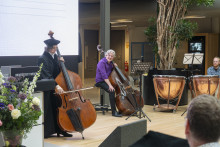
Her inaugural lecture was unorthodox from the outset. Of course, she outlined her vision of her field under the banner The Rhythm of Learning. But how often do musicians perform a piece by Mahler at an inaugural lecture? And how often does the professor herself take to the stage to play The Sound of Silence on the double bass?
Towards the end of her inaugural lecture, Endedijk launched into an impassioned argument. About how, in January 2016, she ‘preferred to leave academia rather than continue living under abuse of power and intimidation’.
‘But sometimes all it takes is one person who stands behind you and fights for you when you no longer can. One person who says: this is unacceptable. For me, that person was Theo Toonen (then dean of the Faculty of BMS, ed.). Without you, I wouldn’t be standing here today.’
Stand up
Endedijk also thanked colleagues Ellen Giebels, René Torenvlied, Ton de Jong and Joseph Kessels. Yet she stressed that this was not a word of thanks, but a plea. ‘Because this was not an incident. It is a symptom of a culture. And we create that culture together. As long as we accept it, after professors P, S, D, L, S and professor M, there will inevitably be another letter of the alphabet.’
Almost poetically, she continued her appeal, urging the audience to stand up against misconduct, intimidation and an academic culture marked by ego, fear, pressure and silence. ‘Stand up when misconduct is weighed against someone’s achievements. No prestigious grant, no H-index of 85, should ever be a licence to harm another person.’
Not an incident
Why did she feel compelled to make this plea? ‘Because it needs to be said. U-Today’s publication about professor M. motivated me even more, particularly the response from the University Council: what if this were to happen again? No, it is happening. Every day. This is not an incident that occurs once every four years. If everyone knows but nobody acts, what does that say about our culture?’
The reactions took her somewhat by surprise. Not only the standing ovation, but also the people who approached her afterwards. ‘From those who had experienced it themselves, to others who said it had been a blind spot for them. A dean and a professor have already told me they want to revive the UT-wide working group on Behaviour and Culture.’

The standing ovation.
A listening ear
What can the university do to improve its culture? ‘Everyone is needed. Not just a support structure with an ombuds officer and confidential advisors, but also the middle layer of assistant professors, associate professors and professors. You must be deeply aware of someone’s vulnerability. And I want to stress the importance of a listening ear. Make it clear that you are willing to listen, that someone can trust you,’ Endedijk says.
And the ‘system’? ‘At a university, it is simply very slow, which makes people feel unheard. It can even take years. What helped in my case was that I was removed from the situation within three weeks. So get someone out of an unsafe situation as quickly as possible and ensure there is a clear point of contact. Not just for a single conversation, but keep talking and keep listening.’
Stand up (the full text)
Stand up
Against an academic culture
With egos so large
That they overshadow others
Where fear and work pressure
Slowly diminish people
Stand up
When you see someone breaking
but no one hears a crack
Stand up
When a hand lingers too long
Too low, too close
When boundaries are crossed
And later are denied
Stand up
When it is said
That speaking out is bad for your career
That you must man up, learn to say no
Or that it’s just part of the job
Stand up
Against staying silent
Against looking away
Against 'the sound of silence'
Stand up
When behaviour is 'resolved'
With a leadership course
Spray & pray
But no one checks whether prayers are answered
Stand up
When misconduct is weighed
Against someone’s merits
Because it is not a balance or a calculation
No prestigious grant, no H-index of 85
Can be a licence, to harm another
Stand up
For the new generation that says
This can be different
This must be different
And we are going to do it differently
Stand up and speak out
Because change never starts with a system
But always
With one person
who stands up.