

Nearly two years ago, ‘Project Beethoven’ first emerged: a government investment plan to strengthen the Dutch chip industry and keep ASML in the Netherlands. Much of the funding went to ASML and the Brainport Eindhoven region, but Twente also secured 72 million euros. Of that amount, 20 million was allocated to UT, to be spent through 2030.
‘Good for the Netherlands’
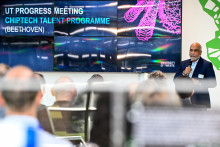
During Wednesday morning’s first UT-wide progress meeting, more details emerged about the projects falling under the Beethoven umbrella. In his opening remarks, president of the Executive Board Vinod Subramaniam already counted around fifty projects. He emphasised both the opportunities and responsibilities for the university. ‘We have committed ourselves, as a university, to educating and retaining more technical talent. Beethoven is not a candy jar for cool research projects. We must contribute to the talent challenge in the chiptech sector.’
After his remarks, ten projects were presented. Some focused on recruiting new students. Cora Salm, programme director of Electrical Engineering, spoke about the ‘South East Asia Short Talent Programme’, a summer school in Kuala Lumpur. ‘We taught for two weeks to fifty preselected top students from universities in the region. One of the participating students ultimately chose TU Delft. Unfortunate for us, but good for the Netherlands.’
‘Holding out the candy jar’
There were more ideas to spark interest among (potential) students for chiptech-related programmes, such as demonstrations during online open days and a podcast series. Herbert Wormeester, programme director of Advanced Technology and Nanotechnology, referred back to Subramaniam’s candy jar metaphor. ‘If we want to attract students, we do need to hold out this candy jar.’
By that he meant: Wormeester wants to offer students real hands‑on experience in UT’s cleanrooms, via the new Semicon Learning Center. ‘At the moment, there is limited capacity for students to learn by doing. Ultimately, we want them to design and fabricate their own wafer.’ Wormeester hopes to launch a minor in September, which should also be accessible to students from the ECIU consortium. He also sees opportunities for existing courses to make use of the Semicon Learning Centre. ‘In this way, we can offer as many students as possible a relevant chiptech experience, rather than having them learn about it from a book.’

Building machines
Other UT staff members see potential in combining Beethoven with lifelong learning. Assistant professor Kostas Nizamis aims to provide in‑company training on systems engineering. His colleague from the Faculty of Engineering Technology, Hans Voordijk, sees opportunities in combining chip technology, EngD programmes, and lifelong learning.
There are also lecturers who are using Beethoven funds to rethink UT’s own education. ET professors Maarten Bonnema and Dannis Brouwer see opportunities for a new profile within the Mechanical Engineering master’s and a new course called ‘High Tech Machine Design’. ‘We offer a lot of in‑depth education at UT, but with so many separate themes, students still do not necessarily learn how to build a machine’, Bonnema said. ‘We see opportunities to bring everything together through a new course and a new profile.’
Later in the morning, the pitched projects were discussed further by the dozens of attendees in the DesignLab. UT is expected to feel the impact of ‘Project Beethoven’ increasingly in the coming years. By 2030, the university aims to educate more than four hundred additional technical students.