

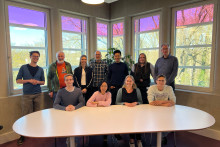
Last summer, CLEAR won the Dutch Higher Education Award. Is this event meant to celebrate that achievement?
Krab‑Hüsken (CSE programme director and CLEAR project leader): ‘Absolutely. It is, on the one hand, a festive moment for the team, students, and everyone involved. At the same time, we will discuss with the attendees how we intend to spend the prize money. Over the past months, we drafted a proposal for that.’
Isn’t it strange to win a prize and then still need to write a proposal?
Pei (educational adviser): ‘Not at all. Think of it as a kind of commitment: the prize acknowledges what we have built over the past years. Attached to the prize money is the mission to further strengthen the initiative’s impact in the future. That is what we formulated – essentially a five‑year future plan for CLEAR.’
What exactly is CLEAR?
Krab‑Hüsken: ‘It stands for Chemistry Learning for Environmental Action and Responsibility. Our focus is sustainability education combined with systems thinking. That begins in the very first bachelor module. What we also notice is that secondary education tends to be very linear: pupils focus on one specific task, problem, or chemical formula. That is not inherently wrong, but the overall system in relation to sustainability challenges is far more complex. We want our students to take off their blinkers and learn to see the bigger picture, with sustainability at its core.
We combine this with fourteen so‑called essential skills, such as critical thinking, quantitative literacy, and problem‑solving abilities. To make this possible, we need a supportive learning environment: as a teaching team we are located close to the homebase in Carré and easily approachable for students.’
How do you improve an already nationally recognised initiative?
Pei: ‘One element of our plans is to conduct educational research. We want to investigate the effects of this method on students – how it influences their behaviour and attitude, also when it comes to sustainability. We will also carry out a sustainability benchmark to further improve our curriculum. One of Friday’s speakers is Jon-Erik Dahlin, an expert in sustainability education at King’s College London. He is supporting us with this benchmark, helping us to assess the programme’s so‑called Sustainability Readiness Levels.’
Could other UT programmes apply CLEAR’s principles?
Krab‑Hüsken: ‘That’s certainly possible. The projects from the other finalists for the Dutch Higher Education Award – VU Amsterdam and Maastricht – already reached far larger student populations. In our case, each cohort consists of around fifty to sixty students. But we managed to convince the jury of the potential and relevance of this initiative for other programmes. That is why Jon‑Erik Dahlin is also giving sessions on Wednesday and Thursday for colleagues and most programme directors, to explain how sustainability can be incorporated into curricula. I certainly see opportunities for the entire UT.’
Pei: ‘Scaling up is indeed one of our aims. If we develop an adaptable framework, it can be used here at UT, as well as at other institutions.’
So that means the €1.2‑million budget is still far from exhausted?
Krab‑Hüsken: ‘No, we also want to improve how we communicate about the programme and, where possible, increase our student intake. There are persistent misconceptions about what Chemical Science & Engineering actually is. With everything in the news, people quickly assume it is all about polluting fossil industries or microplastics. Together with Pre‑U we recently looked into this: among secondary school pupils choosing the ‘science and technology’ track, the number opting for chemistry or Chemical Engineering has halved over the past decade. Yet we are training students to tackle major societal challenges – by focusing on sustainable solutions and teaching them systems thinking. We need to break through those negative stereotypes.’
Pei: ‘Ultimately, this is not only a challenge for Chemical Science & Engineering. Society urgently needs responsible engineers for the future.’