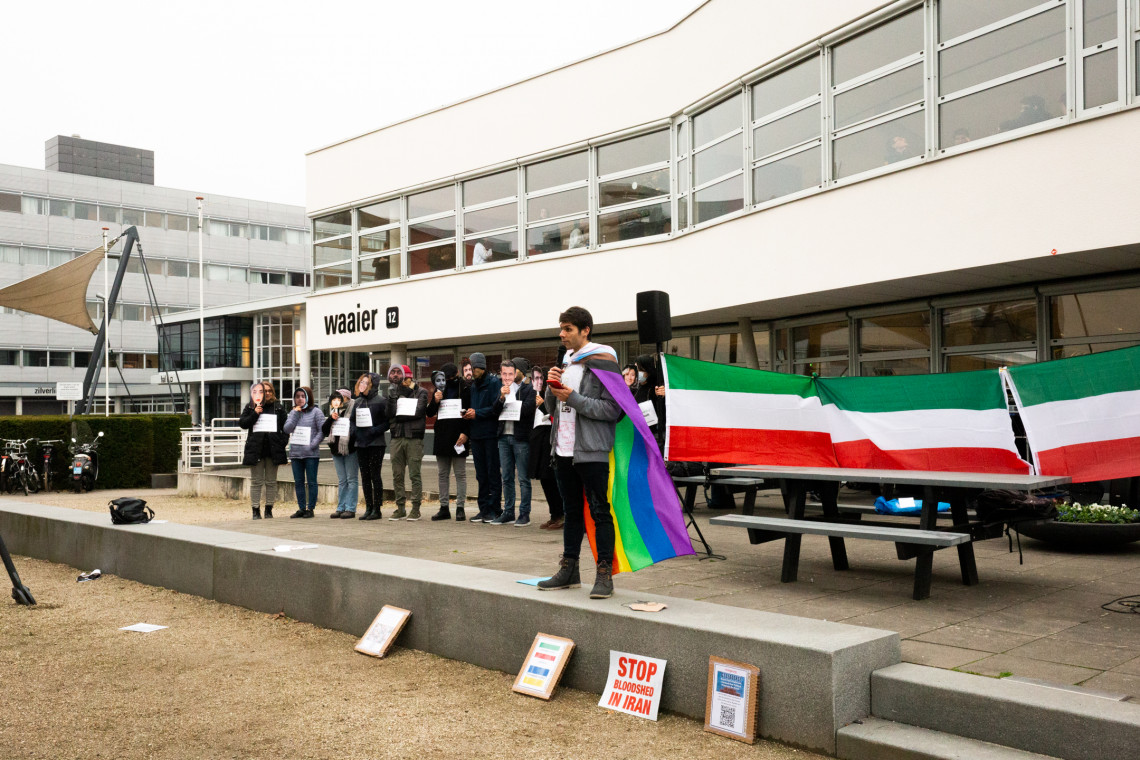


There are about a thousand Iranians living in and around Enschede, most of whom are UT students, PhDs, and professors. They anxiously await every morsel of information that seeps out from under the communications blockade imposed by the Iranian regime. The people back home in Iran have taken to the streets in the latest spate of protests, while the govern tries to contain it by cracking down hard on its citizens.
‘Many colleagues ask me how my family is, but I don’t know. And I know they mean well, but the question makes me very sad. The anxiety is paralysing, we can’t sleep or eat, and it severely affects our daily work.’ He notes that since he has been somewhat vocal about the situation, he has made it hard for himself to return home, running the risk of being arrested upon arrival. Yet he cannot remain silent.
Turkish lifeline
It is more than one hundred hours since he has last heard from his family back home. And he’s not the only one. A friend from his place of birth, near the Turkish border, forms the only connection he has to what is going on in his country. Having managed to get a hold of a Turkish SIM card, that friend goes out into the mountainous area that separates the two countries, to try to find reception from the Turkish telecom providers that bleeds across the border. ‘He can then pass on messages using a Turkish number. But he's taking a big risk. It has become the only possible communication line for millions. He cannot handle all the requests.’
One way the government-imposed blackout has affected Iranian students in Enschede is making it impossible to digitally sign enrolment contracts, transfer money, or pay tuition fees. ‘As a result, some students are unsure whether they can even continue their studies.’ In addition, the fear that family members may be killed is crippling every-day work. Reports of mass killings of protesters in the streets with wildly varying numbers only aggravate the anxiety. ‘We do not know what to believe at this point. But you don’t want to imagine family members being among those murdered.’
'Our women had voting rights years before Switzerland. Now, a woman can't even sing in public'
The current upheaval is the latest in a long line of uprisings ever since the Iranian regime imposed strict Islamic laws on the country 47 years ago up until the death of Mahsa Amini in police custody in 2022. Amini was arrested for failing to meet the regime’s strict requirements, such as not properly wearing the mandatory headscarf in public. ‘Our women had voting rights years before Switzerland,’ he says, proudly. ‘Now, a woman can’t even sing a song in public. It’s barbaric. We just want freedom of choice: if you don’t want to wear a hijab, you should be free to take it off. That’s what we’re fighting for.’
Every time up till now, the Iranian government has managed to subdue unrest by cracking down hard on protesters. This time is different, though, thinks Rezaei: ‘We now see protesters direct their anger at symbols of the regime, burning headscarves and toppling statues. The few clips that do come out, show people in the streets chanting the name of the exiled crown prince.’
European-style government
The eldest son of the deposed former Shah, crown prince Reza Pahlavi, has announced that he has no personal interest in taking on the role of monarch, but that in the event of a government change, he wants to lead the country towards a free, secular democracy. Whether that’s with the former monarchy restored, or in the form of a republic. Rezaei has his own opinions on it, but would be happy with any change: ‘Me and many others would like to see a European-style government. I could live with a constitutional, parliamentary monarchy like here in the Netherlands. As long as it’s secular, with a separation of religion and state affairs, and as long as the people have the freedom to decide on their own fate.’
Propaganda
One sentiment throughout media reports is the idea that if the regime falls, the resulting power vacuum will incite opposing factions within the country to pick up arms and start a civil war. Rezaei is convinced, however, that things will sort itself out. ‘That’s all propaganda. Yes, there are multiple ethnicities within Iran, but we are a highly educated nation, and we’re tired of fighting and living in fear. I strongly believe that we’ll be able to unite, and make our country prosper.’
On-campus demonstration
He hopes that by garnering as much media attention as possible, leaders around the world will be inspired to increase the pressure on the regime, to push for change. He mentions a recent visit to a demonstration in The Hague. Plans for an on-campus demonstration are in the works. Wouldn’t he like to return to Iran soon? ‘Every Iranian does.’