

Klimming and clambering over beams, swinging across the water, and crawling through the mud. Anyone looking to really challenge and exhaust themselves will feel right at home at survival association Tartaros. ‘No matter the weather,’ we often say,’ Silas de Graaf (23), a Computer Science master’s student, gets straight to the point. ‘We train come rain or shine. We never cancel a training session, except in the event of a thunderstorm. When students see us running across campus for our warm-up in winter, they probably think: ‘There go those idiots from Tartaros again.’’
Jesse Snoijer, also a Computer Science master’s student, thinks of another word that characterises the members: ‘handymen’. At Tartaros, it’s all about tackling a technical obstacle course, with an outdoor feel and a touch of scouting.’
Sixteen committees
Snoijer and De Graaf are housemates and have both been members of the survival association for five years. Both served on the Tartaros board a few years ago, but the association still holds a special place in their hearts. ‘Tartaros has sixteen different committees. That’s quite a lot for an association with 75 members,’ says De Graaf. ‘Many members are so active that they sit on several committees at the same time.’
The story continues below the photo.
 Silas de Graaf (l) & Jesse Snoijer (r).
‘We’re still very involved,’ Snoijer adds. ‘Think of setting up the Tartaros Campus Challenge or putting together the obstacles for the Bastille assault.’ Besides building obstacles, the members also put themselves through their paces on their own survival course.
The Bahia’s
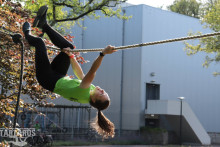
‘We train on our survival course on campus three times a week,’ says Snoijer. After a half-hour warm-up, the members spend an hour tackling the 40 obstacles. Tartaros has a course committee that comes up with new obstacles and rearranges the course four times a year. ‘We make and build those obstacles ourselves. One of the elements is the ‘Bahia’s’. You have to use hanging techniques to reach the other side,’ says Snoijer. ‘I find this one of the toughest,’ De Graaf adds. ‘You can use your feet, but the distance is long, which makes it difficult.’ ‘But the ‘short ropes’ are also quite a challenge,’ Snoijer concludes.
Playing Snakes and Ladders on the survival course
In fact, the members have even come up with their own games. They play Snakes and Ladders and Battleship while working up a sweat on the obstacle course. ‘If someone lands on an unfavourable square during one of these games, they have to complete an obstacle as a challenge. At Easter, we have an Easter course, where we hide eggs around the course, and at Sinterklaas, the presents have to be transported to the other side,’ De Graaf explains.
Strength is not enough
The two members admit that the warm-up can sometimes put off new members. ‘I always find it an interesting moment. Most people are inexperienced, but you also see that people who are usually in the gym building up their muscles don’t have the stamina,’ says De Graaf.
The story continues below the photos.


‘Our sport is definitely a combination of strength, technique, and endurance,’ says Snoijer. ‘And on top of that, you have to tackle some difficult obstacles.’ According to the pair, Tartaros mainly teaches you how to overcome those obstacles efficiently. ‘We learn how to approach an obstacle technically without wasting too much energy. You also learn when to take a rest. During competitions, you sometimes have to tackle 40 obstacles over distances of 6 to 21 kilometres one after another,’ says De Graaf.
Getting soaked
Anyone who thinks they will make it home dry after a survival run with Tartaros is in for a surprise. Survival running with the association means getting dirty. Still, the members adjust their clothing before heading onto the course. Most wear special leggings that protect against chafing and help with some of the obstacles. ‘A lot of students on campus find it funny when they see a group of men running past in those trousers. But we don’t care,’ says De Graaf.
The club spirit also lives on outside training sessions. Every other week, members get together at the storage facility for an evening around the fire pit. The association also organises a joint activity every month. Some traditions have remained unchanged for years. For example, whoever finds an inflatable crocodile during a survival run has to inflate it and get it across the water. ‘Don’t ask us how this tradition started. It’s been around for as long as we’ve been members of the club,’ says De Graaf.
The Tartaros Campus Challenge also brings the association together. Around 1,100 participants and 130 volunteers are involved in the event. For five weeks, members transform the campus into a survival course. What takes weeks to build is dismantled in a single evening after the event. And anyone who gets soaked during the Challenge knows where to go: to the fire pit.