

Late last year, the UT community was shaken by a story that defied belief: PhD candidates pushed to the brink by the reign of terror of a professor. It stood in stark contrast to another U-Today story, in which a PhD candidate spoke emotionally about how grateful he was to his two supervisors.
It is safe to say that a great deal depends on the relationship between supervisors and PhD candidates. Let’s take a closer look at that bond.
Four long years
Evita Lammes, confidential adviser several organisations and author of the book ‘Waar ligt de grens?' (Where is the line?) on transgressive behaviour, sketches the broader picture of what PhD candidates are dealing with.
‘Some have left their homes behind to build an academic career and life on the other side of the world. For four years, as a PhD candidate, you are at the mercy of the ‘whims and quirks’ of your supervisor, who once entered the system in the same way. There can also be significant competition between PhD candidates. At the same time, the old adage of ‘don’t complain, just endure’ still prevails.
Science is also a relatively small world. Research groups tend to focus on such niche topics that those who understand them all know each other. There is a strong chance that, as a PhD candidate, you will deal with the same people for the rest of your academic career. Speaking negatively about an established name as a young researcher is effectively career suicide.’
If a professor takes supervision seriously, the PhD candidate can have a wonderful time. PhD candidate Janike Bolter is one such example. She works for the BIOS-lab on a chip group at the EEMCS faculty and wants to emphasise the ‘positive side’. She describes her supervision team as consisting of a new supervisor doing it for the first time and an experienced supervisor.
‘Care, involvement, and basic human decency should not be exceptional’
According to her, the supervisors are not very closely involved in her research, and the planned bi-monthly meetings sometimes take place only twice a year. ‘Still, I do not complain, because my daily supervisor is very involved, and I know my supervisor will always listen. Whether I worry about my contract, the time my thesis takes, or my mental health, they are there for me,’ she writes.
At the same time, she knows this is not self-evident. ‘What works for me does not work for everyone. We are also all white Europeans, which reduces the chance of misunderstandings. But I know my supervision team adjusts their style to the candidate and to the stage of the PhD trajectory. That is highly valued within our group.’ It even earned the group an award for best supervision in 2025.
Not exceptional
‘I want to stress that this should not be exceptional. These qualities and this level of commitment do not seem extraordinary or demanding, but reflect basic care, involvement, and human decency. The fact that this is apparently already too much for some supervisors honestly amazes me,’ says Bolter.
‘I have a roof over my head, and nice colleagues, but this is not why I came to the Netherlands’
That is a different story for PhD candidate Humphrey Goodman*. He started enthusiastically on an interesting research question from his group, a niche topic that we will not describe for reasons of traceability and to protect his academic career. He even moved to Twente from abroad for it, turning down other offers.
His supervisors proposed a specific technical approach to carry out the research. Through extensive reading as part of his literature review, he discovered that there was a much simpler way to conduct the research. That effectively rendered his research question invalid. He raised the issue, but got nowhere. It had to be done the other way.
High workload
He also proposed an alternative research design, which was rejected. ‘But they did not tell me how it should be done instead.’ In the meantime, he continues working in what he considers the more cumbersome way, so that he at least has something to publish. ‘I only publish conclusions showing that something does not work. I am tied to the duration of the project. I am paid for it. I have a roof over my head, food in the fridge, and nice colleagues, but this is not what I came to the Netherlands for full of enthusiasm.’
‘You are supposed to learn from your master, but how can you if you barely see them?’
Goodman understands that the workload is high and that he is not the only PhD candidate under his supervisors’ responsibility. ‘I have seen my supervisor’s schedule. It is booked from early morning to late evening. How can you effectively supervise people like that? Over four years, I get about sixteen hours with my supervisor, mostly going through a checklist. The system is set up so that you are supposed to learn from your master, but how can you learn anything if you barely see them?’
According to Goodman, there are no clear guidelines for what supervision should look like in practice. There also seems to be little interaction between the promotor and the supervisor. ‘They live in different worlds.’ He would like different supervisors, but that is not something he can choose. ‘Maybe my supervisor could delegate tasks, so that I at least have someone to spar with.’
‘We meet all the requirements set for PhD trajectories in the Netherlands’
According to dean Ariana Need of the Twente Graduate School, the umbrella organisation for PhD candidates, those guidelines do exist. ‘We meet all the requirements set for PhD trajectories in the Netherlands. During the introduction days, it is clearly explained what PhD candidates’ rights and responsibilities are, and where they can go if they run into problems. Each PhD candidate receives an email with brochures, PDFs, and guides such as the Expectations regarding the supervision of doctoral candidates. Supervisors also receive instructions, such as the UT guide to supervision of doctoral candidates. And in year two, all of this is repeated.’
The first document helps to clearly establish expectations on both sides, Need says. It consists of sixteen scales, using five-point scores to define how the collaboration works. One scale, for instance, determines to what extent the supervision team or the candidate is responsible for ensuring that the thesis and academic papers meet the required standards, and whether they enable the candidate to meet the qualifications needed for completion. Another scale specifically addresses how important ‘a warm, supportive relationship between the supervision team and the PhD candidate is for a successful doctoral trajectory’.
That should provide sufficient clarity, Need hopes. ‘Each candidate completes it and signs it together with their supervision team.’ She also points out that the document contains active links to the UT support structure and that confidential advisers introduce themselves in person during the introduction days. ‘But there is so much information coming at PhD candidates during those days that this is probably the first thing they forget. And as a new PhD candidate, you do not expect that you will need it.’
Goodman has spoken to a PhD counsellor, but says they can only provide advice on practical issues. ‘For example, if someone becomes pregnant and needs to arrange something in terms of planning. But they will not help you if you reach an impasse with your supervisors. ‘Come up with an alternative plan’, they said. I had already done that.’
‘I have decided to ignore my second supervisor as much as possible’
Another PhD candidate, whom we will call Floris van Rooij, though his real name is known to the editors, takes issue with a professor who can be quite sharp. ‘In my case, I was subjected to a public interrogation in a way that was simply not appropriate. Questions in themselves are fine, but the way they were asked was very confrontational. It only got worse when I did not know an answer, for example about the workings of a particular device we need for research. When you use a phone, you do not think about how it works, as long as you can make a call, right? It felt belittling and personal. A fellow PhD candidate was subjected to the same kind of intimidating questioning during a colloquium. As if the supervisor could not accept that you do not always know the answer. It was very unpleasant.’
Self-censorship
Van Rooij is not easily intimidated, but still thinks twice before speaking. ‘If I say something about someone, I will still run into them every day at the coffee machine for the rest of my PhD. So you keep quiet. But I am no longer sure I feel like pursuing an academic career.’
For his research, Van Rooij proposed a theoretical approach. His second supervisor insisted that such a thing would never work, that everyone in the field knew that. This led to months of fruitless searching in the literature to find evidence for that claim, after which Van Rooij asked for guidance. ‘They said they did not know either, but just had a feeling it was the case. I have decided to ignore my second supervisor as much as possible.’
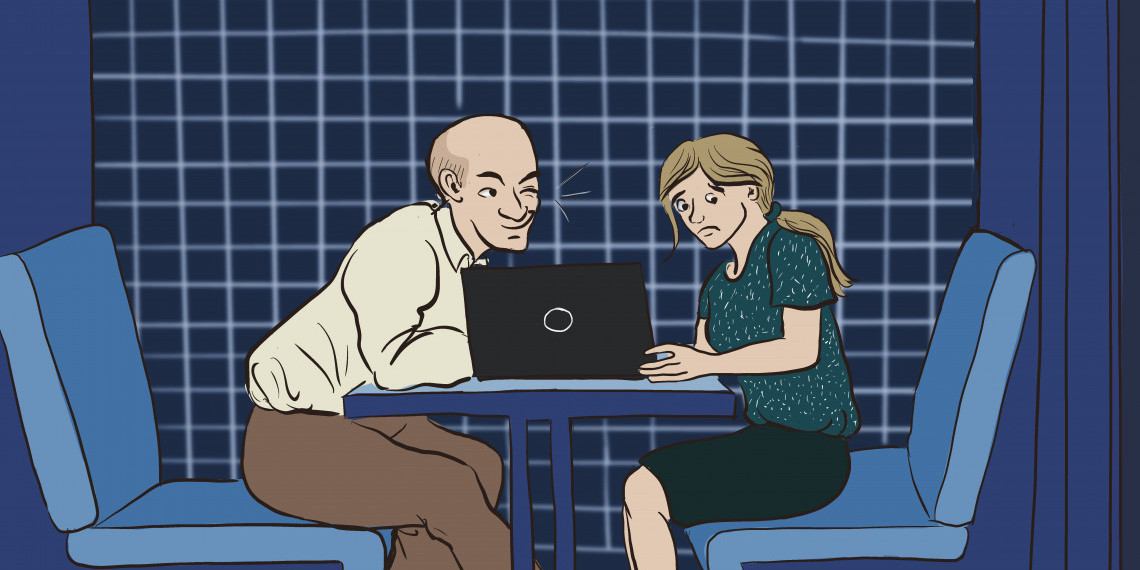
Article continues below illustration.

According to Van Rooij, he is not the only one. ‘All PhD candidates under this person are fed up. Everyone I speak to experiences a lot of stress and pressure, and they are deeply unhappy.’
Lack of support
Another issue is the lack of intervention by colleagues. ‘During that interrogation of another PhD candidate, their supervisor was present. They did not stand up for their PhD candidate at all. They simply walked out of the room when my supervisor started shouting. That is how they protect each other. As a PhD candidate, you feel abandoned.’
According to Van Rooij, there is also little guidance on what PhD candidates are and are not allowed to do. ‘I am from the Netherlands, so I grew up within this system. You know what the law requires, for example something as basic as entitlement to holiday leave. For colleagues from abroad, that is not self-evident. But as a PhD candidate, you are largely left to your own devices.’
Need again refers to the detailed introduction email. ‘It clearly states where you can find information and what your rights are.’
‘You just have to hope your supervisor has the right management skills’
Aditya Pappu, now a postdoc at the EEMCS faculty, had an excellent relationship with his former supervisors and is grateful for how they trained him as an academic. Still, he has concerns about the system. ‘When I hear stories like this, I realise how lucky I have been.’
According to him, the problem lies in the fact that PhD candidates are simply assigned a supervisor and promotor, regardless of whether they are a good fit. ‘And you just have to hope they have time for you and actually have the management skills.’
He stresses how strongly PhD candidates are committed to their research. ‘Especially internationals. They have left everything behind to work on a project for four years. Sometimes there are high expectations from home. You do not just abandon that. You cannot simply walk away either. Many people just accept the negative aspects, because they are told ‘that is just how things work here’.’
Outdated system
According to Pappu, the problem lies in the fact that the centuries-old system has not evolved with the times and now has to accommodate far more competing interests. ‘In the past, scientists worked on fundamental questions. They observed a physical phenomenon and tried to explain it. They had time for that, and for supervision. That is no longer the case. There is pressure from society: here is a daily problem, solve it. On top of that, there is competition. For example, we need to improve our nanochips, preferably before other global players. There is much more pressure on modern research.’
He proposes several changes. ‘The master-apprentice model is outdated. I would turn it into a more collective, team-based approach, like start-ups. They often offer traineeships, which are essentially exploratory phases. If the first year of a PhD trajectory were structured like that, candidates could explore which teaching style suits them best. I would also allow PhD candidates to choose their own supervisors.’
He would also like to see supervisors take management courses. ‘So they have better tools to lead teams.’ In addition, he suggests aligning research groups around a shared vision. ‘Then research projects become more connected. People are aware of each other’s work, and it becomes easier to switch if a collaboration does not work out. You are less stuck in a niche.’
‘You can be a brilliant scientist, but an asshole of a supervisor’
According to Lammes, the system itself enables abuse of power. In her work as a confidential adviser, she sees it all too often. ‘Yes, in the vast majority of cases things go well, but that does not make the individual cases any less serious. If it does happen, it is difficult to break free from it. The worst part is that it is often justified.’
In her book, she distinguishes four types of abuse of power: ‘sexual, bullying, discrimination, and even aggression or intimidation.’ All of these occur at universities. ‘You can be a brilliant scientist, but an asshole of a supervisor.’
According to her, the two roles should be separated. She suggests several alternatives. ‘For example, a kind of mentor who supports organisational aspects, such as planning your week, alongside someone who is an expert in your research area. That creates a better balance in responsibilities and distributes attention more evenly.’
Four-eyes principle
In the Dutch system, there is already a distinction between daily supervision and a final promotor, the so-called four-eyes principle.
On the website of Universities of the Netherlands, there is an advisory document titled ‘A healthy practice in the Dutch PhD system 2.0’, intended as a guideline for creating a sustainable system for PhD supervision. It offers tools for the entire trajectory, from registration and embedding to supervision, assessment, and completion. The key focus is the mental wellbeing of PhD candidates. According to Need, ‘UT already follows almost all of these recommendations.’
Goodman remains sceptical. ‘A four-eyes principle sounds very good on paper, but it would be nice if those eyes were actually looking at the same thing.’
Intimidating leadership
According to Lammes, supervisors often underestimate the pressure their position creates. ‘Research into perceived accessibility of managers showed that about eighty percent of managers considered themselves approachable. They say things like ‘my door is always open’. They do not realise how intimidating it can be for an employee to just walk in. In that same study, only about twenty percent of subordinates found their manager approachable. It would be good for supervisors to be more aware of that. At the same time, PhD candidates sometimes need to take initiative and overcome that barrier.’
Need agrees. ‘We also offer the course Pleasantly Assertive, where you learn to express your needs constructively. If you do not speak up, others cannot know what you need. So raise the alarm in time.’
According to Lammes, it also has to do with the ambiguous position of PhD candidates. ‘They are somewhere between employee and student. That affects how they are seen and how they see themselves. It can be very lonely, because you are working on highly specialised research within a niche field. Students generally have good support structures in the Netherlands when it comes to wellbeing. PhD candidates often fall outside of that.’
Lammes is surprised by how much PhD candidates have to arrange themselves. ‘Booking flights and accommodation for conferences, for example. You were hired to do research, not to act as a secretary. It takes up time and adds extra pressure.’
No ready-made solutions
In 95 percent of cases, the relationship between PhD candidates and supervisors is excellent, Need says. Close collaboration can result in a very positive and memorable experience and a solid foundation for a young researcher’s future. When the experience is good, it is often very good and leads to a deep sense of gratitude, as also reflected in the stories of Bolter and Pappu.
How the relationship is experienced depends on cultural differences, communication preferences, and differing views on work attitude, Need explains. ‘We even offer a course for that: Build your intercultural muscle. Because you have to learn to navigate different cultural values.’
Despite everything, Van Rooij misses self-reflection among his supervisors. ‘You would expect them to occasionally reflect on their own PhD years and show some empathy.’
Lammes agrees. A critical attitude and high expectations do not necessarily indicate bad intentions. ‘There is a large grey area between a supervisor who makes a mistake once and people who systematically abuse the dependency relationship. Everyone thinks they are doing well, until someone says otherwise. There are no completely rotten apples, but we do need to dare to look at our own bruises.’
*Pseudonym, real name known to the editors
Dutch PhD Figures
at the end of 2024, the Netherlands had 3,217 professors, according to the Rathenau Institute. UT has around 240. Last year, UT had a total of 1,766 PhD candidates enrolled across multiple categories, out of a national total of 40,929, according to universiteitenvannederland.nl. A quick calculation shows that an average professor supervises around twelve PhD candidates, in addition to teaching duties and their own research.