

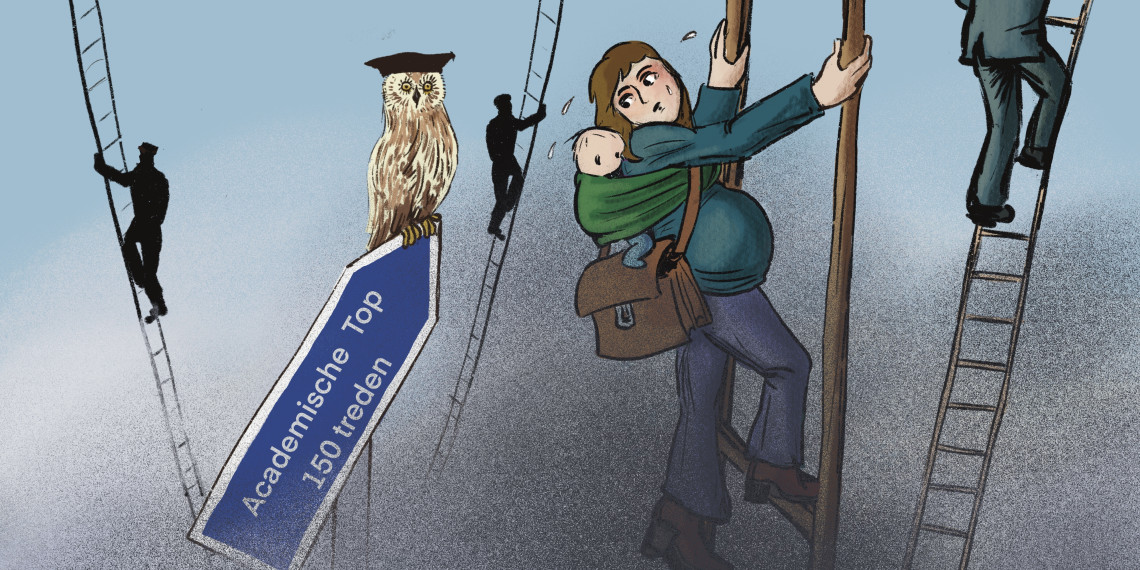
THe Female Scientists
- Gréanne Leeftink, Associate Professor at the BMS faculty, three children aged 4, 5 and 7.
- Saskia Lindhoud, Adjunct Professor at the Faculty of S&T, two children aged 14 and 11.
- Jiska Jonas, Assistant Professor at the BMS faculty, two children aged 3 and 5.
- Rianne de Heide, Associate Professor at the EECMS faculty, son of 2 years old.
- Maaike Endedijk, Professor at the BMS faculty, two children aged 7 and 14.
- Lynn Vosman, PhD at the ET faculty, on maternity leave of her second son.
- Hanneke Kip, Assistant Professor at the BMS faculty, two children aged 1 and 3.
What is it like for you, combining parenthood and wanting to make a career in science?
Lindhoud: 'Now that my children are now 14 and 11 years old, it is much easier to combine care tasks with my work. When I'm abroad for a conference, I call them: are you helping dad out properly? But when they were little, I found it very tough. My eldest was born in England, after which we moved back to the Netherlands. I then started as a postdoc at the UT and had my own Veni-funded research. As a young working mother, I often felt guilty towards my child. After all, you have changed yourself when you become a mother and I had little support from my then new working environment.'
De Heide: 'A lot has improved for me since I have an appointment at the UT and live in Zwolle. I have a safety net there and that makes a huge difference. When I was still working in Amsterdam, it was different. I wanted to set up a new course in statistics right after my maternity leave. Something I had wanted for years. When the space came for that, I returned from my leave even earlier. Actually, that was not possible at all. Setting up a new course turned out to be super tough in combination with a newborn baby.'
'A colleague said; You will definitely go back to work on Wednesdays now that the youngest is going to school?' - Gréanne Leeftink
Leeftink: 'I had three children in three and a half years. I unexpectedly became pregnant at the end of my PhD trajectory. Not planned, but very welcome. But I didn't dare tell it. The due date was a week prior to my PhD defence. In the end, the first ultrasound showed that I had an ectopic pregnancy and that our baby was not viable. I didn't know how to deal with all the emotions. Between all hospital visits, work continued as usual. I didn't tell my supervisors anything at the time. I took two months of holiday leave. I fled, as it were. But during that long period of leave, I did realize: a family is worth more than the academic environment. On my PhD defence date, I was healthily pregnant, twelve weeks. That was very conflicting. I stood there with tears in my eyes. Comments about 'my baby', which meant my dissertation, hit hard. On my first day as an assistant professor, I told my supervisors that I was pregnant, which was received very positively. Eight years later, I can say that the combination of science and motherhood is sometimes intense, but that I am very happy with it. It's a busy life and it's nice that I manage my own agenda. I have the flexibility to be able to deal with situations at home and there is also a good network in my home environment that supports when work requires it. On Wednesdays I have parental leave. Despite the fact that the work does not get any less, it helps me to really focus on home and gives me legitimacy for that. You don't have to call me for questions about work. However, I was recently told by a colleague; Now that the youngest is almost going to school, you will definitely go back to work on Wednesdays?'
Jonas: 'I had my two children during my PhD. That PhD was a collaboration between the UT and Maastricht University, where I mainly worked at the UT. During my PhD, I was able to take leave as usual. As a result, my PhD ended up taking longer with two children, due to maternity and parental leave. During your PhD trajectory, you are very flexible in organizing your hours, I really saw that as an advantage. It also helped that I always received understanding and support from my supervisors. That was very pleasant. I myself have never doubted a career in science because of motherhood. I did consider working at a university of applied sciences for a while, because of the school holidays. But the university just offers me more scientific challenge. I still have parental leave one day a week. Because I’m only available for education on Mondays, Tuesdays and Thursdays, I have had a comment about that. That I wasn’t flexible. Unfortunately, in our case there is no possibility of childcare on Wednesdays and Fridays, so I am forced to work from home.'
'My PhD contract could not be renewed when I got pregnant again' - Lynn Vosman
Vosman: 'I am on maternity leave for my second son. He was born on December 31. Fortunately, it is going very well. Unfortunately, because I gave birth towards the end of my PhD contract – my contract ended on 31 January – my leave was not fully compensated. I have to work towards the end of my PhD at a rapid pace. Fortunately, my supervisors think along with me: I can continue in a postdoc trajectory. This all still has to be arranged, but I trust that this will work out. What I like about working in science is that you are flexible. If there is something wrong with my children, I can work around it. Of course, that means that you have to open the laptop again in the evening or on weekends. It's sometimes a challenge, but because I really like what I do, it works.'
Endedijk: 'When I had my daughter fourteen years ago, I was already an assistant professor. Having a child during your PhD was not recommended at the time. My supervisor responded enthusiastically, but taking parental leave was not possible. It was only when I got a new manager that I was able to do that. My daughter was a little older at the time. Having a second child was not a given for me. I confided in the secretary because I had to go to the fertility clinic regularly and that cannot be planned flexibly. I was also in my tenure track appointment at the time. It meant that I had to appear before the tenure track committee, while my hormones were all over the place. Being or becoming a mother is more than just being out of the work process because of childbirth. It has a lot of impact and takes a lot of energy and that is not always visible. Even later, when your children are in secondary school, they still need care. If I’m helping out with homework, I can't work on a research proposal.'
Kip: 'It’s a bit double for me. On the one hand, I want to work because I need space for myself and I like my work. On the other hand, I also really enjoy being with my children. That combination often goes well, but sometimes it just doesn’t sit right. I have a good safety net around me and fortunately there is a lot of flexibility. A friend of mine is a doctor. Patients are waiting for her. She can’t just switch things around. Although the flexibility is nice, the expectations of academics are extremely high. You kind of have to do it all; go abroad, write papers, attend conferences. And that doesn't always go hand in hand with a baby.'


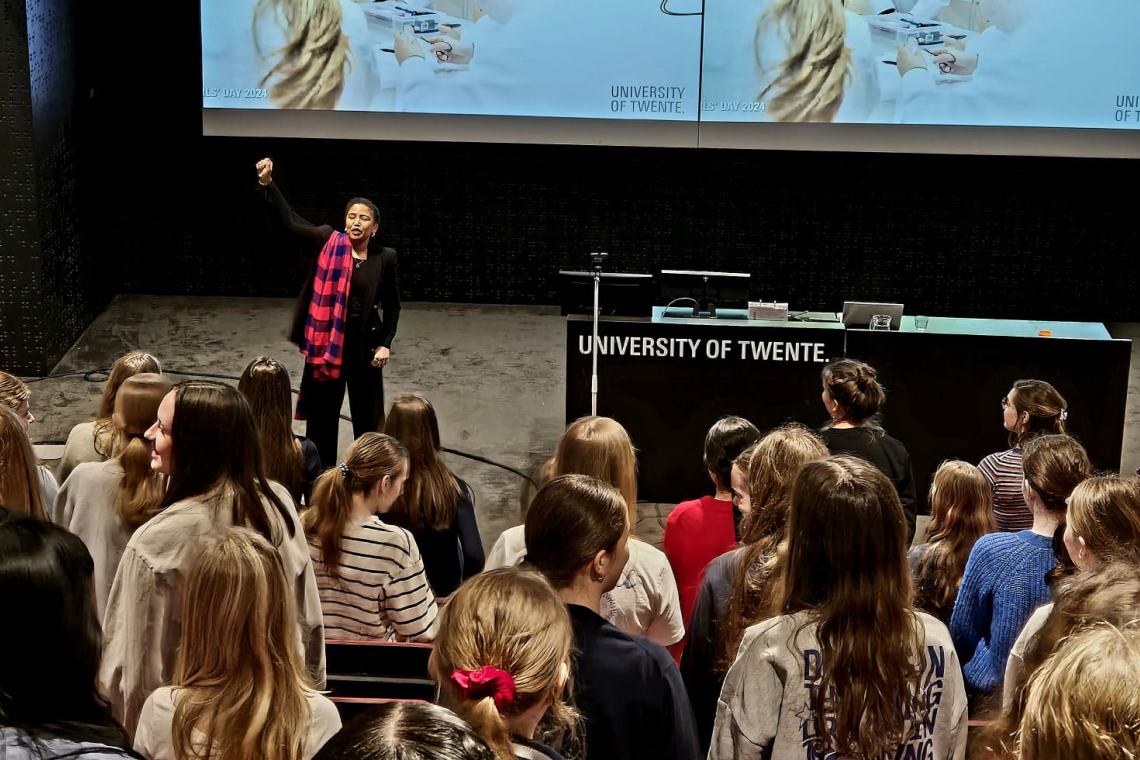
Saskia Lindhoud, Maaike Endedijk, Gréanne Leeftink.
What barriers did – or do – you run into?
Lindhoud: 'I started working less after the birth of my first child. My husband and I had the idea to both work 32 hours so that we could divide the care for the children fairly. But that didn't work out in practice. In the end, he could only be home on Wednesday afternoon. I sometimes had the feeling that I had to solve it on my own. At the time, I didn't have a permanent appointment at the UT. I was working on my own research. I could have gotten a lot more out of that if I had been able to spend more time on it.'
De Heide: 'I still have parental leave one day a week and I really like it. But sometimes this is looked at strangely: a career in science would not be possible part-time. So you really have to deal with prejudice. Well, that's fine. It makes me a happier person. And yes, I also have the wish for a second child.'

Leeftink: 'I know several women who choose to not take parental leave or decide to bottle-feed their child, for the simple reason that combining it with an academic career is nearly impossible. Much can be improved, for example everything around pumping. Yes, those facilities are there, but often I was just in a dark broom closet. The milk then went into the fridge of our department. Something that was quite difficult for a number of male PhDs from other cultures. I have also pumped in the wheelchair-accessible toilet, but then a cleaning lady knocked on the door, saying that she had to come inside. I also once got the comment from someone who said: 'I know you have to pump, but then you can join the online meeting, right'? Or that time we were on our way to a business meeting and a colleague said I could pump in the back seat to save time.'
'My career is not going as fast as that of colleagues without children' - Jiska Jonas
Jonas: 'My career is progressing slower than that of colleagues without children. Promotion is all about scientific output, while education often takes precedence, because there is always a deadline. I work as much as I can in addition to motherhood, but the reward takes longer, because the scientific output takes longer. You see colleagues without children taking quick steps and that sometimes frustrates.
My parental leave will expire soon. I don't want to go back to forty hours, because I want to continue to give my children attention. For me, 36 hours would be ideal, although I can't always work on location. My youngest is at home more often and sometimes I will also have to work around the children. I just got a new supervisor and I hope she can think along with me.'
Vosman: 'While my friends and sisters-in-law extend their maternity leave with parental leave or vacation days, this is not an option for me. Of course I can stay at home longer, but every extra day at home with my baby is one day less for my research. Staying in my baby bubble a little longer gives me stress in advance, so I don't do that. But apart from the rules surrounding the end date of my contract, I don't experience any barriers. I get a lot of support from colleagues. I'm also very lucky with my supervisors, who are both women and mothers. There is a very good atmosphere in our department and I feel supported.'
Kip: 'That motherhood is taken into account on paper, but in practice it doesn't always work that way. For example, after the leave of my first child, I experienced too much work pressure, partly because I had to pump and started working part-time, but my amount of tasks did not change. It would help if there was more support for this and that things like pumping time were actually being attended to. With my second child, I was more assertive about that. It is actually quite special that you are expected to continue after the leave as if nothing has changed. While everything has changed. What is also a problem is arranging a replacement if you have parental leave. You are expected to do that yourself. I felt quite guilty about passing on my work to colleagues who already have overcrowded schedules.'


Jiska Jonas, Hanneke Kip, Rianne de Heide. Due to her leave, there is no picture available from Lynn Vosman.
What could the UT do differently to make it better for women?
Lindhoud: 'When I wanted to get pregnant, I was no longer allowed to carry out certain measurements. Now I realize that women who systematically work with dangerous chemicals or biological substances have to put their lab work on hold if they want to get pregnant. A solution may be to arrange a replacement for this. There are institutes in the Netherlands where this type of replacement for pregnancy already exists. Flexible childcare would also help or a childcare system of nannies that the UT can deploy if, for example, your child is sick and you have to give lectures.'
Leeftink: 'The idea behind all existing leave schemes is that your work is replaceable, but in practice that is super complicated. You are often responsible for finding a replacement for, for example, education or supervision of your students. In doing so, you are increasing the workload for colleagues. You approach maternity leave with a heavy heart, but there is no compensation for parental leave or pumping time. I don't have an immediate solution for it either, but it is an undesirable situation that creates extra pressure, both for you as a (future) mother, and for your colleagues. In addition, it remains complicated to include leave and parenthood in evaluations. Think, for example, of a Veni. If you only compete a little later after your PhD because of the extension schemes, you are often told that you are already too experienced to apply for the grant. For example, through the extension schemes I am still eligible this year because I had three children within three and a half years, but at the same time I am no longer eligible because I am already an associate professor. So I can't tick that box anymore, because I've become a mother.'
De Heide: 'At Young Academy Twente, we are going to conduct research into the dropout rate of women. This will be picked up this Spring. Why do we do this? We hear a lot of noises around us that the high workload is leading to problems. For example, people want to take parental leave, but do not dare to do so because they then shift the workload to colleagues. So there are nice schemes such as parental leave, but in practice it does not work very well. Furthermore, I believe that not everyone should excel in every area, that would also reduce pressure. One person may be more interested in education than research, or vice versa. But then we also have to recognize and reward that.'
'A miscarriage? Nothing is regulated in the collective labour agreement’ - Hanneke Kip
Leeftink: 'I am also involved in the research of Young Academy Twente. We think much of the problem is still invisible and we hope to bring that to the surface a bit more. HR, for example, is seeing an increase in the number of people taking leave. But we hear the struggles of female, and sometimes male, colleagues. What we want with this research is not only to bring the problems to the surface, but also to come up with solutions so that we can move forward with them.'
Jonas: 'There could be a little less focus on scientific output. Look more at the steps that researchers are taking and that can also be done in working four days a week. It should be about quality-oriented work.'
Vosman: 'I myself run into specific PhD rules, such as now with the end date of my PhD contract and that no extension is legally possible by then. It is then difficult to get clarity from the HR department about what this means for my situation. I then think: I'm not the only one this happens to, am I? It would have helped me if someone could think along in my interest.'
Endedijk: 'For me, the discussion is broader than just the one about parenthood. Many women regularly have to call in sick because of hormonal complaints, for example due to menstruation, menopause or fertility treatment. If you have called in sick three times in a certain period, even if it is only for one day, our HR system will issue an alert and advise the supervisor to discuss this with you. These kinds of weird interventions make women more likely to be seen in a negative light or come across as weaker. Suppose you can choose to have a male or a female PhD student to go to a conference. If you then see that the female PhD student calls in sick every month, you are more likely to choose the male PhD student. There is still so much to be gained in this area. HR plays a role in this, but we have to do that culture change ourselves. And that applies to both female and male managers.'
Kip: 'It would have helped me enormously if I had been able to have an occasional conversation with my supervisor, both during and after my pregnancy, about 'how are you doing now?' and 'what can I do to help you with that?'. It would be nice if something like this were introduced structurally. I also found out after my miscarriage that nothing is regulated for this in the collective labour agreement. It was quite disappointing physically and mentally and I felt like I had to figure it out. Fortunately, I did get support from my colleagues. But this should also be better arranged top-down, for example by including it in the collective labour agreement. And not that something is just put on paper, but also that it is talked about. That's so important.'

How important is the role and support of a manager?
De Heide: 'I expect to become head of the statistics department in six months' time and what I think is extremely important is being a good role model for others. I want to show that it is not strange to take up all your leave days, to save vacation days or that certain tasks are sometimes simply too heavy when you have become a mother.'
Lindhoud: 'That role is very important, as is having a role model. I still see mainly male supervisors and that makes it less easy to talk. This has not improved due to the reorganisation at Science & Technology, where a relatively large number of women have been affected.'
Leeftink: 'I often hear from PhD students that they are unsure whether they want to continue in academia, because they find it difficult to see how that can be combined with their private lives. I also know several female colleagues who have put aside their desire to have children for an academic career. I find that really sad. I therefore see it as my task to be a role model in this and to offer a listening ear if there is a need for it. Sometimes you really need to stand tall in that respect and you feel like you have to swim against the current. But your family and your health come before work. I am glad that my supervisors see it that way too.'
‘Work is just work, no one will die if that paper is left aside for a while’ - Maaike Endedijk
Endedijk: 'I myself am the supervisor of thirty people. There are many people with young children among them, but other phases also need attention. Colleagues who are a little older get to take care of their parents again. The most important thing is that as a manager you know what is going on in someone's life and that there is room for it. I always say: work is just work, no one will die if that paper is left aside for a while. People also need to know that they are not alone, but that the work is teamwork and shared responsibility. I always try to link a second colleague to a course or project, so that replacement is possible in the event of illness or leave. Team building should be much more on the map.'
Kip: 'I have had a lot of support from direct colleagues and work in a nice team, in which we also help each other a lot. That's very important to me. More structural support and policy from management would have helped even more.'
Which event will always stay with you?
Lindhoud: 'The period when one of my children got teeth. Instead of crying, he sang Bob the Builder all night long. And I had to give a lecture again in the morning.'
Leeftink: 'That time I thought I had another miscarriage at a conference abroad, because I had a bleeding in the early stages of my third pregnancy. It was still early, so I hadn't told anyone yet. I crawled into bed in my hotel room and confided in a colleague and asked to get sanitary pads. Seven months later I had a very healthy daughter, she is really a miracle. I don't remember anything about that conference.'
Endedijk: 'It's not so much an event, but I remember well how I received all kinds of instructions from the UT during the covid crisis to be able to support my people properly. But in the meantime I also had children sitting at home who had to be cared for and who were homeschooled. Professors are also just people with children and private problems. The university comes up with all kinds of things to better support your employees, but who takes care of the supervisor? They also sometimes have to get rid of a 'monster' under a bed, which causes broken nights. The university is not really set up for the fact that there are more and more young women – and men – in senior management positions.'
Reaction of Women's Academic Network Twente (WANT)
'WANT is aware of the challenges that female researchers face when they combine a career with having children. These concerns are regularly raised in our events and conversations, and cover multiple career stages, from PhD students to senior lecturers.
WANT's role in this is complementary: we provide a community where experiences can be shared openly, we help make structural issues visible by connecting individual stories and we bring these signals into dialogue with UT stakeholders – e.g. HR, DE&I or directors – when appropriate.
From our perspective, improvement requires structural and cultural measures, such as: clearer and more transparent career paths, better alignment between career assessment criteria and life-course realities, and leadership's awareness of how policies work differently across career stages and faculties.'
Canan Acar, board member WANT and associate professor
Reaction Human Resources
'HR is aware that combining parenthood and work can be challenging. Not only for women, but also for men and for support staff. We also recognise that regulations on paper do not always work smoothly in practice. The example of the lactation rooms shows this clearly. It is stipulated in the collective labour agreement that universities must provide such facilities. HR initiates the process, the CFM department allocates a room. But if it turns out that such a space is not sufficient, users must feel able to raise the issue. Only then can we improve the situation. We are currently reviewing all lactation rooms. We had already begun that process, but these personal stories play an important role.’
As HR director, several experiences described in this story stand out to me, and I will address them to see how we can better support the balance between parenthood and work. I fully support the words of Professor Maaike Endedijk, who says that work is a shared responsibility and above all a matter of teamwork. This also means that appropriate replacements must be arranged when necessary. HR is always willing to think along, for instance through strategic personnel planning. Managers naturally play an important part as well. Conversations with employees about work-life balance and awareness of what is going on in their team are essential. That is where it begins. But such conversations must be initiated. We see that this is handled better in some teams than in others, but we are always prepared to offer support.’
Hans Oeloff, director Human Resources
What about women in science?
According to the latest count of the National Network of Female Professors, 3 out of 10 professors are women. However, the UT lags behind that national average, with 23.7 percent female professors. The share did grow – previously it was 22.9 percent – but the UT shows 'below-average growth', according to the monitor. The UT's target number is to have 25 percent female professors by 2025. This will have to be seen in the next monitor that will be published in 2026.
Why is it that the share of female professors is lagging behind? When it comes to young scientists, almost as many men as women obtain PhDs. Things often go wrong when promoting from assistant professor to associate professor, which is where the so-called glass ceiling is located. Women find it more difficult to move on, because they are more likely to be disadvantaged compared to men when promoted. This is partly due to selection committees that often consist of men.
But there is more at play; women are also more likely to leave science. The government investigated this in 2022. Broadly speaking, the research results show that factors such as negative work experience, high work pressure, negative work-life balance, insecurity and the degree of overtime and unpaid work are factors why women are more likely to leave academia.
Take the PhD students as an example. Normally, employees accrue nine vacation days during sixteen weeks of maternity leave. But for PhD students, these days are not compensated in contract extensions. Pumping time is also not deducted: mothers are legally entitled to spend 25 percent of their working time pumping — for a maximum of nine months — without loss of pay. For a 40-hour working week, that amounts to ten hours of pumping time per week. PhD students do PhD research within a strictly defined contract, and thus lose research time that is not compensated.
As a young researcher and mother, you have to be very motivated to persevere in science...
(sources: National Network of Women Professors, House of Representatives, U-Today archive, Folia archive)