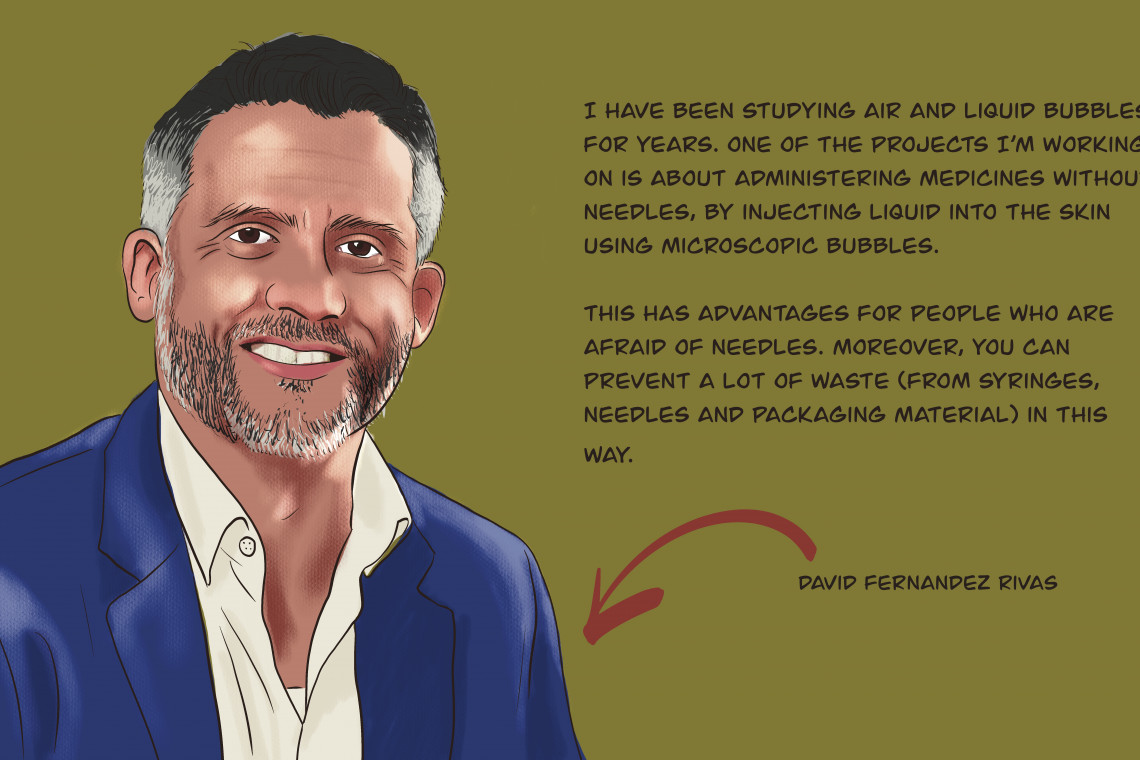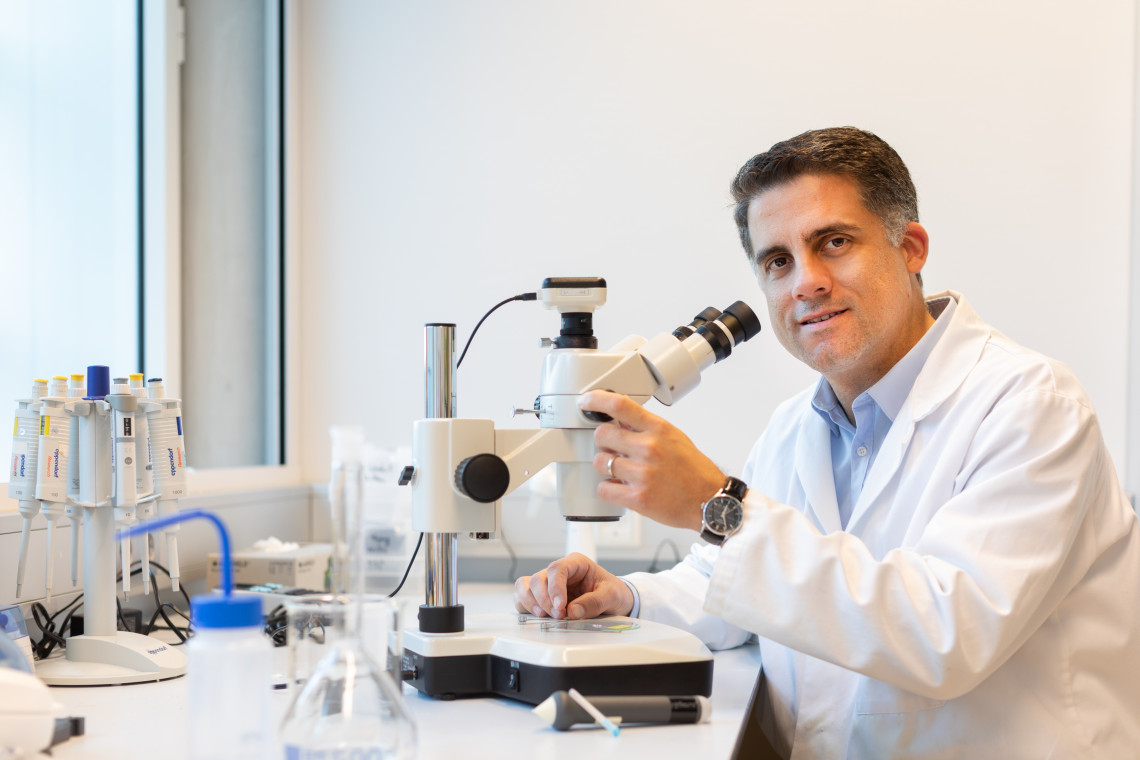


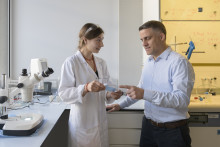
No, it's not the first time his group's work has made it to the renowned Advanced Drug Delivery Reviews. The road leading up to the publication is something that Professor David Fernandez Rivas is so proud of that he wanted to approach the written press at all costs.
Subway shovers
'I am proud', he says, 'of the people who have put their blood, sweat and tears into this publication.' He is referring to former PhD student Diana van der Ven and former postdoc Miguel Quetzeri-Santiago. But above all, first author and PhD student Claudia Muñoz Villaescusa. 'Like me, she is an engineer from Cuba, same university graduate. She is conducting her PhD research here – as a single mother. I see this publication in such a renowned journal as a wonderful reward for her dedication. Moreover, it is special that we as engineers have made it to a pharmaceutical journal.'
Needle-free injection, that's what the research of Fernandez Rivas and his colleagues is all about at the Mesoscale Chemical Systems group (Faculty of S&T). Not with a needle, but with a technology he coined 'Bubble Gun' to penetrate skin. A pain-free way to have a tattoo done for example, but especially useful to insert medication in the places where they are most effective. Needles are not only polluting and sometimes painful, but also damaging to the skin, according to the professor. 'I compare it to the professional shovers at the subway in Japan. A needle is like bulldozing passengers into the train without much respect. The needle-free injection approach of our BuBble Gun basically does the shoving without damaging the skin. You want to get everyone into the carriage in a controlled manner – with a velvet glove, so to speak.'
'The skin is the best possible defence system you can imagine. At the same time, we know very little about the properties' - David Fernandez Rivas
Gelatines and crème fraîche
The publication in Advanced Drug Delivery Reviews focuses mainly on extracting the properties of the skin and eye with the available technology. ‘The skin is fascinating', says Fernandez Rivas. 'It is our largest organ and the best possible defence system you can imagine. At the same time, we know very little about the properties of the skin at the microscale. For example, what is the influence of age on skin characteristics? And how does it differ per season, per body part? How should treatment on the skin on the elbow differ from treatment on the forearm? That is actually still uncharted territory, even for dermatologists who need more quantitative tools.'
For the publication, Fernandez Rivas and his colleagues examined all kinds of different techniques to study materials and their properties, particularly for biomedical applications and drug delivery focused on eye and skin. The methods reviewed range from solid probes, to soft, liquid materials such as gelatines and crème fraiche and harder tissue. One idea the team is developing is using high-speed cameras to record the extent to which the Bubble Gun method hits the mark. 'It is precisely such substances as crème fraîche that are interesting because they are opaque and soft. We can't see through our skin either', says Fernandez Rivas.
'The best available medication routes for many skin diseases are currently still a pill or cream' - David Fernandez Rivas
Personalized care
The publication examines all techniques used in relation to soft biological tissues such as the skin and the eye. This should ultimately pave the way for more research into the skin and the best possible treatments for skin diseases such as psoriasis, eczema or acne. 'The best available medication routes for many skin diseases are currently still a pill or cream', explains Fernandez Rivas. 'That has its disadvantages: in a pill, medication is absorbed by the whole body, and our skin stops most large molecules found in effective drugs. What we want is to treat a specific area with precision and reducing side reaction risks.'
True personalized healthcare, that is what the professor and his colleagues want to work towards: that medication hits the target in exactly the right place, in the right tissue, at the right depth. 'This is a great milestone on the way there. Ultimately, we want to work towards the best possible way to administer medication and knowing accurately the properties of skin and eye are crucial for successful terapies. We are hopeful that our work will open doors to more research funding.'