

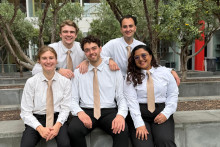
A dedicated association room in the Horst basement is already in place, along with Chamber of Commerce registration, a website, and a five-member part-time board. With plans to establish several committees, the study association is rapidly coming of age, says board member Annusuya Ghimire. ‘There are still a few loose ends to tie up, for instance when it comes to cloud storage and stationery.’
Study association for two master’s programmes
The initiators spent about a year building the new study association from the ground up. Since launching at the start of this academic year, the association has attracted 24 members from the Sustainable Energy Technology programme and Humanitarian Engineering, a new master’s programme that started last year.
Serving two master’s programmes is one of the reasons Sapiens differs from most study associations, according to Ghimire. ‘Study associations generally focus on bachelor’s students, and so do most of their activities. They are often geared towards social events and entertainment. We represent two master’s programmes, so we tailor our activities specifically to the needs of master’s students, for example through events focused on the labour market and career opportunities. We combine these events with fun and social activities.’
Moral compass
What truly sets Sapiens apart, however, is the association’s moral compass. ‘Both programmes we are connected to focus on creating a positive societal impact,’ Ghimire explains. ‘When founding Sapiens, we felt that our ethos should reflect that of the programmes themselves.’
In practice, this means the association carefully scrutinises potential partners for activities such as lunch lectures and company visits, says Ghimire. ‘We put a lot of thought and research into our partnerships. An organisation with a negative societal impact, or a company engaged in greenwashing, is simply a no-go for us.’
‘Drew boundaries’
At present, the association is targeting collaborations with organisations such as HoSt Group, humanitarian aid organisation Kuno and local creative innovation hub Tetem.
Ghimire acknowledges that such ethical choices come with limitations and challenges. ‘Of course, we want to be financially healthy as an association, and that means we need funding. Fortunately, we receive financial support from the faculty, and we try to keep our costs as low as possible while securing sponsorship in kind wherever we can. Yes, we have drawn clear boundaries. But that is a tradeoff we made with full conviction. As long as an organisation is not making a positive contribution to the world, we see no reason to partner up.’