
Intake for teacher training programmes at UT has remained stable for several years. According to programme director Mark Timmer, there are enough students to meet the demand for new teachers in the Twente region. ‘We are well placed to serve the region, because we can easily fill vacancies with teachers we train.’
The teacher shortage in Twente
According to Timmer, Twente is not yet experiencing a major teacher shortage. He says this is partly due to demographic developments in the region.
‘Because the number of births has declined over the past twenty years, there are fewer pupils at schools and therefore fewer vacancies for teachers. If a school here goes from 1,200 to 1,000 pupils, there is no need to replace a teacher who retires. In the Randstad, the teacher shortage is much greater.’
He does expect the shortage to increase again in Twente in the future. ‘The forecast is that Twente will face a teacher shortage in about two or three years. That means we need to attract more students at UT. It is not yet as problematic as in the Randstad, so we do not need to double our intake figures straight away. An additional five students per year on top of our current intake would be nice’, he says.
Intake figures
Students can become teachers at UT in several ways. During their bachelor’s programme, they can take a minor, or after completing their bachelor’s degree they can opt for an educational master’s programme or an educational module. Lateral entry is also an option.
‘Look, every year, including this year, around seventy students enrol. That is spread across all the teacher training programmes we offer. Around fifty of them take a minor or module, while just over twenty students opt for the master’s programme or lateral entry each year.’
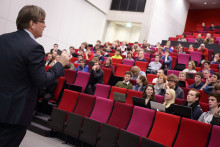
The interview continues below the photo.

The minor and module give students an opportunity to get acquainted with teaching. They qualify students to teach in mainstream secondary education in the lower years of havo/vwo and throughout vmbo. Those who want to continue can take an educational master’s programme to also teach in the upper years. ‘For us, the minor is really a stepping stone and an introduction to teaching’, says Timmer.
‘The mathematics and physics teacher training programmes are particularly large.’ UT also offers programmes for future teachers of chemistry, computer science, technology, and research & design. Around forty of the approximately seventy new students each year choose mathematics or physics. ‘That is actually a good thing, because these subjects also have the greatest need for teachers’, he observes. This can be explained by the fact that these school subjects connect with a large number of UT bachelor’s programmes.
There are also school subjects where the groups are smaller. Computer science is an example, with around ten new students each year. ‘We do not actually need more at the moment, because demand for computer science teachers in the region is currently relatively low. We could train more students at UT for the Randstad, where they are urgently needed, but many students are from this area and do not want to move to the other side of the country.’
Taking action
Because of the nationwide teacher shortage and the social importance of the profession, teacher training has a special position within UT. Unlike other master’s programmes, the programme is therefore allowed to actively approach students from other programmes to encourage them to consider a career in teaching.
‘We are a small programme, but an important one. The Executive Board and the Faculty Board also recognise this’, says Timmer.
The programme has a ‘good reputation’ among UT students and schools in the region. That was not always a given. ‘We noticed that many prospective bachelor’s students thought you could only train to become a teacher at a university of applied sciences, but that is a misconception.’ To reach this group more effectively, the programme has become more visible at open days.
Good education
Bachelor’s programmes actively approach students about the opportunities to become teachers. Timmer, among others, discusses this with other programme directors.
‘They recognise the social importance and think it is important to draw attention to teacher training. Good education in the secondary school subjects for which we train teachers is also important for the students who enrol in their programmes.’
Most students currently following a teacher training programme at UT come from another UT bachelor’s programme. According to Timmer, students who follow the teacher training programme at master’s level often combine it with a technical master’s programme at UT. ‘That way, the other programmes do not lose their students when they choose teacher training.’
Collaboration with schools
UT works with around thirty schools in the region, from Oldenzaal to Deventer and Groenlo. Timmer regularly visits these schools together with the director of Pre-U, where they speak with school boards and management.
‘We discuss, among other things, how we can further improve teacher training, vacancies, the Pre-University programme for encouraging pupils to become enthusiastic about science and technology, professional development for current teachers, and forecasts for the future.’
The collaboration is intended to ensure that the teacher training programmes continue to align closely with what schools need.