


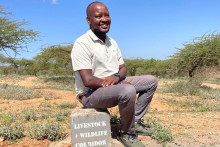
‘As a child, I would run outside early in the morning and see enormous footprints in front of the door,’ Loloju recalls. To him, it shows just how much these animals are a natural part of life in his home region. ‘Then you knew they had been there again, even though you hadn't noticed a thing. As a child, that was incredibly exciting. Elephants are clever. They wait until people are asleep so they can pass through undisturbed.’
Climate change
Kenya traditionally had two rainy seasons each year. In the past, this meant there was plenty of vegetation and water. Loloju explains: ‘But because of climate change, the seasons are no longer clearly defined, and the land is becoming increasingly barren. At the same time, the population is growing. That puts pressure on everything. Our livestock need to eat, but so do the elephants. That leads to conflict.’
And those conflicts can escalate dramatically, Loloju says. Following fatal elephant attacks that claimed eleven lives, eleven elephants were killed indiscriminately in retaliation between 2014 and 2016. ‘That was completely pointless and could have been prevented,’ says Loloju.
Access to satellite maps
That is why Loloju is investigating the increasingly strained relationship between people, their livestock, and elephants in his project Camera-based environmental and livestock monitoring in northern Kenyan rangelands. Through RANGE, a project funded by the Dutch embassy in Kenya, he received a scholarship to come to Enschede and join the ITC faculty.
This gives him access to high-quality satellite maps that allow him to study changes in the landscape. In the field, he uses livestock trackers, camera traps, and tracking collars to analyse how climate change and seasonal rainfall affect the migration routes of livestock and elephants. ‘If you know how livestock and elephants migrate, you can take that into account in land-use planning and prevent problems.’
He uses the data to convince the Kenyan government that migration routes need to be considered in land-use planning. ‘Using camera traps, I was able to prove that around a hundred elephants passed through a particular urban neighbourhood in a single night. That convinced the authorities that they needed to take the elephants migratory corridors into account when expanding the neighbourhood.’
Superstition
At the same time, the data help raise awareness among people in his home region about the importance of the corridors. He considers this particularly important because the community relies heavily on traditional beliefs, while also having a major role to play in nature conservation. This requires cultural understanding, something that is harder to measure from Enschede.
‘There's a lot of superstition here,’ Loloju explains. ‘People believe that certain individuals have ‘the power of the elephant’. They can bless you, but they can also curse you. When we were little boys and wanted to take our livestock somewhere to graze, we would first visit one of these people to have our day blessed. Then you knew an elephant wouldn't harm you that day. You can imagine that these people have considerable power and influence within the community. So we actively try to involve them in protecting the corridors.’
Through the Save the Elephants foundation, he also works with so-called Mama Tembos, or elephant mothers: local women who monitor the corridors and collect data. They use this information to educate the surrounding community, including in schools. One important lesson is that you should never provoke an elephant. ‘Don't throw stones at them to keep them away from your livestock. You might be able to run away, but an enraged elephant can't tell the difference between you and someone in a neighbouring village who is innocently relaxing under a tree.’
Corridors
Elephants travel along corridors covering around two hundred kilometres between the Samburu, Isiolo, and Laikipia regions. According to Loloju, knowledge of these routes is passed down from generation to generation. The corridors vary in width, from as much as a kilometre to just a few dozen metres. Conflicts arise when a community decides to settle within one of these corridors.
He describes how his village helps guide the elephants to some extent. ‘In Oldonyiro, we deliberately keep the main road about thirty metres wide and free of buildings. The elephants run along it at night, as we can see on the camera traps.’ Why elephants sometimes decide to move on remains a great mystery to researchers. ‘Sometimes they suddenly start heading towards a dried-out area, and we can't see why. But you can almost set your watch by it: as soon as they arrive, it starts raining there. They're perfect weather forecasters.’
Balance
Loloju, who is currently in the second year of his PhD, hopes his research will ultimately contribute to greater understanding of the animals and a better balance between people, livestock, and wildlife. ‘If humans defeat elephants through violence, nature will be lost, and we'll only be harming ourselves. If the elephants win, human lives will be lost. But if the community works together to preserve the corridors, we can coexist peacefully despite the challenges.’