

Why is it important for the University of Twente to have its own archives?
‘Our archives document the history of the university. We collect and preserve photographs, audiovisual material, and objects that show how UT has developed over the years. At the university, we often look to the future, but the past is just as important. Photographs and videos show how our buildings, traditions, and customs came about.
‘This helps keep our history alive. We want to further develop our collection of academic heritage, and we are therefore considering setting up a committee to focus on this. At the moment, we accept a lot of material that people offer us. To develop the collection in a more targeted way, we need to decide what to keep and what not to keep.’
How do you decide what should be preserved and what should not?
‘Official documents are subject to legal rules and guidelines. Under the Archives Act, some documents must be destroyed. At the same time, we want to make our collection as accessible as possible and make the material available through the Archives search portal.


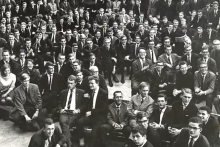
Queen Juliana and Prince Bernhard open THT (1964). Source: UT Archives.
‘When it comes to visual material, we mainly look at its historical value. For objects, we ask ourselves what story they tell. We once found a remarkable chair by Piet Blom that used to stand in the Bastille. Some people still have memories associated with it. Since the chair was not yet part of our collection, we added it. We also preserve a selection of recordings of PhD defences and graduation ceremonies. Perhaps a PhD defence will look very different in twenty years’ time. We also keep material from the COVID-19 pandemic and protests, as it documents important events of our time.’
When did UT start collecting historical material?
‘In the 1990s, the university library began collecting photographs, audiovisual material, and objects. We have been members of the Academic Heritage Foundation for three years now. We were one of the last universities in the Netherlands to join. Membership is important because we have noticed growing interest in UT’s history.’
What can you find in the UT archives?
‘The collection consists of tens of thousands of photographs, two kilometres of paper archives, shelves full of videotapes, old meeting documents from Faculties and the Executive Board, and the personal archives of professors.
‘We also preserve all kinds of unusual objects. For example, there is a pack of rolling tobacco from 1969 and a tea bag bearing the THT logo (Technische Hogeschool Twente, ed.). A pack of tobacco like that is not particularly special or valuable in itself, but it tells us something about the university’s history. In the 1960s, THT sought sponsors for the celebration of its first lustrum. University administrators approached companies such as Grolsch, as well as tobacco manufacturers.
‘The collection also includes old lustrum glasses, posters, and jigsaw puzzles featuring aerial photographs of the campus. Our storage facilities in the Spiegel and the Vrijhof are therefore full of boxes containing historical material.’
Who uses the archives, and why?
‘UT staff and students, as well as researchers and alumni, come to us. For example, former computer science lecturer Herman Koppelman used our archives to find old photographs for his book 60 years of Applied Mathematics in Twente. Alumni also visit because they want to know what the campus used to be like. Researchers from Delft University of Technology have also visited our archives for their research into university campuses in the Netherlands.’
What is the biggest challenge when it comes to preserving UT’s heritage?
‘The biggest challenge is digitising everything. Large numbers of videotapes are still sitting on the shelves. This takes time and money. We also depend on specialised companies and the availability of staff to carry out the digitisation.’


Rolling tobacco from 1969 and a bottle of Bokma Bröggel Bitter, the Drienerlo lustrum drink from 1966. Source: UT Archives.
Which item in the archives do you find particularly special, and why?
‘The pack of rolling tobacco, actually, perhaps partly because it dates from the year I was born. These items have a story of their own. You can bring it out whenever the subject of a smoke-free campus comes up again. We also have several unique items belonging to Rector Magnificus Harry van den Kroonenberg, including his medals.’
Are you ever surprised by what turns up?
‘I’m constantly amazed by what emerges from the depths of UT. Once, someone from the technical services department came to me with ten full photo albums. On another occasion, we tracked down old films made in 1964 that the first female lecturer at UT had kept in her attic. They contain unique footage that we still need to digitise.
‘We also regularly hear from the relatives of former UT staff members who want to donate belongings. For example, we will soon receive an old academic gown belonging to a special professor. We don’t have one in our collection yet. Sometimes we also come across interesting objects on Marktplaats, the Dutch online marketplace. Listings occasionally mention that an item was used at UT. It’s always fun to come across pieces like these.’
Video: Founding of the University of Twente (part 1).