


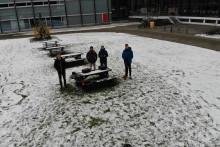
The fact that UT and VU are working together within the alliance on a so-called seed grant to detect landmines was not new, but the addition of excavation is. ‘We do that with a rover, a remotely controlled robotic vehicle.’
The challenge is to make the process as cost-effective as possible. ‘Clearing landmines is relatively expensive, which means it is often not done, or not done enough, with all the consequences that entails. We want to do something about that,’ says Martinetti. He is collaborating with, among others, professor Francesco Nex from ITC, assistant professor Sven Askes from VU, and assistant professor Kostas Nimazis from ET. Together, they supervise a wide range of students from various degree programmes, including Industrial Design Engineering, Mechanical Engineering, Humanitarian Engineering, and Advanced Technology and Robotics. ‘They developed the robotics, software, and prototypes.’
Detecting landmines using a drone equipped with a thermal camera is already working. ‘We fly it over a minefield. Differences in temperature between the ground and the mine allow you to see clearly where they are. But once you know that, you also want to remove them,’ Martinetti explains.
To do this, they are working on a mobile robot with an excavator arm, which is currently being tested at the UT Fieldlab. It needs to be able to carefully expose the landmine so that the explosive ordnance disposal service can safely access it. There is still one small obstacle, however. ‘We initially had a solution in which the arm responded to hand signals from the operator. But because we want to use cheaper technology, there was some delay between the controls and the arm, causing the robot to respond too late. Obviously, you don’t want that when you’re working next to an armed landmine. That’s why we’re now investigating whether we can use a simple Xbox controller instead.’
Martinetti does not know when the technology can be used ‘in real life’. ‘We still need to fine-tune the technology a little. Ideally, we’d have it working tomorrow.’
According to the United Nations Mine Action Service (UNMAS), an average of around 26,000 people worldwide die each year as a result of landmines left behind by past conflicts. Even more people are injured and maimed by them.
Klaar voor de oorlog
Presenter Petra Grijzen explores the role of science in warfare technology.
Date: Tuesday 22 September
Time: 21:45