


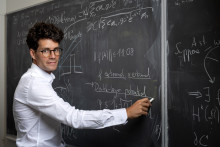
Congratulations! Can you explain what you solved?
‘First of all, you never solve a problem like this on your own. There are always several people working on it, such as Michel Crouzeix himself, who came up with the problem, but my co-author Emiel Lorist from Delft and certainly PhD candidate Jens de Vries also played crucial roles. All these people had already filled in important parts of the puzzle. We only put in the final piece.
In 2007, Michel Crouzeix, a well-known French mathematician, formulated a problem in matrix analysis, a mathematical inequality. That inequality contains a constant, a fixed number. The challenge is to make that constant as low as possible. Crouzeix thought it was probably no greater than two, while initially he himself could not get it below eleven. Crouzeix and his co-author Palencia later managed to bring it down to 2.4, but it could probably go lower still. And so began a search that lasted for years. Our solution now shows that two is indeed possible.’
But... what is it actually good for?
‘That question isn’t so easy to answer. The average person on the street won’t notice much of it. But it is a fundamental solution in the world of mathematics. The steps in reasoning that we went through provide insights that can help solve other problems. And who knows where technological developments will take us in the future, perhaps to a point where this can be applied directly.’
When did you know you were on the right track?
‘Looking back, there were two moments. The first was more or less ten years ago, when we started working on it. I was a postdoc at a conference in San José and was sitting in my hotel room tinkering with formulas when I was actually supposed to be preparing a presentation. I saw how, using a mathematical trick, you could find Crouzeix’s own second solution, 2.4, in a much simpler way. But then you still have to test that trick further, refine it, and optimise it. All kinds of other insights were added along the way. All in all, that took nine years.
The second moment came last July, when my colleague Emiel Lorist showed me some results from ChatGPT Pro that fitted very well with those earlier insights.’
So ChatGPT actually solved it?
‘No, AI complemented our work by pointing towards a path that fitted our initial guesses. In any case, it all starts with Crouzeix’s own brilliance, because right from the start he estimated that this could be the solution. With the idea of ChatGPT, we only put in the final piece of the puzzle.’
Were mathematicians celebrating?
‘Well, it wasn’t entirely unique, because about eight days earlier, a Chinese neurosurgeon in training had also found a conclusive solution using an AI prompt. AI probably built on earlier research in doing so.
Around that time, I was at the IWOTA conference in Canada to give a keynote about all the attempts to crack the problem. That very week, we published our own solution. So I decided to completely change my talk and discuss that instead. It ended up being included in the announcement as well.
That created a somewhat strange atmosphere. Of course, it is great to see such a long-standing problem solved so conclusively, but I sensed that people are very wary of AI. They are afraid they will soon become redundant. But I don’t think things will move that quickly. We will always need brainpower to keep thinking for ourselves.
Still, it does feel a little like the end of an era in which, as a mathematician, you could quietly sit and think about these kinds of problems. I think that’s something we need to have a proper discussion about in the mathematics community.’
And now? A void? Or is the next problem already waiting?
‘There was never going to be a void. It’s not as though I spent the past ten years working on this non-stop, that wouldn’t be healthy. Of course, I’ll just carry on teaching and supervising students. But there is another variant of Crouzeix’s Conjecture that still needs to be solved. AI won’t be able to do that one yet either. It is tempting...’