

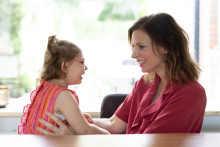
'It's quite a step for me to share this,' says UT employee Silke Wesemann. 'At UT - until now - only my immediate colleagues and HR knew about my daughter's condition. Not because I'm ashamed of Linna, but because I always wanted to protect her. Only now do I know - after the last therapy session in the US - that it is extremely important that there is more awareness about my daughter's condition. It is the only way to raise money for research, so that there is hope for children like Linna in the future.'
Alarm bells
Linna is born on 4 May 2023. Silke is very happy, as she has consciously chosen single motherhood. The pregnancy and delivery go well, even when the girl is born by caesarean section after it turns out that the umbilical cord is twisted around her neck several times. Only a month later, a check-up at the child health clinic shows that Linna's head is growing too slowly.
'I had to come back after the weekend and I remember thinking; That’s odd, how much can a head grow in a weekend?', says Silke. When it turns out that Linna's head has indeed not grown, she is referred to a paediatrician who orders an ultrasound, but initially finds 'nothing special'. The alarm bells go off when a few months later, Linna’s head still hasn’t grown sufficiently.
Small head
After extensive examinations, including genetic blood tests, it appears that the girl suffers from the so-called CASK disorder. This condition is caused by a mutation in the CASK gene on the X chromosome, which plays an important role in the development and functioning of the brain and nervous system. Common symptoms are a small head (microcephaly), epilepsy, hearing and vision problems, severe developmental delays, stimulus processing problems, sleep disorders, feeding problems, and the list does not end there... Worldwide, about five hundred children have been diagnosed. In the Netherlands, there are only seven known cases.
'She can't walk or eat on her own yet'
'My world collapsed,' she says. 'Linna is such a wonderful child, I thought she developed early for her age and thought; This is going to be a bright girl! But due to the mutation in the CASK gene – which affects the development of the cerebellum – her coordination lags very much behind. So she cannot yet walk or eat independently. Talking is not yet possible either.'

It means that Silke takes care of her daughter as a single mother twenty-four seven - with a job at UT. And that makes life quite difficult. She doesn't want to complain, but something like 'time for yourself' has not been on her calendar for the past three years. There has been no time for trips with the girls, her circle of friends has become small, she says.
Fortunately, Linna can go to a regular shelter, although she also needs extra care there. 'All the children and the management there accept her, and that’s wonderful.' After the summer, she will receive additional, more specialised care at Het Roessingh rehabilitation centre, where more intensive therapy is also possible.
Single parent
'Linna sleeps in bed with me and then clings to me. Sleep disorders are part of the condition, but the lack of sleep takes a toll on me as a single parent. That's why I go to bed with her at half past seven in the evening. Otherwise, it is not sustainable.' Silke emphasises: 'It's not Linna who makes it tough, it's the extra hassle around it. The worrying, making all the applications and care administration. It’s the situation that is tough; my daughter is fantastic.' Fortunately, Silke gets a lot of support from her parents, who regularly help out. 'I am beyond grateful to them.'
'The flow of money for research must not dry up'
At some point, the UT employee comes across therapy in the US, specifically aimed at children with CASK. Because the treatment costs almost 30 thousand dollars and is not reimbursed, she starts looking for ways to raise the amount. 'Childcare Babbeloes in Enschede heard about this and took action. They asked me to create a crowdfunding link, which they shared with parents. They also organised a sponsor run with all the children of the shelter. I didn't want to do that with our names at the time, because I was afraid that other parents would look at my child differently,' says Silke. But all help was welcome, and in the end around 12,000 euros were raised, which covered part of the costs of the therapy. Family, friends, acquaintances, and people close to her also contributed. 'That helped enormously.'
Through the therapy in the United States, she meets parents of children with the same condition online. 'One of the mothers set up a foundation to raise money for research. Important genetic research is currently taking place, which is already being tested on mice. It is crucial that the flow of money for this kind of research does not dry up, otherwise there will never be hope for a better future for these children.'

Little is known about the life expectancy for children with CASK. According to Silke – who now calls herself an 'expert' in this field – there are women in their forties who have the condition. 'But prognoses vary greatly from person to person. Fortunately, Linna has not yet developed epilepsy, because this could lead to many complications.' Because boys only have one x chromosome, they often do not live very long with this syndrome.
America
Silke sees the mother she met in America as an example. 'We must do more to generate attention for our children. Hence my decision to go public. It's the only way to make an impact.' And yes, of course she hopes that her story will be picked up, perhaps by researchers at UT. 'It is important that people realise how important research into CASK is.'
'For other children, such steps may be self-evident'
Her UT colleagues understand the situation, but she also knows that 'people haven’t the faintest idea' what her daily life looks like. 'My house is full of practice material. Every spare minute I have, I try to practice with Linna so that her coordination improves. Since our trip to America, I have regained some fighting spirit: I see what we can achieve now. She took her first steps on the grass in England, in front of my parents; it was a moment of intense happiness. I was so proud of her. For many other children, such steps may be self-evident, but for Linna they are absolutely not. These are real bright spots for us.'
CASK and Linna
Want to know more about the CASK condition? https://www.projectcask.org/about-cask
Silke continues to follow intensive therapy with her daughter, and leaves for England in November. If you want to contribute, you can do so here: https://supp.to/intensieve-therapie-in-amerika/donate