

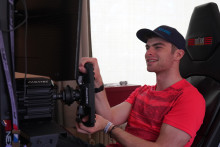
We meet Wragg at his home in an ordinary residential neighbourhood in Enschede. The small living room is dominated by a racing simulator and a whole collection of musical instruments.
How did you get into racing?
‘When I was 12, my family went to a fairground where there was a karting track. I was immediately hooked and did quite well. The staff there told me I had talent. From that moment on, I wanted little else. I kept nagging and eventually got my first racing simulator.’
You are aware of your fitting surname?
‘Oh, you would not believe how often I hear that.’
What does an average day look like for you?
‘I have three optimised daily schedules that I follow very strictly. My days are packed from around 9 in the morning until midnight. I alternate between physical training, searching for sponsors and handling administrative tasks, managing my social media channels, training in the simulator, and then possibly studying as well. I have a completely different schedule for race days.’
Is it easy to find sponsors?
‘No, that really is a daily struggle. Fortunately, I have had good results so far, but you do need to get yourself noticed. An average racing season costs around 300 thousand euros, so it definitely is not a cheap hobby. As a newcomer in the sport, I do not have the luxury of a wealthy family, unlike many drivers. That is why I want to perform as consistently well as possible.’
So how do you finance it?
‘We work a lot with tech start-ups that see it as a good way to increase their visibility among their target audience. I am coached free of charge by a racing coach in exchange for advertising space on the car. I also work as a racing coach myself for beginner drivers. That is essentially my business case and provides me with a basic income.’
What are you hoping for?
‘A lot of people think that if you get into racing, your automatic goal is Formula 1, but that level of stardom is not really for me. Over the past few years, I have achieved a few podium finishes, and the attention is nice for a while, but I also like the fact that I can still walk outside here without having a whole line of cameras pointed at me. For now, I want to build a solid position in the GT racing world so that I can make a living from it.’
How are you preparing for the race on 13 May?
‘I study race footage of myself and others and spend a lot of time in the simulator. As the race date gets closer, I focus more on physical training and simulator sessions. There is not much more you can do, because weather conditions also play a role and you cannot really practice for that. And because I am basically a one-man band, I do not have the money to reserve track time in advance and do test sessions.’
Speaking of one-man bands, who owns all these instruments in your house?
‘Those are mine as well. Before I became serious about my racing ambitions, I was well on my way to becoming an all-round professional musician, mainly playing piano and double bass. But it increasingly started to feel like an obligation. I still play every day though. Now it helps me relax again.’

How does that connect to racing?
‘As a musician, you learn how to practise in a very focused way. You isolate one specific element that is not quite right yet. By practising that one thing until it works, you improve your overall performance. You can apply the same principle to racing: taking one corner slightly differently, adding a bit more throttle here or easing off there…’
So your studies are really secondary?
‘In a way, yes, but I still learn a lot. It is all about entrepreneurship and sharpening business cases. Especially in the field of marketing, my studies help me enormously. I can apply everything I learn directly to my own racing career. It also makes it easier to talk to sponsors, who are entrepreneurs themselves. It helps that, through the student support fund, I am given the space to develop myself in this area. Otherwise, this would not be possible.’