

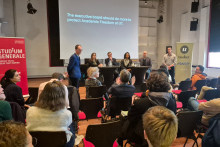
‘Where was the Executive Board’s protection when external parties attacked the academic freedom of several BMS researchers?’ The question came from Professor Barend van der Meulen, addressing an audience of about fifty people. He said he was disappointed by the rector’s earlier response to the statement: ‘The Executive Board should do more to safeguard academic freedom.’
Rules and steering
Rector Tom Veldkamp had explained a little earlier that the Executive Board has only limited influence over developments. ‘We have our responsibilities regarding academic freedom, but there are limits. For example, the way research funding is organised, or the far‑reaching bureaucratisation of the academic world. Funding is highly steered, the number of rules keeps increasing, and our licence to operate has diminished.’
Van der Meulen found that too easy an answer and brought up the case concerning Professor René Torenvlied. When UT received the complaint about his report on the Enschede fireworks disaster, which was later dismissed, should the Executive Board not have immediately and unequivocally defended Torenvlied’s academic freedom, and that of the other researchers, by discarding the complaint outright?
Veldkamp countered by saying that UT did provide Torenvlied with legal support. And that bureaucratisation played a role. ‘Such a complaint must be assessed by an independent committee. This bureaucratic structure was established through national agreements, and at that moment we were bound by it. That is how the system works.’
‘Impact domains feel like a constraint’
The disagreement turned out to be illustrative of the rest of the debate: the audience and other panel members — UT researchers Stefano Stramigioli, Sage Cammers‑Goodwin, and Julia Hermann — actively challenged the rector, who repeatedly felt compelled to clarify that matters were more complex or more nuanced than suggested.
This happened again during the second statement: ‘The four UT impact domains are a self‑chosen limitation on academic freedom'. University Professor Detlef Lohse agreed with that statement. ‘Two or three board members cannot determine the direction of the entire university,’ he said from the audience. ‘That must emerge from the bottom up. Diversity in topics strengthens the university.’ One more remark from the floor: ‘I hear colleagues say that the impact domains feel like a constraint. People worry that their proposals or career paths will be seen as less promising if their research does not align with those domains.’
‘The ideal of universities took centuries to build, but can be dismantled in an instant’ — Professor Stefano Stramigioli
Once again, it was Veldkamp who had to counter and explain. ‘The impact domains are optional, not mandatory. Anyone is free to choose a different direction; we do not penalise that. What we do is provide targeted support for researchers working within these domains, helping them to secure relevant funding. We believe these domains allow us to create societal impact. For that, you need the right infrastructure and critical mass. These choices did not appear out of thin air, but developed over time.’

‘The ideal of universities under pressure’
Many of the discussion points revolved around one question: when is something imposed from the top down, and when does it develop from the bottom up? The latter was seen by those present as a defining factor for academic freedom: being able to make your own choices as a researcher, without pressure from above or outside.
Panel member Stefano Stramigioli delivered several passionate pleas. ‘I am deeply concerned about societal and political developments. The ideal of universities as free communities of scholars and students is under pressure. It took centuries to build that ideal, but it can be broken down in an instant. We are increasingly influenced by political pressure and becoming too hierarchical. We must avoid functioning as an enterprise instead of a community of values.’
‘I even feel that I was almost forced into ethics washing for certain publications’ — Postdoc Sage Cammers‑Goodwin
Illusion
Other panel members, BMS researchers Cammers‑Goodwin and Julia Hermann, also voiced their concerns. Hermann pointed to the decision‑making process behind the reorganisation at ITC, partly driven by strategic themes chosen by the faculty itself. For her, this represented a red flag in terms of academic freedom. Cammers‑Goodwin referred to the final statement of the afternoon, which argued that additional defence‑related funding puts academic freedom under pressure. Young researchers are particularly vulnerable, she explained. ‘As a postdoc, I know how dependent you can be on other people’s funding. I even feel that I was almost forced into ethics washing for certain publications, simply because of this reliance on external funders.’
This brought the afternoon to the central question: does total academic freedom even exist within a landscape shaped by external funding constraints, excessive bureaucracy, and the choices a university makes within that framework? ‘No, total academic freedom is an illusion,’ Hermann said. Followed by Stramigioli: ‘But we must fight until we drop to defend it.’