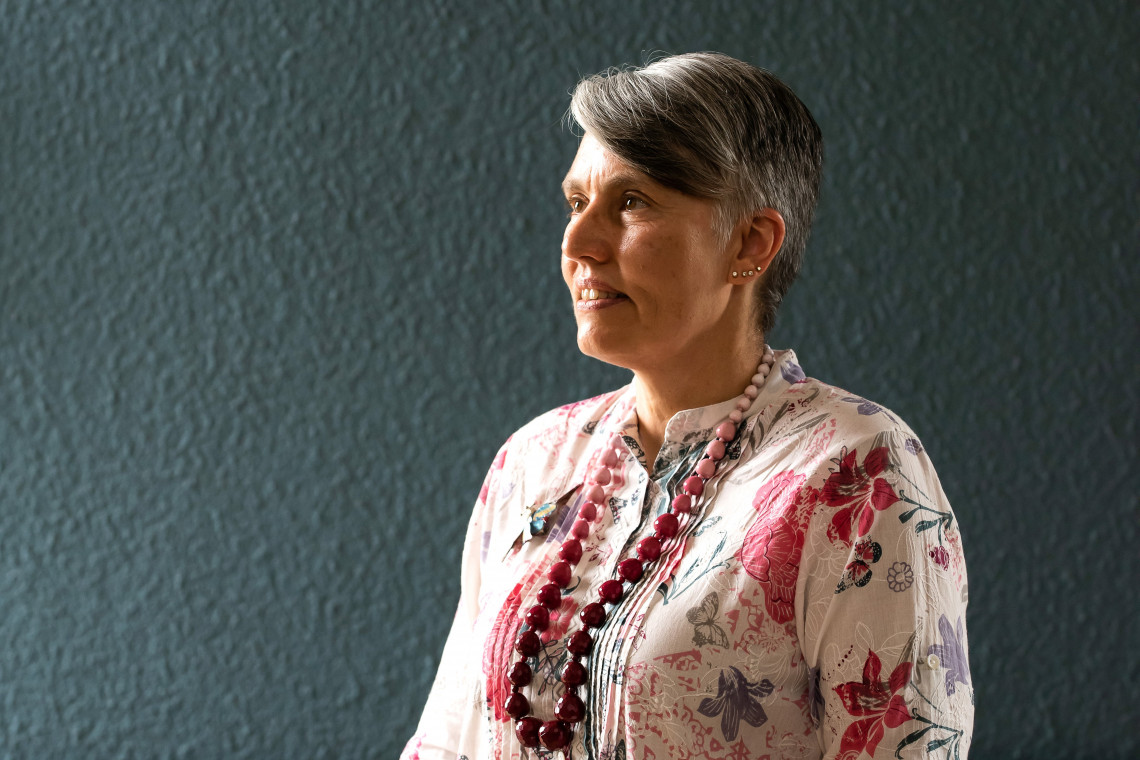


Rocking a bright lemon-patterned pullover while donning a dark shawl against the biting Dutch November cold, Roberts sits in a roaringly undecorated conference room at ITC’s Langezijds building. She bemoans the never-ending pile of emails waiting for her, saying there was a time she marvelled at the possibility of sending them. She’s only here for a couple of days, and then she’s back on a flight to South Africa. And she’s just after flying in from Brazil. Not from the COP30 conference in Belèm, but rather the Local Leaders Forum in Rio de Janeiro, because she likes the more practical approach.
Necessary compromise
Roberts is aware her relentless ‘zooming around the globe’ is rather contradictory to the ideas for which she’s such a frenetic advocate. ‘Yes, it’s a problem, I’m not going to walk away from that. But the constant flying is a necessary compromise.’ She argues that climate change is being discussed in many different places and processes around the world, driving her need for intercontinental travel. She’s one of the few people on the planet who are in a unique position to sit down with both local urban leaders and international scientific institutions , bringing together the often abstract world of science and boots-on-the-ground policy makers. She’s constantly advocating for the inclusion of practitioner voices and real-world knowledge in climate science debates and policy. ‘I’m a sort of a Jiminy Cricket of climate science debates.’
Building bridges
So, what is she here for, exactly? Roberts finds that the Schermerhorn chair’s subtitle (Open Science from a Majority World Perspective) is a bit of a mouthful, and she’s trying to figure out what it actually means. In her own words, she wants to create structured, sustained collaborations between the Global North, of which UT is a proponent, and the Global South, such as the University of KwaZulu Natal. She also wants to give the practitioner community a more prominent voice at the table, so that their interests are taken into consideration as well. It involves promoting open access and sharing information, but more importantly co-development of knowledge. ‘Basically, I want to make it easy for scientists and policy makers of the Global North and Global South to work together.’
She’s also creating a network of what she calls ‘boundary people’, who much like herself stand with either foot in separate worlds and can serve as interdisciplinary translators to facilitate cooperation. She’s trying to sit down with people at the start of the knowledge pipeline. Those are the people who ask the questions, and decide what’s being researched and done.
Pragmatic academic
Roberts explains that she once was a biologist herself, ‘back when dinosaurs roamed the earth’. when South Africa moved towards democracy and the country had to reinvent itself, she too, went through a transformation. Her work initially focussed on nature conservation in fragmented landscapes, such as in cities. But she found the academic world wasn’t really interested in applied sciences back then. And she soon understood that she could not ignore the needs of the people who lived there. ‘In cityscapes, there’s a close intersection of humanity and the natural world. If you want to deal with natural issues, you’ll also have to take people issues into account. And then you’ll have to navigate discussions with politicians and governments.’
‘That science alone wouldn’t carry, that day was a big revelation for me’
That’s when she took up a role into local government of Durban, a city of more than 4 million souls on South Africa’s southeastern coast, to get her ideas woven into policies that made a real change to the city itself, setting up climate change and biodiversity projects. ‘Science alone wouldn’t carry the day. That was a big revelation for me.’
Waffle
She acknowledges that, perhaps contradictory to its own name, in the climate change world there is a lot of talk, without real action. ‘Yes, there’s a lot of waffle. And I hate waffle.’ It is a key factor why she chose not to attend in Belèm, but in Rio instead, where she met people who are action-minded. Similarly, she contends, a lot of energy has been invested in writing thick reports which very few people ever read and without real-life implications. ‘I have a stack of them back home of about half a metre high. I use them as a doorstop.’
First-hand experience
To many people in the relatively uneventful climate of the Netherlands, climate issues seem a world away, and talks of climate action have already begun to lose their novelty and sense of urgency. Roberts has noticed the same trend at the global level too, and she recalls the first years after the Paris Agreement, when there was a shared sense of necessity for change. With current geopolitical developments, however, she thinks it may have lost a bit of its initial momentum. Back home in Durban, however, Roberts has experienced first-hand how her city flooded in 2022, in part because of climate change, including her own house. ‘Believe me, it doesn’t get realer than that.’
‘Arguing with naysayers is a waste of time’
How does she feel about Bill Gates’ recent priority shift from climate action towards hunger relief? To her, these are not separate issues, but rather, they go hand in hand. ‘Of course, in the end it’s his money, so he can do with it as he sees fit.’ Similarly, she points out, the recent absence of the US in all climate discussions is a sad reality. At the same time, many smaller and developing countries don’t have the luxury to wait until the Americans have a change of heart. ‘Our door is open, but we can’t afford to wait for them.’
Roberts mentions the news that the world is about to exceed the critical 1.5 centigrade point of global warming, agreed on in the Paris Agreement. ‘The moment you cross that threshold, you begin to see a greater level of extreme events, more impacts in ecosystems and so on.’ She points to floods in Spain and the south of the Netherlands as recent local examples. ‘We now must begin to envisage what a suboptimal second best future will look like, and a third, a fourth best, and so on.’
Which is why she has no time for naysayers. ‘Arguing with that segment of society is useless. They’ll simply double down on their claims, and bury their heads in the sand even further. It will catch up with them eventually.’
Looking ahead
Will she still be at the climate forefront in ten years’ time? She gives off a resolved look. ‘I’ll be retired by then and won’t look back. Then, it’s up to the next generation. I don’t think I’ll have a difficult time entertaining myself. At the moment I can’t even sit down and watch a film. So, I’m really looking forward to finally getting round to all sorts of unfinished handicraft projects I still have lying around the house.’
Until that day, she has quite some more zooming to do.