

four interviews
During UT’s 65th Dies Natalis on Friday 27 November, the university will award four honorary doctorates. The U-Today editorial team has interviewed all four recipients and will be publishing the stories over the coming weeks. This fourth and final interview is with 'Mister ASML' Martin van den Brink.
‘A journalist? These days anyone can write, can’t they, with the help of AI? I always tell people to learn a trade. Do something that sets you apart. You can always write later.’
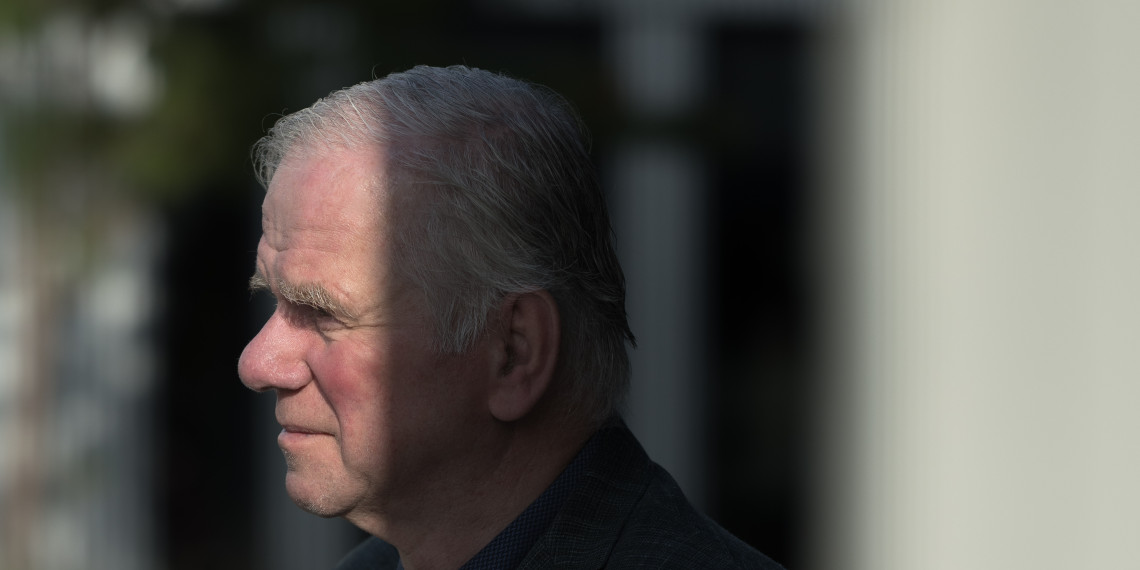
The tone is set immediately. Sitting in a meeting room on the twentieth floor of ‘Building 8’, better known as the ASML Global HQ, Martin van den Brink looks out over a sprawling landscape of chipmaking equipment, cleanrooms, and technical complexity. ASML now employs more than 43,000 people, carries a market value exceeding €600 billion, occupies a dominant position in the semiconductor industry, and has become a key player in geopolitical tensions. Forty-two years ago, when Van den Brink left the UT campus for his first job, this was little more than farmland.
Changing in the back seat
Van den Brink says his connection to UT is not especially strong. Still, he quickly brings up Fred Bijkerk, emeritus professor and founder of the XUV optics group now led by honorary doctorate promoter Marcelo Ackermann. ‘Fred was one of the first researchers to publish on EUV in 1989, back when he was still at the FOM Institute for Plasma Physics Rijnhuizen. He went against the grain by setting up a lab in Twente. The group’s work remained relevant and influential for industry for decades. It still is. That’s remarkable.’
'I understand universities like to broaden their scope. But you can do that without losing sight of your engineering roots'
At the time of the interview, his most recent visit to UT was for study association Arago. ‘A memorable day, though I honestly can’t remember how long ago it was. I’d just come back from an international trip and was already running late. Normally I would have showered and changed at home. Instead, I got changed in the back seat of a taxi on my way to Twente. Not exactly my habit, and giving talks isn’t either. But the people at Arago had put so much effort into it. I just couldn’t say no.’
An engineer through and through
When UT rector Tom Veldkamp informed him about the honorary doctorate, Van den Brink responded with a lengthy letter. Alongside his gratitude, there was also some frustration. ‘I looked at the list of previous recipients and found very few engineers among them.’ That bothered him. ‘I understand universities like to showcase science and broaden their scope. These days you can study economics or psychology practically anywhere. But you can do that without losing sight of your engineering roots. As the first alumnus, and one of the few engineers to receive a UT honorary doctorate, I’m pleased the university is awarding me this title. Not so much for myself, because my trophy cabinet is already full. I’m pleased for the engineering community.’

Van den Brink is, by his own account, an engineer at heart. His father died when he was young. ‘So I became the technician at home. I fixed everything and wasn’t afraid to try anything.’ He recalls dismantling and reassembling a pendulum clock ‘with a wound spring, so parts went flying across the room’, renovating an unstable chimney, and learning to work with wood and metal at a local wheelwright’s workshop. ‘Completely irresponsible for a small boy... I’ve always been an engineer. Maybe that’s why my letter to the rector struck that tone. Consider it a plea to give engineers more space.’
Higher education was not a given for Van den Brink. Struggling with severe dyslexia, he began at a lower technical school studying electrical engineering. After progressing through intermediate and higher technical education, also in electrical engineering, he arrived at what was then the ‘Technische Hogeschool Twente’ as a 22-year-old student. ‘I’d already done an internship in Delft. I didn’t like it, too busy for my taste. Looking for peace and quiet, I managed to get myself a room on Witbreuksweg.’ He focused primarily on applied physics, finding electrical engineering ‘too narrow’. ‘The only association I was ever really involved with was basketball club Arriba. I’m still carrying a souvenir from that, a knee injury that I always have to watch out for when I go skiing.’
The role of luck
After completing a graduation project on district heating, Van den Brink applied for a job at Philips. The application went nowhere, until Philips director Wim Troost pulled a brochure from a drawer about a lithography machine, the PAS 2000 wafer stepper, being developed by a yet-to-be-born company called ASML.
It immediately caught Van den Brink’s attention. In March 1984, a month before ASML was officially founded, he became one of fifty employees who transferred from Philips. In its early years, the chip-machine maker repeatedly hovered on the brink of collapse. Colleagues told him he had made the wrong decision.
Later, former colleague and CEO Peter Wennink described ASML’s success as follows: ‘Philips treated us like the dog in the kennel at the back of the garden that occasionally wanted another bone.’ It was, he said, ‘pure and simple luck. Poverty and neglect.’
'The plane was completely full because apparently everyone feared a new world war'
Luck is a recurring theme throughout the interview. Unlike Philips and many of the semiconductor industry’s larger players, ASML often chose, partly out of necessity, not to do everything itself. Instead, it forged close relationships with suppliers such as the German optics manufacturer Zeiss and ambitious customers such as the now-giant Taiwanese chipmaker TSMC.
Many breakthroughs depended on circumstances falling into place. Van den Brink himself led the PAS 5500 project, a system that laid the foundation for ASML’s future success. In January 1991, ASML was due to give a live presentation to IBM. With the Gulf War approaching, the American delegation cancelled its flight to Veldhoven. Van den Brink was determined not to let months of work go to waste. ‘It was a modular machine that we could assemble in two hours. Since we couldn’t demonstrate it live, we recorded a video on Monday instead. Then we flew to the US. The plane was completely full because apparently everyone feared a new world war. We had no idea. We weren’t thinking about the war at all.’
The video convinced IBM, giving ASML a foothold with a major customer. There were many more make-or-break moments. A demonstration of immersion lithography to Toshiba opened the Japanese market. Years later, ASML prevailed in a major lawsuit brought by Nikon.
The now-celebrated EUV technology also came close to failure. For more than two decades, ASML worked on extreme ultraviolet lithography while technical problems mounted. At one stage, Van den Brink chaired daily crisis meetings involving dozens of people in both the Netherlands and San Diego. First the light source lacked sufficient power. Later, mirrors inside the machines became contaminated. The breakthrough came from an accidental discovery: adding a small amount of oxygen to hydrogen kept the mirrors clean for longer. Large orders soon followed.
Common sense

By then, Van den Brink had already spent nearly twenty-five years as ASML’s Chief Technology Officer. Together with CEO Peter Wennink, he formed the company’s leadership duo. Accounts of ASML almost invariably describe his intense and uncompromising character. ‘Martin scares the life out of you,’ Wennink joked in the book Focus. Van den Brink says: ‘You know, I much preferred doing this interview in person. I hate video calls. I try to read how someone responds. I’m very sensitive to that. When I put people under pressure, it was never about pushing them over the edge. It was about helping them take the next step.’
Still, there were people for whom the pressure became too much. ‘I certainly regret that one project manager ended up on sick leave with burnout. Alongside ambition, the atmosphere has to remain enjoyable too. That’s something I learned over the years. Yet with almost everyone I clashed with, there was never any lasting damage. And I can ask myself: if I had done things differently, would we still have achieved what we set out to achieve?’
Alongside his drive, says Maarten Bonnema, professor of Systems Engineering and Van den Brink’s honorary doctorate promoter, is a rare talent. ‘[Van den Brink] is someone who understands both the crucial details and the bigger picture.’ Van den Brink believes a lack of systems thinking is one of society’s greatest weaknesses. ‘Take the energy transition. The way we approach it is completely misguided. Energy is just like water. Three hundred years ago we already understood the basics: how much you have, how much you can move, and how much you can store. Electricity is no different. Yet all we talk about is generation of electricity, not the rest. As a result, the entire system is becoming clogged up because nobody understands the system as a whole. Nobody thinks like an engineer. And it’s not complicated. It’s simply common sense.’
'Is this some Rome that I built? Not at all. In fact, that idea makes me uncomfortable'
That Van den Brink remains an engineer to the core is clear from an anecdote he tells in passing. Shortly before retiring, he wanted to replace the pedals on his mountain bike on the same day he was due to fly to meet a customer. He became frustrated after overlooking one of the two physical effects that determine whether a pedal should be loosened clockwise or counterclockwise. After lengthy reasoning, he phoned no fewer than forty senior scientists, only one of whom could explain the mechanics correctly. That experience, he jokes, convinced him he could probably accept an honorary doctorate in mechatronics from Eindhoven University of Technology after all.
Solving the puzzle
Van den Brink and his long-time colleague Peter Wennink retired simultaneously in 2024. Yet he can still be found at ASML’s headquarters several times a week. Looking out over what might be considered his kingdom, what does he feel? ‘The trophy cabinet has almost become an annoyance. My greatest satisfaction is that I’ve been part of a success story for forty years and helped customers move forward with our technology. Perhaps I’m even more proud that my successors largely come from within the organisation, from people I helped train myself. But is this some Rome that I built? Not at all. In fact, that idea makes me uncomfortable. Twenty thousand people work here, and plenty of them are smarter than I am. Sometimes you just have to be in the right place and not mess it up. That’s what I did.’
Finally, what advice would he offer today’s students, particularly as UT is investing more heavily in talent for the chip sector through the Beethoven programme? ‘I’d like engineers to have more confidence in how important they are to society, even if society seems increasingly unaware of that. I hope craftsmanship and technical expertise will be valued more highly than they have been in the past. I’d advise everyone to have a plan that matches their ambitions and abilities, without setting everything in stone. The ability to dive into detail when necessary while still understanding how that detail contributes to the bigger picture is becoming an increasingly important skill. Above all, keep thinking about how you will make a difference in the future. And keep solving that puzzle for yourself, again and again.’