

As chief of airworthiness, the alumnus is now responsible for the certification that will allow the PAL-V, or Personal Air and Land Vehicle, to take to the skies. ‘We are now turning those science fiction ideas about flying cars into reality,’ he says. Van den Hoorn, who studied mechanical engineering at UT, has now worked for the company in Raamsdonksveer for a decade. Over the past two years, he has focused on certifying the innovative vehicle, which can travel both on roads and through the air. ‘We are unique and a pioneer in what we do. That is why we do not call it a flying car, but 'FlyDrive mobility'.’
From hardcore design to airworthiness
Van den Hoorn joined PAL-V as a design engineer in 2016. ‘After completing my bachelor’s and master’s degrees, I wanted to work as a mechanical engineer or product developer, developing something for consumers.’ He was not specifically thinking about aviation. ‘The company was still in its infancy when I started. At the beginning of my career, I was heavily involved in design. I worked on the technical development of systems, for example.’
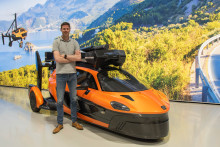
 UT alumnus Henk-Jan van den Hoorn.
The PAL-V concept eventually grew into a product, and the company continued to develop. It now employs around 200 people.
Van den Hoorn’s role also changed. For the past two years, he has no longer been a design engineer, but chief of airworthiness. ‘That means I have overall responsibility for the entire certification programme and lead a team of ten experts.’ Together with his team, Van den Hoorn ensures that all airworthiness and legal vehicle requirements are met. ‘We coordinate the necessary verifications, testing, and certification activities, and provide the evidence needed to allow the vehicle to fly and drive in Europe. I am also the point of contact for the aviation authorities.’
Two in one
At first glance, the PAL-V looks like a combination of a sports car and a helicopter. Yet the vehicle works differently than you might expect. The PAL-V is a so-called gyrocopter. This means that the vehicle has a pusher propeller and flies by building up forward speed, causing the rotor blades to turn. This keeps the vehicle stable in the air. ‘You are essentially hanging in the air like a balloon,’ Van den Hoorn explains. As a result, he says, it is less demanding to control than a helicopter.


On the road, the PAL-V behaves like a three-wheeled car, with an accelerator, brake, and gearbox. Anyone who wants to drive again after flying can transform the vehicle in five minutes, using just a few steps. However, we should not expect everyone to be taking to the skies. ‘We mainly focus on professional services. Think of the police, fire brigade, and surveillance services. Or, for example, when a donor organ needs to be transported to a hospital quickly.’ On the road, the PAL-V reaches a maximum speed of 160 kilometres per hour. In the air, the vehicle can fly 500 kilometres.
On the way to the first flight
The company is now in the product certification phase. Van den Hoorn has an important role to play in this. ‘Compared with similar companies, we are years ahead. I expect us to enter production within a few years and that we will soon see the PAL-V driving and flying in the Netherlands. That includes private use.’
Anyone dreaming of owning a PAL-V will need to dig deep into their pockets. The purchase price is around €500,000. ‘You can compare it with an expensive sports car.’
UT as a foundation
Ten years after Van den Hoorn started as a design engineer at PAL-V, he is still the only UT alumnus at the company. He hopes more UT students and alumni will find their way to PAL-V. ‘It would be nice if I can be a source of inspiration and more people from UT come this way, so that I am no longer the only alumnus here.’
UT provided him with an important foundation for his career. ‘Especially when I first started here, I made a lot of use of the knowledge I had gained at university. In my role as an engineer, I was heavily involved in product development. That had a lot of overlap with my studies. The technical knowledge I gained at UT has been valuable.’
There is one thing he still benefits from every day thanks to his student days: he learned how to work together on campus. ‘I studied in Twente for seven years, and during that time I worked extensively with fellow students on projects. The lessons I learned through collaboration are still reflected in my job every day. We celebrate milestones together here, just as we did at UT. It is a great feeling when you work towards a goal together as a team. In our case: a vehicle that can both fly and drive.’
 Image: PAL-V