

Why did you decide to write this book?
Beldad: ‘It boiled down to the question: what do we want to leave behind? With ATLAS being phased out, we discussed what the legacy of the programme would be. We hope that through this book, the essence of the innovative programme will endure even after it ceases to exist.’
What is the book about?
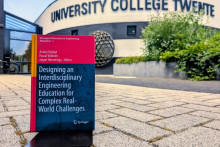
‘The book is titled Designing an Interdisciplinary Engineering Education for Complex Real-World Challenges and is published by Springer. It’s mostly fit for educational designers and developers. As editors of the book, we focused on how such a programme is designed. The three of us have been part of a team of academics who set up the ATLAS programme in 2012. In this book, we described how the educational programme was organised, while also describing its important features such as interdisciplinarity and self-directed learning. With contributions from ATLAS academics and researchers from other educational institutions, the book discusses the societal value of an interdisciplinary and liberal arts education, while also reflecting on the challenges of implementing an interdisciplinary engineering education.’
Are those things typical for ATLAS, compared to other studies?
‘There are even important differences with other liberal arts programmes, like the ability for students to fully determine their own learning path and choose courses from other educational programmes, either at the UT or at other universities.
In the book, we also look into differences in organising interdisciplinary and liberal arts education by inviting contributions from researchers from other institutions, such as the University of Amsterdam and the Thapar Institute of Engineering & Technology in India.
What are the main takeaways from the book?
‘There is always a certain tension for students when personalising their curricula, such as the need to balance knowledge broadening and deepening when choosing their elective courses.
The book also concentrates on how self-directed learning is implemented throughout the ATLAS programme and what an experience with self-directed learning means for ATLAS graduates. The focus on self-directed learning throughout ATLAS requires careful selection of students entering the programme. While students are at the driver’s seat in the learning process, the role of a mentor is also indispensable, especially since students will certainly require guidance in making curricular choices.’
With ATLAS having been around for only thirteen years, we can’t say the study programme withstood the ‘test of time’, right?
‘That’s true, to some extent. Despite the decision to close the programme, students, teachers, and alumni recognise its value and innovative character. We are also seeing how self-directed learning and interdisciplinary collaboration are being fostered in some study programmes at the UT.’
So this book cements ATLAS’s legacy?
‘Our goal was to document what we experienced and what we did within the programme since it started. We believe the insights in the book can be helpful for educational designers and developers and educators who may be thinking of setting up a liberal arts and science programme with a focus on engineering.’
And within the University of Twente?
‘Who knows… We might see a similar educational concept reappear in the future, so there is this book to learn from. In any case, our alumni are our most important legacy. So the ATLAS spirit will live on through them.’