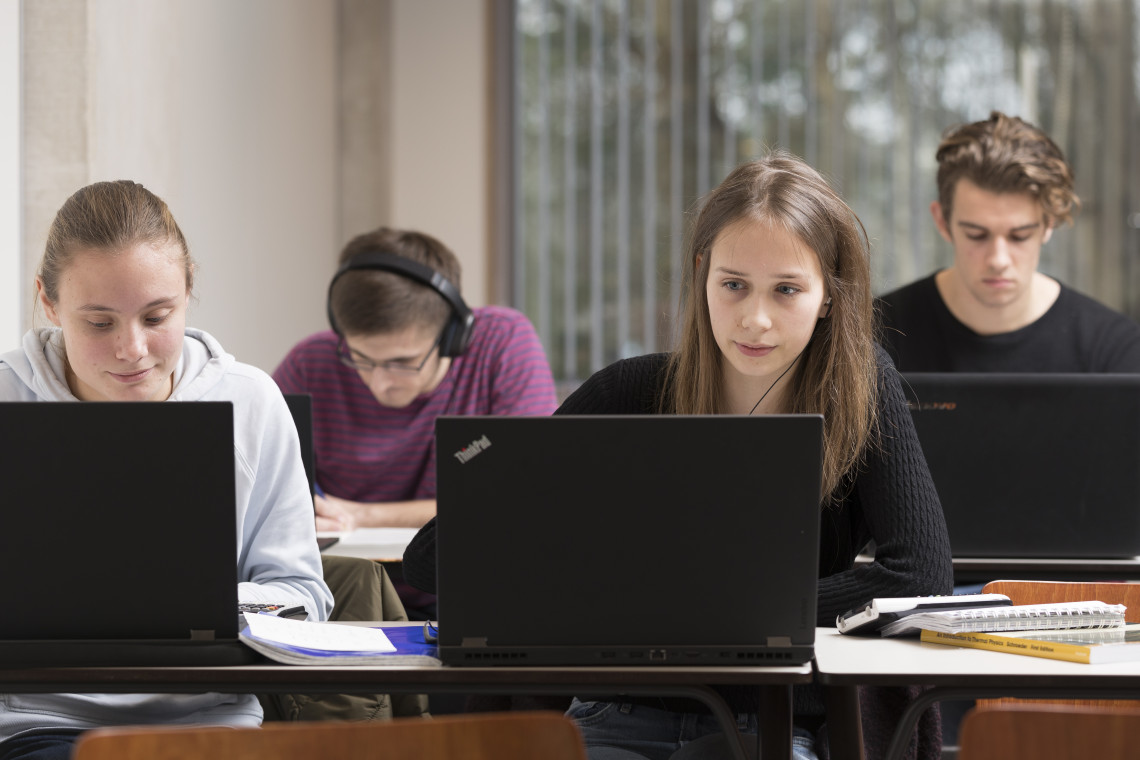


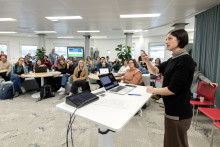
CELT, the Centre for Expertise in Learning & Teaching, organised the session, as it often does. Last week the topic was AI literacy; this time the focus shifted to assessment. According to educational adviser Francesca Frittella, who opened the meeting, it is a pressing issue. ‘Debates about AI within our context very quickly turn to assessment. There is a clear shift underway. Not only is AI use increasingly difficult to detect, it is just as hard to prove.’
The credibility of a diploma
At the same time, the Student Charter is explicit: unauthorised AI use is simply a form of fraud, just like any other prohibited tool. Which is why Frittella urged to create course‑specific AI policies. These should clarify what is and is not allowed, how students can declare their use of AI, and what the consequences are when unauthorised use is suspected. ‘Ultimately we are talking about the value and credibility of our diplomas,’ she said. ‘It is no coincidence that NVAO accreditation panels are asking more and more questions about this.’
That students are making extensive use of AI is a public secret. What became clear during the session is that UT lecturers are not willing to passively accept yet another AI‑generated report landing on their desk. Six of them shared how they have made their teaching more AI‑resilient.
Less writing, more reasoning
Dennis Reidsma (Creative Technology) overhauled one of his courses. Where students used to write a report, they now work with a pre‑prepared PowerPoint template. ‘The setup is so fragmented that I cannot imagine generative AI adding much value. Previously the focus was on writing; now it is on logic and argumentation. The course ends with an oral assessment.’
Gül Özerol, programme director of the master’s in Environmental and Energy Management, took a similar approach. Students once wrote an essay reflecting on the course; now that reflection takes the form of a video, supported by a PowerPoint presentation.
Yudit Namer (Psychology) moved from group presentations to a consensus‑building session, ensuring that each student takes an active role. ‘Perhaps not so much because of AI,’ she admitted, ‘but mainly because going through twenty identical presentations had simply become too boring.’
Digital footprint
Mark Timmer, programme director of the UT’s teacher training programmes, replaced a take‑home assignment with an open‑book test in Remindo, plus a take‑home assignment and an oral discussion afterwards. ‘A helpful side effect is that students pay more attention during lectures, knowing a test is coming. The oral discussions force them to read the literature and understand their own work.’
Dipti Sarmah (Technical Computer Science) and Marcello Gómez Maureira (Creative Technology) took things even further. Gómez Maureira built a plug‑in for Blender, the software in which his students design 3D objects. The plug‑in takes a screenshot every ten seconds, effectively allowing him to look over a student’s shoulder digitally. Sarmah previously required students to submit a final project as a group. Now, in her process‑focused projects, everything revolves around the development process itself. Using GitLab comments, she tracks each student’s digital footprint. She has also scheduled multiple peer review moments and interim evaluations.
Less on the result, more on the process
The session’s takeaway was clear: lecturers are adapting their teaching to the rapid pace of AI developments. What stands out is that the emphasis is shifting away from the final product and towards the learning process. Yet the discussion also left many questions unresolved. What should teachers do when AI use falls into a grey area? How do you confront students about suspected misuse? And how time‑consuming is it to constantly reinvent your assessment methods in an attempt to stay one step ahead of the ‘clever’ student?
Dennis Reidsma captured that never-ending search succinctly: ‘Whichever way you look at it, what you ultimately want is to determine as reliably as possible whether your students truly understand and have mastered the material.’