

In their Nature article, Van der Wiel and his team describe how, by combining chips, they can make image and speech recognition more energy-efficient; not by processing it in the cloud or through complex software, but directly in the material itself.
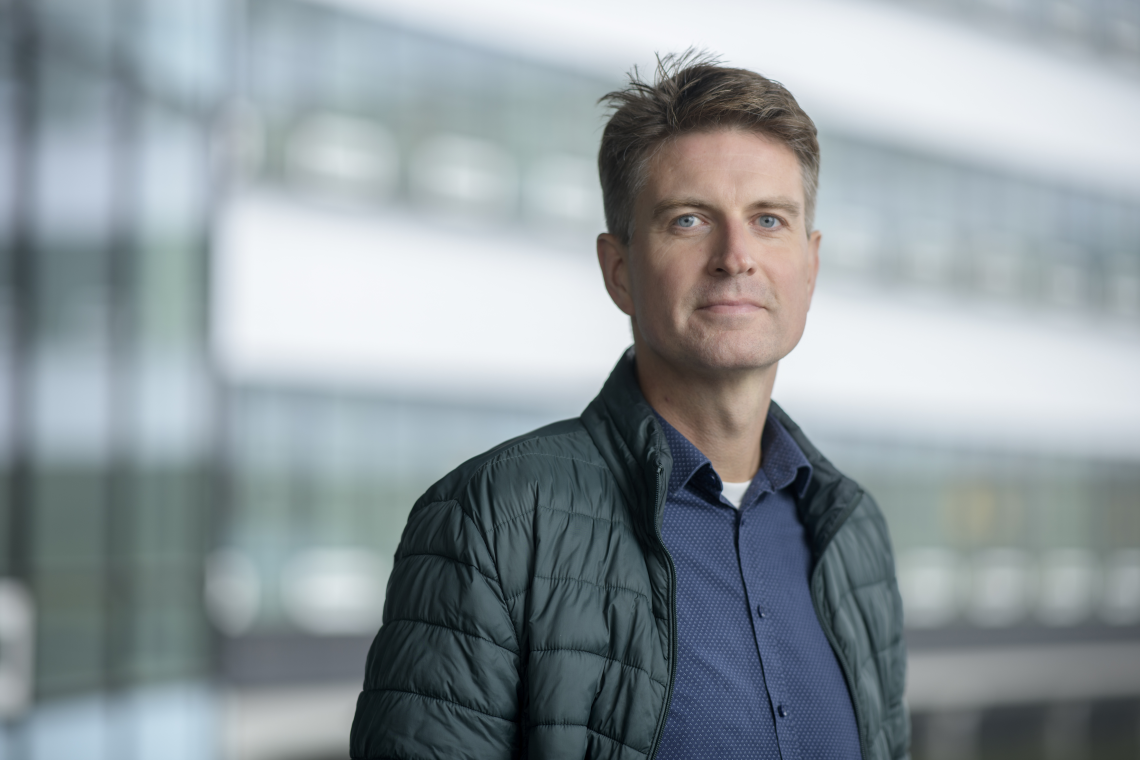
Van der Wiel, professor of nanoelectronics at the Faculty of EEMCS, has just come from an interview with BNR Radio, and de Volkskrant is already waiting pen in hand. In the meantime, he still finds time for U-Today.
Congratulations on the publication. Was it a tough delivery?
‘Well, more a long delivery. We submitted the manuscript in July last year, and it was only this August that we heard it was accepted. But before submission, we had already been working on the research for about three years. So, yes, it required patience.’
What does it take to get something published in Nature?
‘Naturally, a lot of time goes into the manuscript. With Nature, you know exactly what you are aiming for and what the standards are, so you want everything airtight. But once you submit, reviewers go through it and pull out the full toolbox. For example, they wanted us to test our technique on another dataset beyond our own, such as Google Speech Commands. That meant months of new experiments, all of which had to be meticulously described according to Nature’s rules.’
Your name is at the top, but you didn’t do it alone…
‘So many wonderful people and partners were involved. The first author is Mohamadreza Zolfagharinejad, my former PhD candidate and now postdoc. A fantastic researcher. He carried out most of the experiments and simulations. We also worked closely with Julian Büchel, Ghazi Syed, and Abu Sebastian from IBM Research in Zurich. Our chips were made by PhD candidate Lorenzo Cassola, working within the European research project HYBRAIN, which I coordinate.’
'If you want to compete in the Champions League of science, you have to get your facilities right'
‘We also collaborated with Toyota Motor Europe, who co-funded part of the research and with whom we filed a joint patent application. And I really must thank the people at the MESA+ NanoLab and the cleanroom, where our chips were fabricated. People sometimes ask whether such an expensive lab is truly necessary. Well, here’s your answer: if you want to compete in the Champions League of science, you have to get your facilities right.’
What does it mean for you personally?
‘Not every publication puts you on the phone with BNR and de Volkskrant. But when everything comes together, the egg is laid, and it turns out to be a golden egg… those are the raisins in the pudding. It’s wonderful to explain it to a broader audience. Last year I even spoke about it at the Zwarte Cross festival. You do get around that way, haha.’
Not every project is a high-flyer. When did you realise you were holding gold?
‘At the Center for Brain-Inspired Computing, we have been searching for solutions to the problem of AI being such an energy guzzler. We had already studied logic circuits and image recognition techniques. Then we thought: “This could also work with time-dependent signals, such as speech recognition.”
‘At first you just start your research with a “let’s see where it goes” attitude. But soon the solution proved to work remarkably well. It processed information with far less energy and virtually no delay. Then you begin to think about applications: what if we combined this with IBM’s technology and covered the entire chain end to end? After some optimisation, it worked beautifully.’
‘It also compared very favourably with what had been published in the literature. That makes your heart beat faster — you start to believe you are working on something truly special.’
But then you still have to convince the editors at Nature…
‘Exactly, they receive piles of research papers daily. You need to articulate very clearly what the broad scientific impact of your work is.’
Almost like a job application, then. Speaking of which…
‘I think every scientist receives offers from other universities now and then; I’m not unique in that. But I’m very happy at UT. This publication certainly raises visibility, which is good for our work. I’ve received lots of emails from colleagues around the world — very nice. Sometimes we need to make a big splash, to show that Twente is making its mark globally.’
What’s the next step?
‘We want to launch a startup to scale up production of our technology, so that our chips can be manufactured in a foundry such as TSMC (Taiwan Semiconductor Manufacturing Company, ed.). We currently make our chips in our own cleanroom at the NanoLab, but that’s not designed for large-scale production. Our Twents chip excels at certain tasks, but you need to combine it with other technologies. From lab to fab, as they say. That opens up applications in fields like smart sensors, cameras, and smartphones.’
'In the future, we may be able to bypass certain brain disorders that cause blindness'
‘I also think it’s important that our research contributes tangibly to society. Right now, we are exploring whether our circuits can interact with biological neural networks — for example, with stem cells from my colleague Kerensa Broersen, who gave her inaugural lecture on 18 September. First, can we read their signals? Later, perhaps, can we send signals back? Could we even create brain implants? In the future, we may be able to bypass certain brain disorders that cause blindness. It’s a big step, but we’re working on it with colleagues at the Netherlands Institute for Neuroscience in Amsterdam.’