

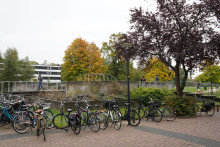
American artist Andrea Blum designed Information Plaza in collaboration with the Mondriaan Fund in 1996, intending it to become a meeting place on campus. Asked what she thinks of the plans to demolish her artwork, she reacts with surprise. It turns out she has not yet been informed.
‘I believe everyone has the right to access knowledge and information about what is happening in the world,’ Blum says of the idea behind the artwork. ‘That is why, as well as serving as an entrance to the campus, it was designed to be a meeting point for cyclists and pedestrians, where students would display university news alongside local, national, and international news on information boards. The idea was that news would bring people together. That was not something you could take for granted at the time, as the internet and mobile phones were not yet so widespread.’
The artwork, covering several dozen square metres in total, consists of several layers of concrete, with two terraces and benches about two metres above ground level, intersected by a cycle path.

Controversial from the start
A look through the archives reveals that the UT community was divided from the outset, both over the artwork's aesthetic value and over how much say people had in the overall appearance of the campus.
In 1997, philosophy professor Peter Várdy organised a tongue-in-cheek protest in the form of a symposium about the news ticker. He announced a series of professors who would supposedly give lectures with titles such as ‘The news ticker, at last a bulletproof gossip column’ and ‘Cul-de-sac: 82 metres of cycle path or the end of grand narratives’. Várdy said he was embittered by the ‘undemocratic atmosphere surrounding UT's building policy’.
In his view, the ‘pretentious, postmodern artwork’ was ‘the epitome of contempt for people's feelings’.
A year later, this newspaper reported on a team of around six students who updated the news ticker daily with new stories, ‘scouring the internet for hot news’. The reporter noted that cyclists and pedestrians only stopped to watch when something spectacular scrolled past. The information boards have been blank for years now, a fact made all the more striking by the enormous news screen directly opposite, above the entrance to the Vrijhof.
According to Hiska Bakker of Studium Generale, who was involved with the cultural centre in the artwork's early years, there were two problems. ‘There was no proper succession plan for handing over responsibilities when students graduated. At some point, the news schedule probably ended up forgotten in a desk drawer. On top of that, the news tickers regularly suffered technical problems due to the weather.’

Grafitti on one of the news tickers stating in Dutch that it is broken.
The artist herself says she cannot comment on how the artwork was maintained and used after its completion. ‘You trust that it will be maintained according to the contract. Whether that actually happens is beyond my control. I'm not their mother, after all.’
A failure
Three years later, several university administrators, including rector Frans van Vught, described the artwork as a failure. Van Vught said it had not fulfilled its purpose: ‘According to Blum, it was supposed to be a meeting point, a square where people come together, but that simply doesn't work. Everyone cycles quickly underneath it or walks straight across it. Nobody sits there.’
He even said that, had it been up to him, he would not have chosen Blum. In his view, the concrete structure did not fit the campus's friendly, green image.
Even the campus's 2019 visual quality plan states unequivocally that the artwork ‘has not fulfilled its intended function as a central meeting point’.
A metaphor for UT
The Executive Board at the time, of which Van Vught was a member, suggested painting over the concrete or adding benches and parasols to make the artwork more attractive. This immediately prompted a fierce response from art historian Elvira van Eijl: ‘Too ridiculous for words!’ She pointed out that the artwork was protected by copyright and constituted the artist's intellectual property. ‘I wouldn't just start drawing on a painting because I thought it would make it look more inviting!’
In her view, the artwork was actually a good fit for UT. Van Eijl argued that it served as a metaphor for UT as a centre of information. She was supported by Hannah de Vries, head of the cultural centre. The steel and concrete did indeed contrast sharply with the greenery, they argued, ‘but so do UT's high-tech activities,’ De Vries said. At the same time, she also felt that the benches on the artwork were not particularly inviting. She admitted that she had never sat on them herself.
In the same article, Hiska Bakker suggested having lunch there. ‘I did actually do that a few times back then,’ she says when asked. It never became a tradition, however.
‘Not finished yet’
In that same article, Petran Kockelkoren, who sat on the advisory committee for the artwork, explained that Blum had intended nature to gradually take over the structure, creating a ‘synthesis between nature and culture’. Peter Timmerman of Studium Generale recalls that Kockelkoren personally made sure ivy was planted around the artwork. In that sense, the artwork was not yet finished. However, the greenery was repeatedly cut back by the grounds maintenance staff.
Hiska Bakker is also unhappy with the way outdoor artworks are maintained on campus in general. ‘A lot of them are rusting away.’
Obstacle course runners and smokers
Yet in 2026, the artwork still brings people together. Members of student obstacle course running association DSSV Tartaros see it as an ideal obstacle for practising their climbing skills. It also serves mainly as a lookout point for students who smoke, allowing them to spot staff enforcing the smoking ban. Blum loves that.
However, she is upset by the irony that, according to the latest redevelopment plans, the artwork has to make way because UT wants to ‘create more space for people to meet’, only to be replaced by bicycle parking. ‘It's short-sighted.’
She also says she was not informed of the demolition plans beforehand, despite an earlier article stating that Campus & Facility Management (CFM) was in talks with the artist. ‘You could call that negligent. Legally speaking, both the Mondriaan Fund and I should have been informed about this. As it stands, it amounts to a breach of contract.’ When contacted, the Mondriaan Fund also says it knows nothing about the plans.
Blum realises that the artwork cannot be relocated. ‘Many of my artworks eventually disappear. That comes with the territory when you design for public spaces. I understand that a university never stands still. In any case, I'm grateful that it has been allowed to remain there for so long.’