


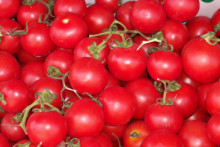
Tomato trade between Burkina Faso and Ghana alone is valued at 60 million USD per year. However, traders are uncertain about their returns and sometimes have to deal with losses. There are price fluctuations, of course, but a bigger problem are huge postharvest losses. At times, as much as half of the produce is unfit for human consumption once it arrives at its destination. This is due to delays at border crossings, (illegal) toll stops, police controls, and poor road and truck conditions.
Especially because the losses tend to be higher in countries with the largest food shortages, a solution is no unnecessary luxury. There are several measures to think about, such as semi-controlling cargo conditions, different transport scheduling or trying to reduce delays along the transportation route. Valentijn Venus and his colleagues developed a spatial-temporal simulation model that calculates the cost and benefits of such measures in order to anticipate on the situation more adequately. Every 15 minutes, satellite observations and numerical weather models produce regional maps of transport conditions of the locations visited by the trucks with the tomatoes.
According to the researchers, postharvest loss could be limited to 27% if the transportation time is reduced from 43 to 24 hours. A 12 hour transportation trip may even limit this percentage to 15. However, this would require better cross-border trade policies to regulate the sector, and will not be realistic in the short-term. The researchers emphasize to identify where cross-border trade regulations efforts are most likely to have an impact. Other short-term actions are educating key players on appropriate packaging, packing and handling techniques to limit rough handling of the produce.
The simulation model uses publicly available data on road conditions and satellite observations, mathematic models, kinetic tomato physiology and vegetable-environment interaction to estimate postharvest losses. The model has proven to explain 77% of the variance in actual losses during transports. The researchers hope that the results will trigger programs to reduce these losses, or to encourage production and marketing of processed agricultural products as soups or purée.
Mariska Roersen