

‘We are dependent on external instruments to make your research and our university a success’, were the opening remarks of the event by Rector Magnificus Ed Brinksma. Last year, UT researchers obtained a proud €8 million in personal grants.
Nevertheless, many consider writing proposals as a time-consuming and administrative burden. Brinksma counters this perception: ‘Writing proposals helps you to formulate ambitions and non-granted ones can be cannibalized for other grant proposals. Rejected applications do not constitute failure’. However, he does recognize the effort it takes to write a decent project. ‘We want to limit the burden, and provide all kinds of help to increase chances of success’.

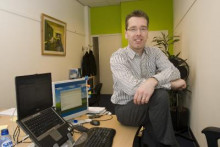
Liaison officer Rolf Vermeij is the first contact point at the UT for assistance in applying for EU grants. Foto: Arjan Reef
Work abroad before application
Rolf Vermeij, the UT’s liaison officer, is the first stop to find this assistance. He advises on strategic steps to overcome possible shortcomings in CV and application, in close collaboration with the Career Development Center. The help ranges from trainings and feedback sessions to larger career path developments. Vermeij: ‘One time we had an excellent researcher, but he lacked the necessary international experience. We helped him to get a position abroad before applying for the personal grant.’
The assistance really seems to pay off. The UT is doing well in EU competitions. The average of granted applications for ERC projects is below 15%. At the UT, this average is 30%. Even more amazing is the success rate of Marie Curie Career Integration Grants: since the UT has started to provide trainings for this purpose, the success rate has become almost 100%.
Practicing for the football team
A few applicants who were doing well are Dr. Femke Nijboer (VENI), Dr. Djoerd Hiemstra (VIDI) and Dr. Regina Luttge (ERC starting grant). They all applied twice before obtaining their grants ‘It seems to be the power of twice’, says Luttge, who works on nanostructured surfaces and its applications. She believes that confidence is of utmost importance and advises not to go to any interview unless the attitude is: ‘Yes, I am really one of the best scientists walking on earth!’
The researchers agree that preparation is everything. Hiemstra, whose work on a faster search engine for train traveling became national news last week, explains: ‘It is good to be aware that any scientist or any person should be able to understand your proposal, as the committee will not always consist of scientists from your field. I practiced my interview for my football team.’
Femke Nijboer can relate to the remarks that receiving a grant is not only about excellent research: ‘It is about showing that you are passionate about the proposal. In my first application, I was just looking for money. Around the time of my second try, I found my passion and instead of continuing the work I did for my PhD, I proposed something new.’ She is currently working on brain-computer interfaces.
Rolf Vermeij is happy to be a sparring partner to those researchers who would like to follow the example of Nijboer, Hiemstra and Luttge. ‘I am always willing to visit departments and speak about strategic planning’.
Mariska Roersen