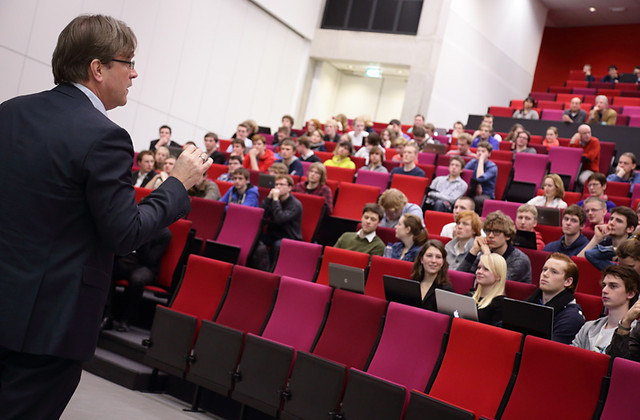



Van Vught sees the academic world as fundamentally international with roots dating to the Middle Ages when studying meant traveling to distant places, to well-known professors and universities. Competing globally implies the need for an institution of higher learning to specialize. 'We're not a very large university,' concedes Van Vught, 'for this reason the need to cooperate internationally is increasing tenfold.' For the UT this entails doing research, specializing, and collaborating. Attracting qualified students from around the world will help the UT continue its mission to be the best in a few select fields.
Plans for internationalization at the UT represent a big step for a young, provincial Dutch university with neither large funds for recruitment nor substantial governmental support. Nonetheless, Van Vught asserts that the internationalization plans have already been fruitful. The number of foreign PhD candidates is growing steadily, proving the efficacy of the efforts of the UT in internationalization. However, the number of international Masters program participants remains low at 59 for 2000-2001. This is the area that the university would most like to see grow in the decade ahead, seeking an overall total of 500 international graduate students by 2004.
The UT primarily targets countries with whom it traditionally has had connections such as China, South Africa, and Indonesia. In addition, Van Vught favors renewed contact with universities from Eastern Europe.
As far as recruiting foreign students, the methods vary according to degree level. PhD students most often are put into contact with departments or professors based on their professional interests. Generally Masters students tend to access information via websites or friends. The UT has virtually no official recruitment strategy in place. Van Vught cites limited funds as the principle reason for this void, adding that he would welcome a higher budget dedicated to international recruitment.
Once accepted at a UT program, the needs of PhD and Masters students vary considerably, as do the ways in which the UT meets those needs. PhD students earn a salary for working at the university. Once they have earned their degrees, the government rewards the university monetarily for each doctoral degree. Often these students remain in the Netherlands after their tenure at the UT. Thatthey stay in the country, sharing their skills and knowledge, is undeniably a goal of internationalization.
Masters students, on the other hand, must pay tuition, which may reach 10,000 euros in some departments. Van Vught is a strong advocate of availing scholarships to international students in need, but he acknowledges that it is difficult to garner support for them. These students tend to return to their home country after one or two years.
As far as helping international students to integrate in the UT community, Van Vught claims, 'It is part of our policy to strengthen our facilities to make people feel welcome here.' At the same time, he recognizes that hospitality is not the same in each UT department. Some of them have proposed attractive welcome programs, courses in English, and extensive information networks. Each department has the right to choose its own strategy, leaving some PhD students exceedingly pleased and others left in a bewildering cloud of ignorance.
Where the Masters students are concerned, Van Vught opines that the UT's attempt to create a friendly, international atmosphere is already visible due to the efforts of the International Office and student organizations such as SMIT. The latter, for example, not only provides valuable information for newcomers but also offers informal social get-togethers. Accommodation remains a problem, but closer contact with Enschede's housing institutions could be helpful.
Language sometimes poses an obstacle for international students of all levels. 'Dutch will not disappear,' Van Vught insists, 'but English will become the academic lingua franca.' Already foreign students can go everywhere on campus thanks to signs in English. They can read news and information on the UT in this paper and websites. Van Vught is also open to other improvements in the international process. For example, he favors a plan to lend support to partners of international students and faculty members.
While there may be drawbacks to internationalization - such as overly zealous recruitment which yields low-level graduate students - Van Vught declares that internationalization is vital if the UT wants to remain a respected presence in the scientific world. A sound recruitment strategy and a strong commitment to students during their stay at the UT would only improve the internationalization practices already in place.