


Hometown: Huesca, Spain
Languages: Spanish, English, Dutch (een beetje)
Favourite food: roasted chicken with potatoes (Pollo al horno)
Favourite movie: Star Wars - a new hope
Favourite sport: table tennis
Favourite music genre: classical and Irish
Favourite place in NL: the island of Schiermonnikoog
Best part about living in the NL: the resources of the University; the possibilities of learning languages and knowing a different culture; the location of the country, in the central part of Europe; the welcome I had from Dutch people
Worst part about living in the NL: the difficulty of the language, the weather, the absence of mountains, and the price of the cinema
Dream destination: Mexico
Hobbies: playing violin, computers, dancing
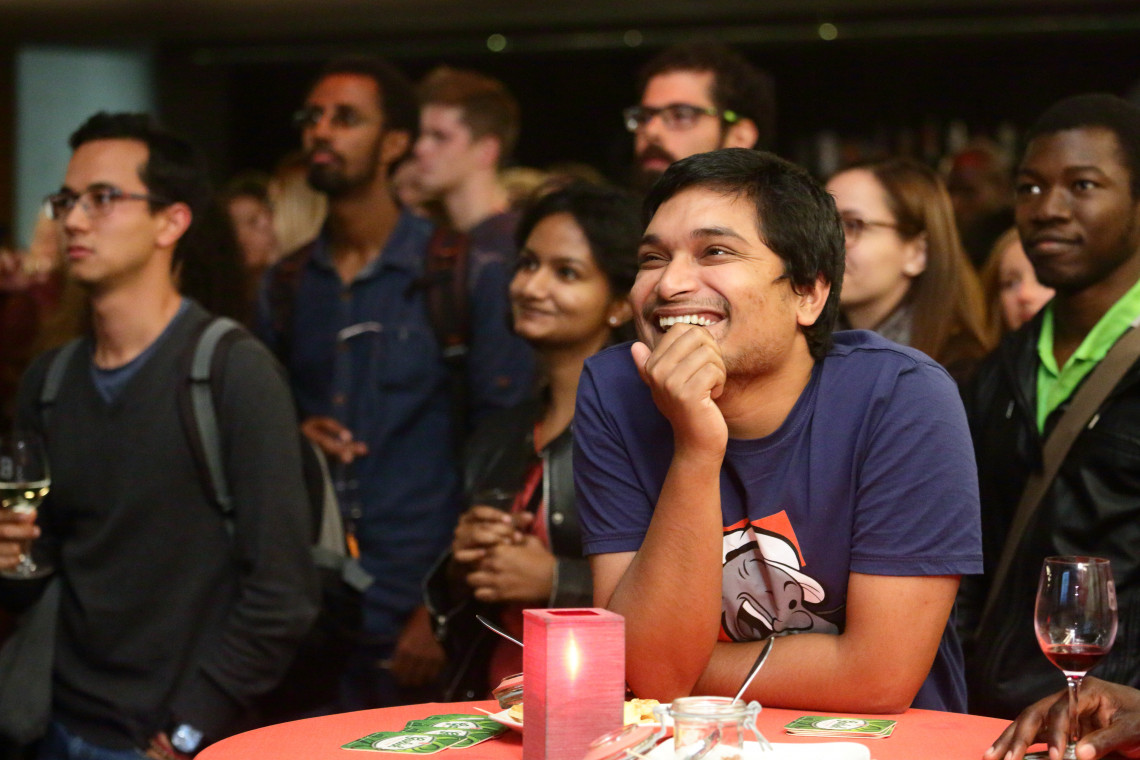
After graduating from the faculty of Physics at the University of Zaragoza in Spain, Javier Oliván Bescós came to the Netherlands via the Erasmus programme. In four months he managed to find a proper PhD-position at the UT-faculty Electrical Engineering, Mathematics and Computer Science, in the Signals and Systems group.
Working on an interesting project, Javier is satisfied with the opportunity to learn things he always wanted to know. He explains: 'My research is about three-dimensional visualisation of medical data. MRI and CT scanners, and rotational angiography systems generate the data I visualise, although the same techniques can be used on data generated by other scanners.' These scanners provide the data in the form of a three-dimensional matrix. The values of the matrix elements are related to some physical property of the human body at a certain spatial location. Assuming that the value of that physical property is the same for tissue along the whole matrix, it is possible to generate images to visualise that tissue by visualising points with the same value, he explains.
Three-dimensional medical imaging makes it possible to observe internal parts of the body that one would have not been able to see without performing surgery. It is also possible to remove or cut structures to see what is behind, or to perform measurements, all without actual surgery. Javier adds with excitement: 'I have seen my own heart!'
Javier made software that some people from the Photoacoustics department and medical doctors are using to visualise their data. 'It is very satisfactory when other people use your software for their research.'
Coming to the Netherlands is a positive experience for Javier, 'I have learned to appreciate some aspects of Spain I was not aware of, and to be critical of other elements of Spanish culture.' But still he misses the Spanish hilly landscape, warm and dry weather, culture, high mountains: 'Some of the mountains in my region (Aragon) are more than 3,000 meters high.' Also, he needed some time to adapt to different eating times and empty streets in the beginning: 'In Spain, people spend more time outside their houses, shops are open till nine in the evening, and the streets and cafes are busy till late, especially during the summer.'
Nevertheless, working hard on his dissertation in the last year of PhD-studies, Javier keeps in mind continuing his research in another position,perhaps as a post-doc.
Jelena Radovanovic
Javier Oliván Bescós