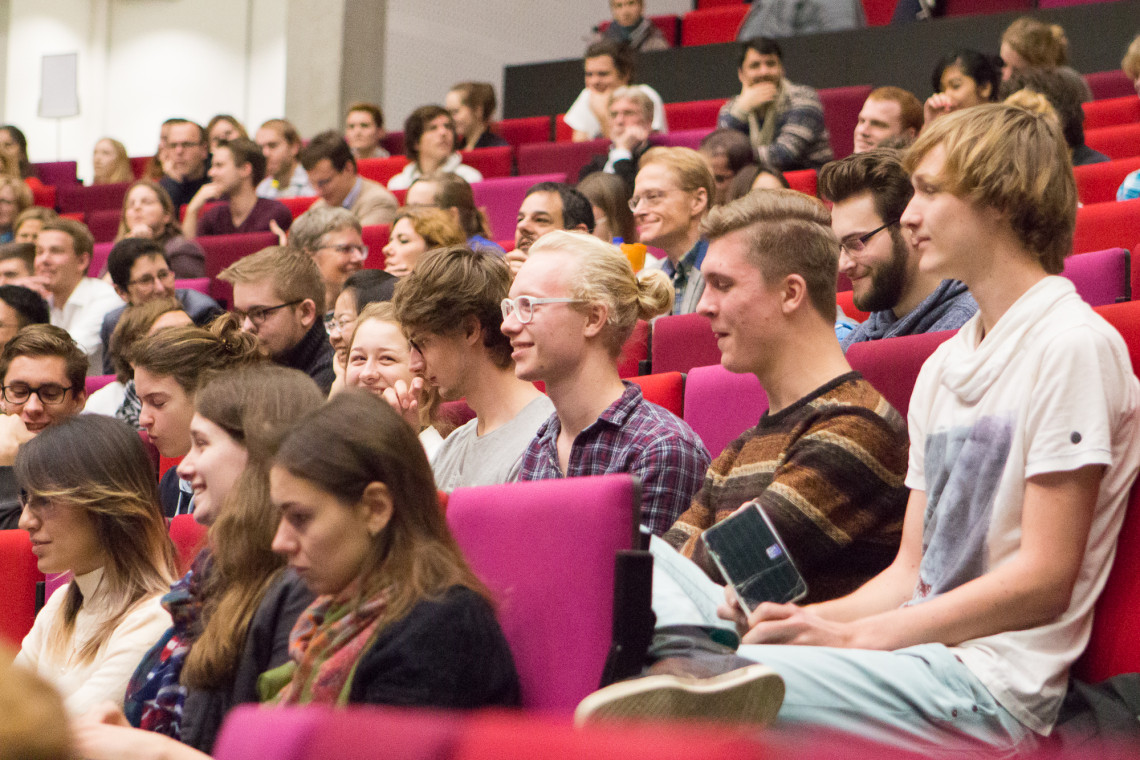



On a gray, windy, but mercifully dry, day more than 120 people set off to tour the UT campus art and architecture in guided or self-guided tours.
My group comprised 12 friendly people ranging from 45 -75 in age, all residents of Enschede or Hengelo. Many had had previous contact with specific aspects of the university, but were curious to learn more about its art and architecture. One participant rides his bike through the campus every day as he bikes from Hasseler Es to Enschede. Another man has played his bass tuba on numerous occasions in the Vrijhof.
The student guide, Joris, kept a brisk pace as he led us through the campus, where early signs of spring were apparent in sunny daffodils and hints of light green on the tips of bushes.
The first stop was De Boerderij (The Farm). Architect Piet Blom used a pre-existing farm as the base for the original in 1964. His son, Abel Blom, led the 2003 renovations to the building's current status as the luxurious Faculty Club, the official name of the building.
Next, we stopped at Bubus (1987) - coined from `ball' and `cubus' - whose 2500 kilos of rust free steel were designed by Ruurd Hallema. Also in the same body of water sits another work of art; unfortunately it is not visible to the casual viewer because it sank upon installation.
Joris explained the origin of Het Ding (The Thing). In 1974 seven UT students assembled the structure of telephone poles and steel cables over the course of a single day, using 14 isosceles and six equilateral triangles, after a long year contemplating the construction of an icosahedron.
Joris also pointed out the systematic layout of the campus. Viewing the campus from Checkpoint Charlie (the official entrance), to the right are laboratories and classrooms, to the left sit housing facilities, and directly in front lie buildings associated with cultural and leisure activities.
Most of the UT buildings adhere to one of two architectural movements: functionalism and structuralism. Functionalism is typified by the EL/TN building (1967) with its logical layout, right angles and cold, clean lines. Generally, such buildings are designed without preconditions of aesthetics and style, instead determined exclusively by functional considerations. Hogekamp is the new name of the building. Structuralism is characterized by its emphasis on user participation and by flexible arrangements of interchangeable, but clearly defined, modules. Resembling a Lego project, the Rekencentrum (1973) is composed of clusters of identical structures serving the users' needs; each one has a lecture hall, offices and a staircase. The part of the building that survived the big fire in november 2002 has been renovated and given a new name: Cubicus.
Strolling onward, the Carillon (1964) was designed by internationally renowned architect Gerrit Rietveld. It is the first and only carillon on a Dutch university campus, featuring 49 bells and ranging four octaves.
Conversation and questions drifted away from modern art and architecture to more mundane questions about the cooking habits of students, the concept of a minor, the haphazard way which students park their bikes, and the diminutive nature of the phallus on Fred Bellefroid's 1998 statue De Blijvende Verwondering (Enduring wonder) near the Bastille.
De Bastille brought the discussion back to the topic of architecture as visitors debated the merit of the recent renovations. The conclusion: while the structural changes have destroyed the integrity of Piet Blom's original 1969 building, at least no one gets lost in the Bastille anymore.
Our tour ended in front of the Vrijhof, gazing at The Drienerlo Tower (1979) designed by Wim T. Schippers - whom you might better know as the voice of Ernie on Dutch Sesame Street.