

 ‘We do not see jobs disappearing,’ says Rebecca Jekel, managing partner of the Delft-based business Kojac, a student employment agency for IT students in higher education. ‘What we do see is that the content of jobs is changing.’
According to her, companies look beyond just technical skills. She illustrates this with the example of front-end developers. They used to be judged mainly for their knowledge of programming languages, but right now they need to be able to do more than just writing in code languages. ‘Do they also understand what they are making? And do they understand the user’s needs?’
Checking and interpreting
Alain de Bont, IT & Logistics Process Manager at Kerger, recognises this shift. A customer of Kojac, he is a supplier of electrotechnical products for the shipping and offshore industry. ‘For the time being, we are mainly replacing administrative and input tasks with AI, such as the automatic processing of purchase invoices.’
For Kerger, Kojac is working on an AI tool that automatically sends suppliers a reminder if they have not responded to a quote request after three days. ‘In the long run, we also expect AI to contribute to analyses and advice.’
According to De Bont, this does not mean that the use of AI will require fewer people, but that people with different skills will be needed. 'The focus is shifting from performing actions to checking and interpreting the things that AI generates.'
Soft skills are becoming more important
Jekel: ‘There will be more emphasis on soft skills, such as critical thinking, understanding context, and communicating. We also call this 'context engineering': understanding what the question behind the question is. Building a model is one thing, but understanding whether it is correct and what to do with the outcome is equally important.’
At the same time, new functions are emerging. Jekel roughly detects two directions in which this is happening: ‘On the one hand, there is automation, in which AI makes processes more efficient. On the other hand, there are new roles emerging around AI itself.’
Sometimes this happens even unexpectedly. ‘We recently came across a job posting for someone who needed to clean up an automatically generated code,’ she says with a smile. ‘That kind of thing just did not occur a few years ago.’
Stay curious
Although developments in the field of AI succeed each other rapidly, De Bont does not think that recent graduates need to worry that AI will take away jobs. ‘Still, you can be replaced by someone who is more apt working with AI. You cannot avoid having to develop AI skills.’
‘It is more important now than ever to stay up to date,’ says Jekel, ‘to understand how your field of work is changing and how you can keep up. Read blogs, listen to podcasts, and experiment with different AI tools. If you do that, you will have a considerable head start.’
Text: Marjolein van der Velt
Photo: Thijs van Reeuwijk and own picture
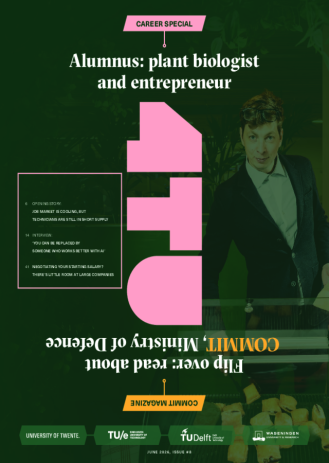
4tu career special

This article appeared in the 4TU Career Special 2026, a shared publication by the news editors of Cursor (Eindhoven University of Technology), Delta (Delft University of Technology) Resource (Wageningen University & Research) and U-Today (University of Twente).
The magazine came into being in collaboration with industry and is explicitly aimed towards students who are either in the final phase of their studies, or have just graduated.