

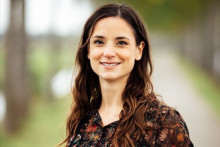
Maureen van Eijnatten was completely new to the field of crop improvement and the industry when she applied for her position over two years ago. After studying Medical Technology & Physics and completing her PhD research focused on 3D printing and artificial intelligence (AI), she spent six years in academia working on medical applications of AI. A world very far away from plants.
‘I felt that I should practice what I preach’
‘Another complication was that the very same week I was invited for an interview at KeyGene, I found out that I was pregnant with my second child,’ Van Eijnatten explains why she wondered if she should in fact switch jobs. ‘But I’ve always been an advocate for women in science and leadership, so I felt that I should practice what I preach: I shouldn’t miss out on a career opportunity just because the timing was inconvenient.’
At the time, Maureen had a Tenure Track position at the Eindhoven University of Technology. Although she was enjoying the research, she found that working in academia left her feeling ‘diluted’. ‘All my responsibilities were competing with one another, and so I decided to find a role that focused more on research.’
She went to an interview at KeyGene, felt very enthusiastic, and got hired, even though she was pregnant. She saw the company’s flexibility as a positive sign. Now, she leads a research team focused on Systems Biology and Artificial Intelligence. Her work covers a variety of topics, such as using large language models to understand crops’ DNA and a project on protein design. ‘With AI, we can now predict how proteins fold and understand more about their functions,’ she explains. ‘Essentially, we can change how proteins behave, which is very important in case we want to change properties of plants to achieve better resistance, for example.’
Working at KeyGene might be different from her previous roles, but Van Eijnatten is forever ‘a scientist at heart’ and the skills she acquired in academia still come in handy. ‘What you learn during your PhD is how to take on a really complicated research question you know nothing about. You also gain the ability to train yourself in new topics,’ she says. ‘At the same time, I still work with AI just like I used to. The difference is that I now apply it to plants, not to humans.’
What she enjoys the most about her job is the collaboration with other experts. ‘Because of the complexity of our projects, we always work in teams. I really love this aspect of my job, and I get a lot of energy out of it. Moreover, people at KeyGene tend to have a lot of passion – for their work but also for their other interests. It’s a special type of people who work here and it makes my job great.’ Photo credited:michaelbrown.nl

4TU Career special
 This article appeared in the 4TU Career Special 2026, a shared publication by the news editors of Cursor (Eindhoven University of Technology), TU Delta (TU Delft) Resource (Wageningen University & Research) and U-Today (University of Twente).
The magazine came into being in collaboration with industry and is explicitly aimed towards students who are either in the final phase of their studies, or have just graduated.