

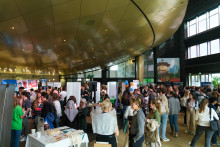
‘We see this reflected in career events that we organise’, says Van Noordenburg. 'About sixty percent of the visitors are international. It is simply more difficult for them to get a job.'
 On the one hand, this has to do with mastering the language. 'Dutch is still the working language for many employers. Think of a municipality or a job in healthcare. Those sorts of employers are out of reach. In addition,' says Van Noordenburg, 'foreign alumni sometimes only realise at the last minute that they want to stay in the Netherlands. Then it is too late to learn the Dutch language while also looking for a job at the same time.'
Her advice? 'Apply to the large, internationally oriented companies where English is the official language.' But even then, Van Noordenburg recommends at least learning social Dutch. 'Basic Dutch, because Dutch is often spoken at the coffee table and during the lunch break. Make sure you get a little involved in the conversations, otherwise it will be lonely. Showing interest helps a lot.’
Another reason why internationals have difficulty finding a job is the imbalance in the distribution of vacancies. ‘As the workforce is ageing, there are a relatively high number of senior positions available. For recent graduates, this is often a mismatch for their profile.’ (text continues below picture)

If success does not come immediately, she advises broadening your search area. ‘Look further afield and think outside the box. While it is, of course, still important to do work that gives you energy and suits you, there are often other opportunities that overlap with your field of interest. These may not be obvious at first, but they can still offer valuable prospects.’ She continues, ‘Students also often have ‘transferable skills’ acquired during their studies or work experience that can be applied in other sectors or roles. Make sure to highlight these.’ She strongly advices making the most of your network. ‘You need to make yourself visible. Be findable, network actively and adopt an extrovert approach when looking for a job. Sometimes that doesn’t come naturally for some cultural backgrounds. Therefore it is important to maintain informal relationships and don’t hesitate to ask for advice.’
Van Noordenburg mainly sees highly driven internationals. 'They have a broad knowledge of languages, often already have work experience and possess a strong intercultural competency. Moreover, they are extremely motivated to succeed.'
And she is well aware of those successes. She remembers a student from India. 'She just could not find a job. After her studies, she decided to do a four-month internship at a small company to gain work experience. In the end, that company offered her a contract.'
According to Van Noordenburg, it is easier to find a job in some sectors than in others. 'There is a lot of demand for technical staff, data analytics, biotechnicians, etc. It will also depend on the position whether the Dutch language is a requirement. In a more technical position, language is a less important requirement. If your CV shows that you already have a good command of the language and that you are willing to develop yourself further, that is certainly a plus.'
A few characteristics of Dutch work culture:
- Casual and informal communication is common; people often “tutoyeren”, i.e. use the informal version of the pronoun “you” (“jij” or “je”) instead of the formal address (“u”);
- Straight forward communication is appreciated, also in emails;
- A healthy work–life balance is considered very important;
- There are a lot of meetings, where expressing your opinion is encouraged and valued;
- Employees often bring their own lunch, and lunch breaks include informal small talk;
- If you need help, you are expected to ask for it directly;
- There is a strong focus on meeting deadlines, efficiency, and being on time;
- Workplaces often have flexible office setups (open or “garden-style” offices);
- Some organisations have a “vrijmibo” (an acronym for “Vrijdagmiddagborrel”, or Friday afternoon drinks/social gathering).
About Astrid van Noordenburg
After completing her bachelor's degree in Personnel & Organisation, Van Noordenburg worked as an HR advisor for about fifteen years, with more than ten of those years at the Animal Sciences Group Wageningen Bioveterinary Research. She did a part-time master's degree in Culture, Organisation and Management at VU Amsterdam. From 2010, she worked as a policy officer for Internationalisation at WUR and set up Student Career Services in 2017. Since January 1, 2026, her focus has been the Relationship Management Labour Market, where she helps students and graduates in all kinds of ways to find an internship or job through her contacts with employers.
4TU Career Special 2026
 This article appeared in the 4TU Career Special 2026, a shared publication by the news editors of Cursor TU Eindhoven (Technische Universiteit Eindhoven University of Technology), TU Delta (TU Delft University of Technology), Resource Wageningen UR (Wageningen University & Research) and U-Today (University of Twente).
The magazine came into being in collaboration with industry and is explicitly aimed towards students who are either in the final phase of their studies, or have just graduated.