

Hammad Qureshi, 28, a PhD candidate in the Faculty of Science and Technology, has good reason to be alarmed about the disaster. The native of Multan says, ‘Many of the hospitals are overcrowded. The floods destroyed or damaged crops and crippled the farmer’s capacity to farm the land during the beginning of the planting season in September,’ as significant areas of the country are still under water.
Though somewhat quieting in the media spotlight, the need for continued aid relief, says Oureshi, is urgent as more people are being displaced by a ‘second wave’ of floods with a spur of the Indus River now stretching through the southern regions. ‘The most venerable sector of the population is the children between the ages of 6 months to 35 months and women who are pregnant or lactating. Children are dying of hunger at the moment,’ he says. Now in his country, waterborne diseases, including diarrhea, dehydration, and malnutrition are having an impact on the nearly 8.6 million children who are believed to be affected and in need of humanitarian assistance.
In his mind, Qureshi, puts aside his own feelings of sorrow to focus his energy on raising awareness on the issue and collecting donations to help in relief efforts. The death toll has now reached 1600, with 2366 people injured and over 1.2 million houses have been either damaged or destroyed, according to the most recent United Nations Department for the Coordination of Humanitarian Affairs (OCHA) report. A key problem is the large-scale population movements and combating a range of diseases.
‘I think anyone who wants to help can transfer the money to the PSA official bank account,’ says Rauf Abdul, PSA member and a PhD candidate in Human Management Resource. ‘We will try our level best to make sure it reaches affected people through reliable NGOs working on the ground. The Edhi Foundation is one of the trusted names in Pakistan. We already sent the first amount to this organization through an online transfer.’
The Pakastani Student Association (PSA) has been able to raise € 3750 to date and had hoped to continue fund raising efforts at their ‘Cultural Carnival’ which was planned for 13 September. Qureshi brought back mehndi paste for the event after his four week summer holiday, returning to the Netherlands only one week before the floods began.
At a meeting on Monday evening, PSA board members decided to postpone the carnival. ‘There are many reasons for the decision,’ says Qureshi, ‘The foremost reason is that our country is facing the worst possible crisis in its history, the atmosphere is somber, and also there are people here at the UT and ITC whose families have been directly or indirectly affected by the havoc, so it would be an injustice to celebrate in these conditions. As a sign of unity to our nation, we would like to postpone the celebration for two months.’
Readers interested in contributing to help victims can make a donation to the Pakistani Students Association, bank account 618803280 (ABN AMRO).
|
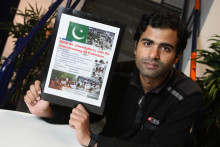
‘People in my country have to literally start from scratch. But before this can even happen, the most immediate needs are providing adequate healthcare and sanitary drinking water,’ says Hammad Qureshi, holding one of the pamphlets distributed by PSA members. (Photo: Gijs van Ouwerkerk) |
Pakistan’s Edhi Foundation
What started out as a one-man show, operating out of a single room in the city of Karachi, has grown to the largest non-profit welfare organization in Pakistan with over 300 centers, and its own fleet of air ambulances.
In Karachi alone, the expansive ‘social welfare network’ extends its services to operate and staff eight hospitals, manage two blood banks, and deliver 1 million babies in Edhi Maternity Homes.
The earliest clinic was established in 1951 by Edhi’s founder, Abdul Sattar Edhi, a touted Muslim philanthropist, who has devoted his entire life to providing social services and relief aid to disaster victims. His foundation gained international charter status and is now able to extend its reach beyond Pakistan, with branches in New York, London and Dubai. With a strong conviction to stay independent, the organization has refused to accept financial aid from the government.
Read further on the services and mission of Edhi www.edhifoundation.com