• EN
  • NL
Science
22 million for 4TU collaboration

Research with a social impact

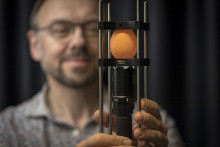
Conducting research together to resolve social issues. That is the challenge that the 4TU federation posed to the four participating technical universities, along with a research budget of €22 million. UT professors Tatiana Filatova, Herman van der Kooij and Michel Versluis are at the head of three of the five 4TU studies.

  • EN
  • NL
Science
22 miljoen voor samenwerking 4TU

Onderzoek met maatschappelijke impact

Samen onderzoek doen om maatschappelijke problemen op te lossen. Dat is de uitdaging die de 4TU-federatie heeft neergelegd bij de vier technische universiteiten, met een pot onderzoeksgeld van 22 miljoen. UT-hoogleraren Tatiana Filatova, Herman van der Kooij en Michel Versluis staan aan het hoofd van drie van de vijf 4TU-onderzoeken.
Science
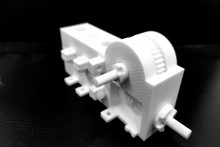
PneuAct

Unique motor can improve cancer diagnosis

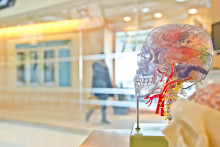
PneuAct is a pneumatic stepper motor developed by UT researcher Foad Sojoodi Farimani. It’s one of a kind – it is fully 3D printed, very fast, highly precise and it’s the cheapest of all similar motors out there. It can improve cancer diagnosis, be used in radioactive environments and even for space exploration.

Science

Vaker ja dan nee bij EU-referenda

Regeringen winnen driekwart van de EU-gerelateerde referenda. Belangrijke voorwaarde daarbij: economische voorspoed. Dat concludeert UT-onderzoeker Joost van den Akker in zijn proefschrift over EU-referenda, dat hij vandaag verdedigt.

Science

A step closer to understanding Parkinson’s disease

Researchers from the Nanobiophysics group led by Professor Mireille Claessens have uncovered important facts, which can help us understand mechanisms of Parkinson and similar neurodegenerative diseases.

Science

Twentse superplankton gaat CO2 te lijf

Hoogleraar Albert van den Berg vindt dat wetenschappers over het klimaatprobleem moeten nadenken. Zijn eigen oplossing: de Emiliania huxleyi, een CO2 vretende planktonsoort.

Science
Science & Technology Magazine

Saving billions of chicks

The words 'science' and 'creativity' are not often used in the same sentence. However, Wiendelt Steenbergen, professor of Biomedical Photonic Imaging, manages to combine the two. He has been awarded the NWO Open Mind Grant twice already, with his proposed research into the use of peppers for a possible new cancer treatment and a way to save billions of chicks.

Science

Water Bottle Flipping Physics

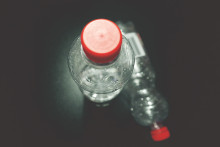
Have you ever tried to flip a water bottle and make it land upright? If you have, you know it’s not as easy as it looks. Five UT bachelor students of Applied Physics decided to find out why. They wrote a paper, describing how to optimize the chances of a successful bottle landing, and it got accepted for publication in the American Journal of Physics.

Science
Photonics and its countless possibilities

The invisible impact of light

Red, green, blue. Light is in everything and it makes everything around us visible. At the same time, there is light which we cannot see, yet which has a growing impact on our society: photonics. Klaus Boller, Professor of Laser Physics, discusses his views on the sense, nonsense and countless possibilities of what he calls a ‘disruptive, enabling technology.’

Science
Levens redden met augmented reality

‘Door virtuele hulp ben je niet alleen’

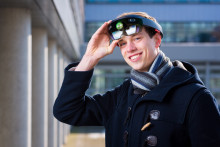
Reanimeren met behulp van een VR-bril. Sander Giesselink (24), masterstudent Human Media Interaction, schrijft er zijn scriptie over. Sterker nog, hij bouwde samen met een studiegenoot een 3D-visualisatie, die het reanimeren op afstand begeleidt.

Science

Global map of accessibility

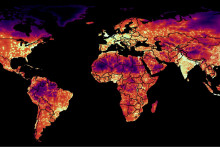
‘When I first saw the finished map it surprised me how connected the world looked. On the other hand, it also shows there is still a lot of inequality in the world. And that there is no easy solution for that,’ says ITC Professor Andy Nelson when asked about the ‘Global map of inequalities in accessibility’, which he helped to create and which was recently published in Nature.

Science
Science & Technology Magazine Cover story

Smart Cities: creating the cyberville we want?

More than half of the world’s population now lives in urban areas, and by 2030 this number will increase to about 5 billion people. Urbanization is happening on a massive scale, larger than ever before, bringing huge social, economic and environmental challenges. To ensure cities remain livable, we need ‘smart’ solutions. Hence, we need to transform our current cities into even smarter cities. How can we do that?

Science

Using water to create resilient cities

European project CATCH, with the UT as one of its partners, wants to prepare cities for climate change and resulting extreme weather events - by putting water in the center of urban design. It’s starting with seven pilot cities, where new climate adaptation measures are being tested. Enschede is one of them.

Read more articles